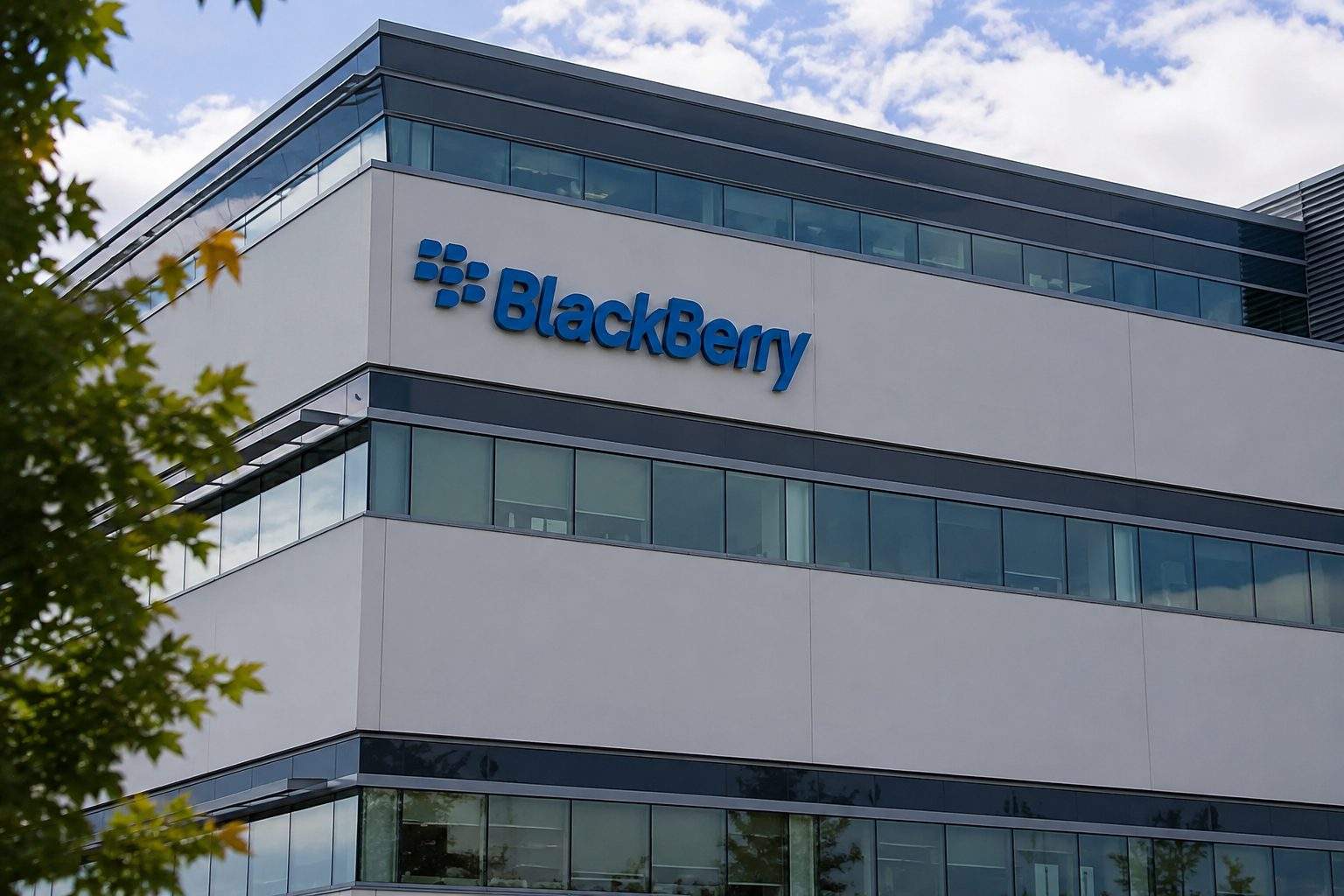

Toronto, May 21, 2026, 16:07 (EDT)
- BlackBerry’s Toronto shares closed up 7.9%, while its U.S.-listed stock was recently about 7.5% higher.
- The move followed a U.S. government cloud-security re-certification for BlackBerry AtHoc and fresh investor comments on QNX.
- Management is trying to show that the former handset maker is now a growth software story, but royalties and government buying still carry timing risk.
BlackBerry Ltd shares jumped on Thursday, putting the former smartphone name back on traders’ screens after its AtHoc crisis-communications platform won a fresh U.S. government security re-certification and executives talked up its QNX embedded-software business.
The move matters because BlackBerry is no longer being judged as a faded handset maker. Investors are weighing whether its two main businesses — secure government communications and QNX software used in cars, robots and industrial machines — can turn recent cost cuts into durable revenue growth.
BlackBerry’s Toronto-listed shares closed at C$9.18, up 7.87%, with the price shown at 4 p.m. local market time. The U.S.-listed stock was recently at $6.665, up 46.5 cents, or about 7.5%, with a market value near $4.0 billion. The broader tape was quieter: SPY, the S&P 500 exchange-traded fund, was up about 0.2%, while QQQ, a Nasdaq 100 fund, rose about 0.2%.
BlackBerry said on Wednesday that AtHoc had completed its 2026 FedRAMP Class D (High) re-certification. FedRAMP is the U.S. government program that reviews cloud products for federal use; the High level applies to cloud services handling sensitive, unclassified government data where a security failure could have severe consequences.
Ramon Pinero, general manager of BlackBerry AtHoc, said the re-certification underscored the platform’s “operational maturity and security rigor.” Dubhe Beinhorn, senior vice president for public sector at BlackBerry Secure Communications, called trusted communications infrastructure “essential” as agencies face more complex threats. BlackBerry said AtHoc is trusted by 80% of U.S. federal government agencies. ACCESS Newswire
At a CIBC investor conference in Toronto on Thursday, Chief Financial Officer Tim Foote said BlackBerry was “a fundamentally different company” after selling Cylance, cutting more than $150 million from its run-rate cost base and moving from cash burn to profitability. Foote said the company generated $50 million of operating cash flow in the last fiscal year and expects that to double this year. StockAnalysis
The QNX business remains the main swing factor. QNX sells foundational software for mission-critical systems — software that lets machines respond predictably and safely, not just run apps. John Wall, president of QNX, told the CIBC audience that QNX works across automotive and “general embedded” markets, including robots and industrial systems. StockAnalysis
Foote said QNX’s royalty backlog, meaning estimated future revenue from production-based fees, is “closing in on a billion dollars.” He said the business has unusual visibility because once QNX wins a design, it can generate revenue for five to 10 years. StockAnalysis
Competitive pressure is still there, but Wall framed it narrowly. He said older real-time operating system rivals such as VxWorks and Green Hills are more visible outside autos; in automotive, he described Linux as the main competitor and said QNX had not yet seen a strong safety-focused Linux answer for carmakers.
Wall also linked QNX to the physical-AI push — artificial intelligence used in machines that move or act in the real world. He said NVIDIA’s IGX platform for robots will be based on QNX and called robotics “a whole new realm” for the business, though Foote declined to give average selling prices for those products. StockAnalysis
BlackBerry’s latest financial base gives the rally some footing. In April, the company reported fourth-quarter revenue of $156.0 million, up 10% from a year earlier, and full-year fiscal 2026 revenue of $549.1 million, up 3%. QNX revenue rose 14% for the year to $268.0 million, while Secure Communications revenue was $258.9 million.
But the upside case is not clean. Foote said the QNX backlog is “estimated” and “not guaranteed,” because much of it depends on vehicle production. If automakers delay programs, government agencies slow purchases, or certifications do not convert into new contract dollars, the stock’s jump could leave less room for disappointment. StockAnalysis
For now, investors have another date circled. BlackBerry said Foote and Wall are due to meet investors again at Baird’s Global Consumer, Technology & Services Conference in New York on June 2. Traders will be listening for the same thing they wanted this week: proof that the software story can keep turning into cash.