New York, June 12, 2026, 13:49 ET
- NuScale Power shares recently traded at $10.00, up 4.5% on the day, after moving between $9.67 and $10.31.
- The company’s newest update is a workforce-development milestone, not a commercial reactor order.
- The next major catalyst is evidence of binding customer demand, especially power purchase agreements or financing tied to the TVA-ENTRA1 program.
NuScale Power Corporation’s SMR shares bounced Friday, recently trading at $10.00, up 4.5% from the prior close, with a market value of about $3.19 billion. The rebound matters because the stock has been trying to stabilize after a sharp 2026 selloff: a Zacks report syndicated by TradingView said Thursday that NuScale had fallen 23% over the past month and 34.5% year to date, reflecting investor concern over timing, dilution and limited current revenue.
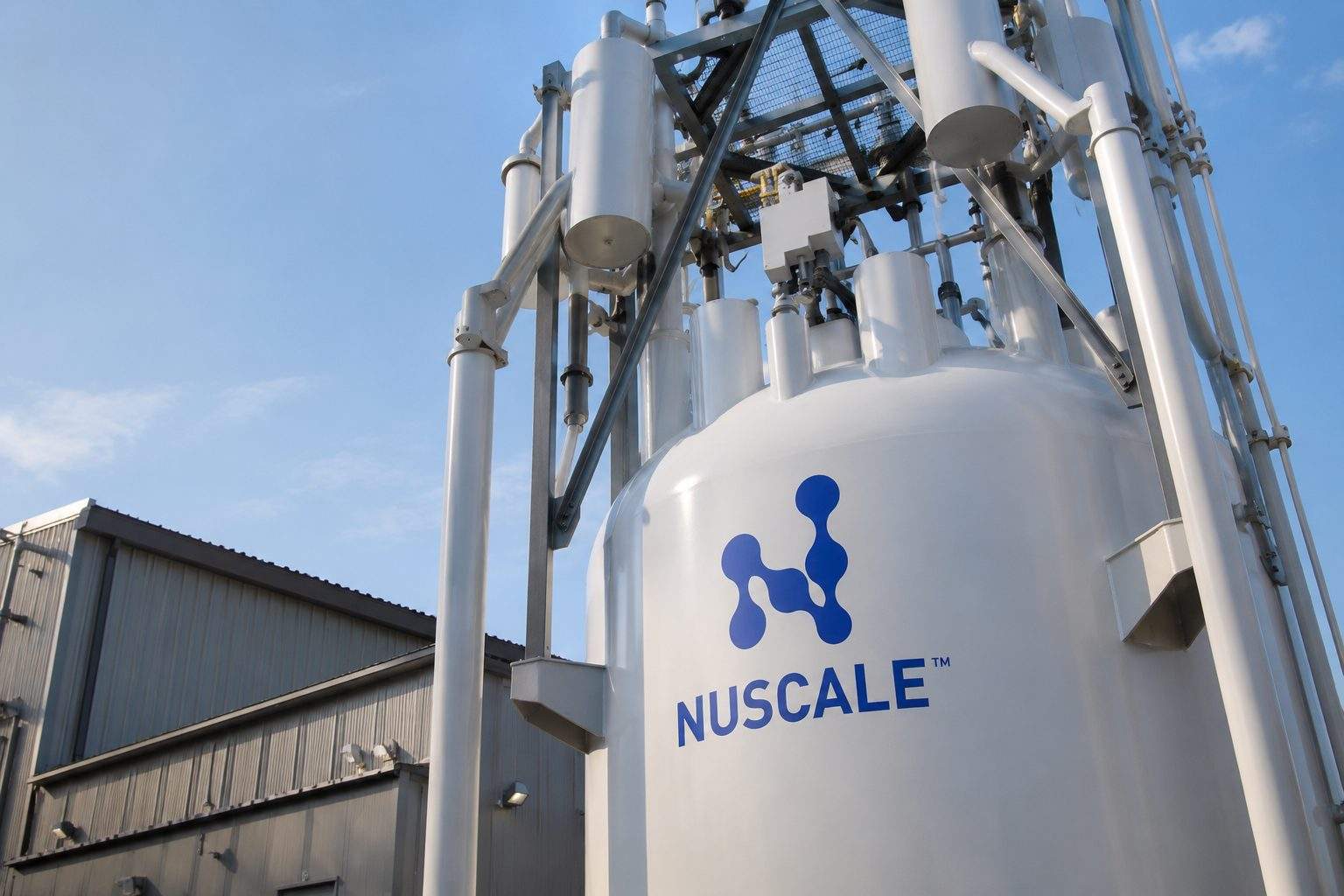
The latest company news came Wednesday, when NuScale announced the opening of its 12th Energy Exploration Center at the University of Virginia’s College at Wise. These centers use simulator technology to train students and future operators on small modular reactors, or SMRs — smaller nuclear reactors designed for modular deployment rather than the scale of traditional gigawatt-size nuclear plants. NuScale Chief Executive John Hopkins called the opening “an important step forward in the expansion of clean-energy workforce development.” NuScale Power
For the stock, the UVA Wise announcement is supportive but not decisive. It helps NuScale’s long-term ecosystem by expanding nuclear workforce training, but it does not by itself add near-term reactor sales or cash flow. Investors are valuing SMR less on today’s revenue and more on whether NuScale can convert its regulatory head start into binding commercial contracts. The company’s key technical advantage remains its licensing position: the Nuclear Regulatory Commission issued standard design approval for NuScale’s US460 SMR design in May 2025, allowing that design to be referenced in future construction, operating, combined-license or manufacturing-license applications.
The financial backdrop explains why the stock remains volatile. NuScale reported first-quarter revenue of just $565,000 and a net loss of $46.7 million, while net loss attributable to Class A common stockholders was $44.0 million, or 14 cents per share. The company ended the quarter with $341.1 million in cash and cash equivalents, $549.0 million in short-term investments and no debt; liquidity, in this context, means the cash and investment resources available to fund operations and commercialization.
The bear case is that NuScale is still a pre-commercial revenue story with heavy capital needs. Its 10-Q shows a $1.0 billion at-the-market, or ATM, stock-sale program — a mechanism that lets a company sell new shares into the market over time — with $962.1 million still eligible for sale as of March 31. NuScale also sold 22.36 million Class A shares after quarter-end for net proceeds of $213.5 million, which strengthens cash but can dilute existing holders by increasing the share count.
The bull case is that NuScale has one of the clearer commercialization paths in advanced nuclear if demand from artificial intelligence, data centers and industrial electrification turns into signed contracts. Its biggest visible opportunity is the TVA-ENTRA1 plan to develop up to 6 gigawatts of NuScale-powered nuclear capacity across TVA’s seven-state region. Under that structure, ENTRA1 would develop and own plants and sell electricity to TVA through future power purchase agreements, or PPAs — long-term contracts that can make power projects financeable. Independent industry coverage has noted that public timelines and cost analyses have not yet been disclosed, which is why investors are watching for firmer terms.
Based on the verified facts today, SMR looks risky rather than clearly cheap or fairly valued. The stock may be attractive to speculative investors who believe NuScale’s NRC-approved design and potential TVA, Romania or data-center opportunities can become commercial orders. But for more cautious investors, the combination of minimal revenue, continuing losses, possible dilution and uncertain project timing argues for patience. The next major catalyst is not another training-center announcement; it is a firm reactor sale, PPA, project-financing package or customer commitment that proves NuScale’s technology can move from approved design to commercial deployment.