
KOUROU, French Guiana, June 17, 2026, 09:47 (GFT)
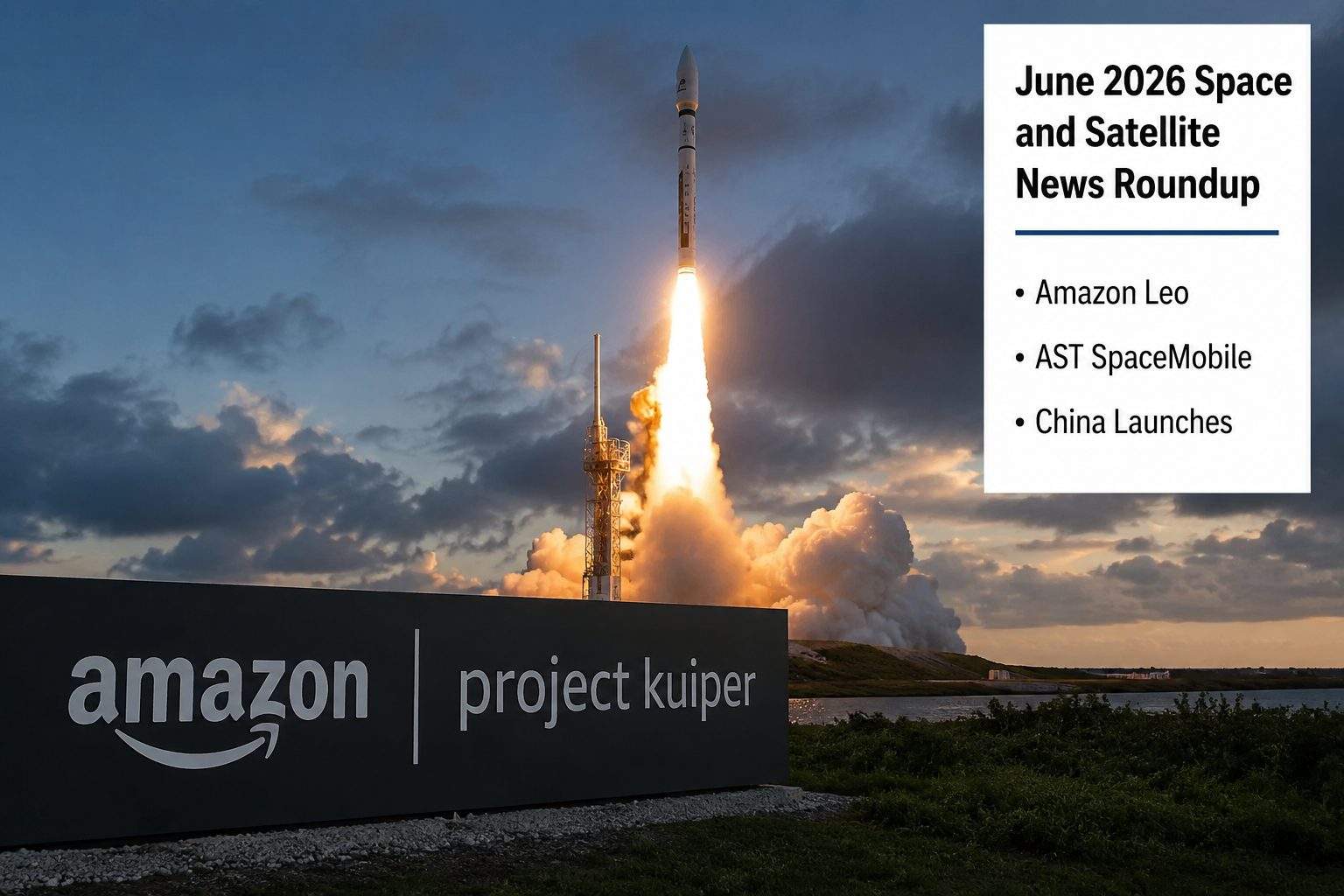
- Ariane 6 launched with 36 Amazon Leo satellites on board, its heaviest payload for an Ariane rocket. Amazon is aiming to speed up launches to get an edge in broadband.
- AST SpaceMobile launched three new direct-to-phone satellites after an earlier satellite was lost during a Blue Origin flight.
- China sent up Shijian-31 while Hanwha in South Korea pushed to raise its KAI stake, with state-backed space efforts still on the agenda.
Arianespace’s Ariane 6 rocket launched from French Guiana on Wednesday, carrying 36 Amazon Leo broadband satellites. That’s the most satellites the Ariane has flown at once, and a test for Europe in the satellite-internet launch rush. Liftoff was at 9:22 a.m. local time, with satellite separation set for about 1 hour and 51 minutes into the mission. “36 is a milestone for us,” CEO David Cavaillolès said before launch. Via Satellite
Amazon Leo is out of planning and into the execution phase. The company said it has over 330 satellites in orbit and plans to start service this year. Each larger payload means fewer launches to finish the network. “Every additional satellite” put up on a single rocket moves the constellation buildout faster, said Melissa Wuerl, Amazon Leo’s launch systems director. Amazon News
Arianespace said its VA269, or LE-03, flight is the first Ariane 64 mission to use the new P160C solid boosters. That upgrade raises the rocket’s low Earth orbit lift capability to around 22 tonnes. Low Earth orbit satellites stay close to the planet, so they support lower-delay internet compared to older high-altitude systems. If this mission goes as planned, Arianespace will have launched 100 Amazon Leo satellites in five months.
Competition is heating up. Starlink and Amazon could get access to future European mobile satellite spectrum, but about two-thirds would stay with European firms, two people familiar with the matter told Reuters in May. The EU’s planned IRIS2 multi-orbit system, set up as a counter to Starlink, was also seen getting a share.
SpaceX carried out a commercial launch in the same timeframe. A Falcon 9 blasted off from Cape Canaveral Space Force Station at 2:39 a.m. EDT, deploying AST SpaceMobile’s BlueBird 8, 9 and 10 satellites, according to Spaceflight Now, which cited a SpaceX confirmation. The new satellites are part of AST’s direct-to-cell push, aimed at providing broadband to regular smartphones with no need for a separate dish or terminal.
AST is looking to get its momentum back. CEO Abel Avellan described the latest satellites as “continued execution.” The company said it now has deals with almost 60 mobile network operators, naming AT&T and Verizon. With the new launch, AST has 10 satellites in orbit, counting the prototype, and it’s aiming for about 45 by year-end. Houston Chronicle
China lifted the week’s tally of launches. Long March-3B sent up the Shijian-31 satellite from Xichang at 5:45 p.m. Beijing time on June 16, state news agency Xinhua said. Shijian-31 is mainly for space environment detection, a catch-all for checking spacecraft conditions. This marked the 651st flight for Long March rockets.
Industrial names are active as well. Hanwha from South Korea said Tuesday it’s aiming to push its total holding in Korea Aerospace Industries past 12% by end-2026. The company pointed to rising space competition and a need for more scale. Hanwha mentioned SpaceX as proof that heavy capital now matters as much as engineering. KAI, which makes aircraft, is also in satellites.
Amazon’s cadence risk is in focus. The company landed a waiver from the U.S. Federal Communications Commission on the deadline to deploy half its planned Leo constellation, but the FCC set spectrum priority conditions. According to Via Satellite, Amazon has 331 satellites in orbit, short of the 1,616-satellite figure needed for the half-constellation milestone. Launch slots are tight too, as some rockets expected for Leo missions aren’t ready.
June’s space tape isn’t seeing a breakout launch, but focus has shifted to throughput. Amazon is pushing for mass deployment, AST still has to prove direct-to-phone works, and China is keeping up its state launches. Aerospace players are either acquiring or scaling up ahead of market consolidation. Operators that manage frequent launches, quick hardware swaps, and good standing with regulators could come out ahead.
Related articles: NASDAQ:ASTS