
New York, June 17, 2026, 10:07 EDT
- Eos Energy shares rose 11.7% to $7.61 in early Nasdaq trading after the company announced a binding Germany-led supply pact.
- The deal with CAPAC Energy carries a 750 megawatt-hour capacity commitment, with a route to as much as 2 gigawatt-hours of deployments through 2031.
- The move follows Eos’ start of commercial production at its second battery line, while a coming rights offering remains the main financing overhang.
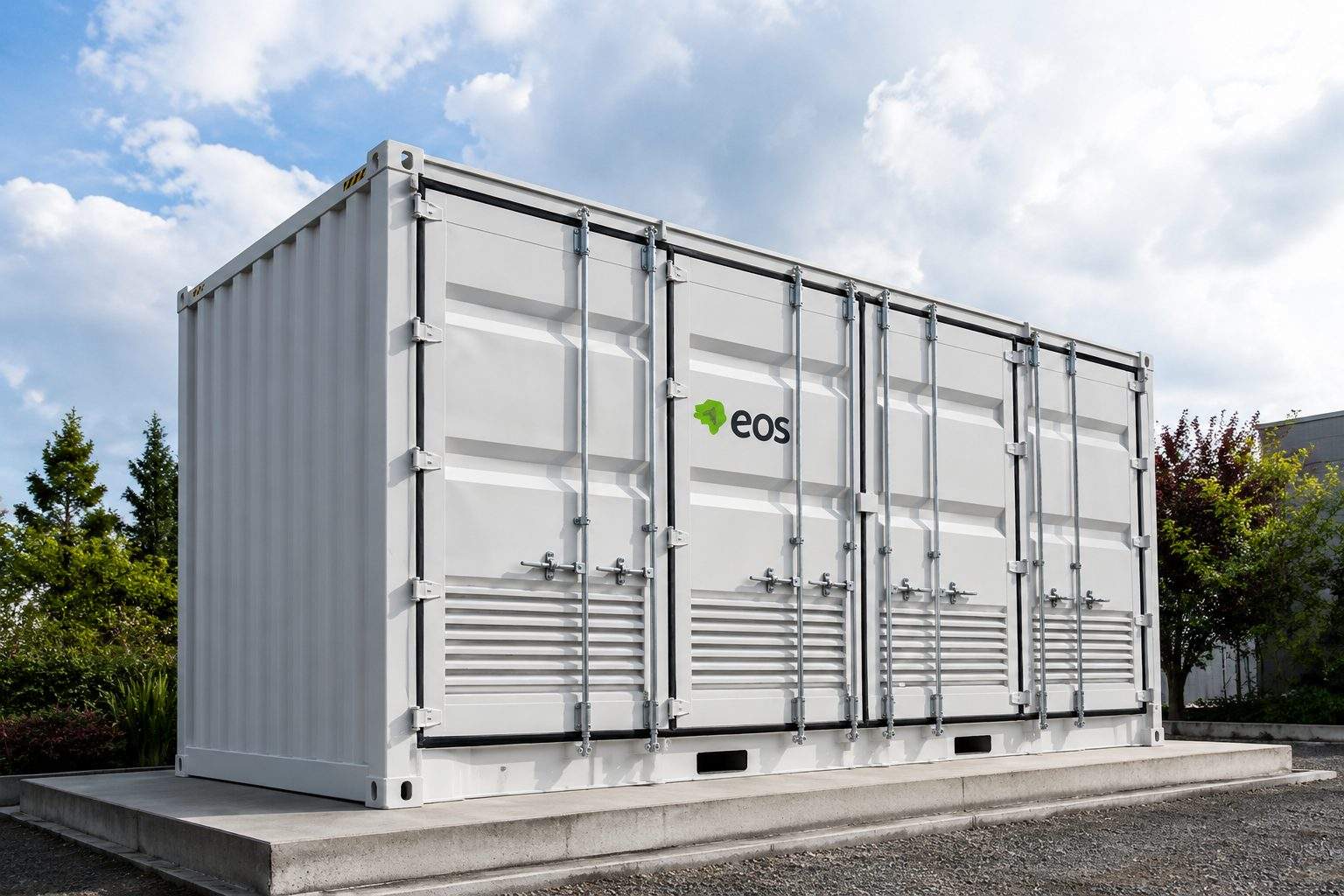
Eos Energy Enterprises shares jumped in early trading on Wednesday after the U.S. zinc-battery maker said it had entered Germany through an exclusive long-duration storage partnership, adding fresh orders momentum a day after it started commercial production at a second manufacturing facility.
The stock was recently up 11.7% at $7.61, after touching $7.71, on volume of about 9.25 million shares. The prior close was $6.81.
The timing matters. Eos is trying to show investors that demand, manufacturing scale and financing can come together after years in which many battery-storage names struggled to turn project pipelines into revenue. Long-duration energy storage means batteries that can discharge power for several hours, helping grids cover gaps when wind or solar output falls.
Eos said the binding master supply agreement with CAPAC Energy, formerly Nala Energy GmbH, covers Germany, Austria and Switzerland and includes a 750 MWh commitment, with a pathway to scale to 2 GWh through 2031. A megawatt-hour is a unit of stored electricity; a gigawatt-hour is 1,000 megawatt-hours.
CAPAC is advancing its first Eos projects in Germany, with commercial operations targeted for late 2026, the companies said. Eos Chief Commercial Officer Nathan Kroeker called the pact an “entry into a critical international market,” while CAPAC CEO Benjamin Henecka said the framework supports growth across one of Europe’s key storage markets. Eos Energy Enterprises, Inc.
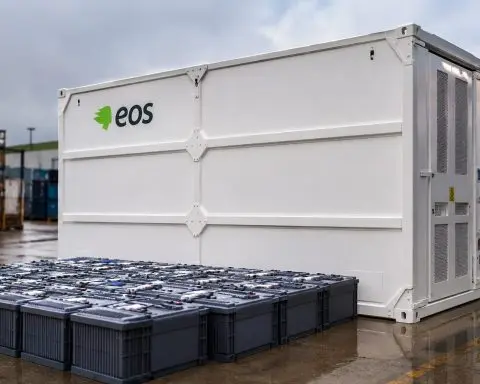
The German deal landed less than 24 hours after Eos said Battery Line 2 had begun commercial production at its Thorn Hill facility in Marshall Township, Pennsylvania. The company said the new line supports its push toward 4 GWh of annual manufacturing capacity by the end of 2026.
Chief Operating Officer John Mahaz said the second line showed Eos could scale “with discipline.” The company said Line 2 would ramp through the year, with subassemblies expected early in the third quarter and full production targeted in the fourth quarter. Eos Energy Enterprises, Inc.
The market reaction also put Eos ahead of several storage-related peers. Fluence Energy rose 1.0%, Stem gained 3.5%, and Energy Vault slipped 0.4% in early trading, a mixed tape that made the Eos move look tied more to company news than a broad sector bid.
Eos has already told investors it expects 2026 revenue of $300 million to $400 million. In the first quarter, revenue rose to $57.0 million, backlog stood at $644.6 million, and its commercial opportunity pipeline was $24.3 billion, though the company still reported an adjusted EBITDA loss, a measure of operating earnings before interest, taxes, depreciation and amortization.
The risk is dilution and execution. Eos has set a July 1 record date for a rights offering — a sale of purchase rights to existing holders — to help fund its Frontier Power USA joint venture, with the subscription price expected at a 10% to 20% discount to a trading-price average. The company also warns that project financing, future orders, supply chains and the conversion of backlog into revenue could all move differently than planned.
Cash gives Eos some room, but not a free pass. Its March 31 quarterly filing showed $410.7 million of unrestricted cash and $61.7 million of restricted cash, while operating activities used $119.7 million in the quarter. That keeps the next questions simple: whether the German orders become purchase orders, whether Line 2 ramps cleanly, and how much stockholders pay for the next leg of growth.
Related articles: NASDAQ:EOSE