
New York, June 20, 2026, 14:02 EDT
- Applied Optoelectronics ended the holiday-shortened U.S. trading week at $161.85, down 3.3% on Thursday and 4.3% from the prior Friday’s close.
- Nasdaq was closed Friday for Juneteenth, leaving Thursday’s close as the latest regular-session price before trading resumes next week.
- Recent filings and management comments put the focus on capacity, insider-sale notices and whether demand for 800G optical transceivers can translate into shipped revenue.
Applied Optoelectronics shares head into the week ahead on the back foot after a sharp reversal in a holiday-shortened U.S. trading week, with investors reassessing one of the year’s hottest AI-infrastructure optics trades.
The stock closed Thursday at $161.85, down 3.3% for the session, after rising 13.3% on Monday and then falling for three straight sessions. From the prior Friday’s $169.05 close, the shares lost about 4.3% in the four-session week.
That matters now because the Sugar Land, Texas-based maker of optical networking products has become a high-beta proxy for demand from artificial intelligence data centers. High beta means the stock tends to move more sharply than the broader market. In AAOI’s case, the debate is no longer just whether cloud customers want faster optics; it is whether the company can build, test and ship enough product without denting margins.
The latest company-specific items were filings rather than a new commercial order. Applied Optoelectronics’ filings page showed June 18 Form 144 and Form 4 notices, including a proposed sale notice tied to Yeh Shu-Hua, also listed as Joshua Yeh, an officer. A Form 144 is an SEC notice used before some sales of restricted or controlled stock; it is not the same as confirmation that a sale has been completed.
A separate 8-K filed June 16 showed that Global Technology, a wholly owned subsidiary, entered a one-year credit line with Shanghai Pudong Development Bank’s Ningbo branch for up to 500 million yuan, twice the prior 250 million yuan facility. The line is meant for working capital, fixed-asset loans and bank acceptance bills, while the bank can revoke it under certain conditions.
The week ahead will test whether buyers treat the pullback as a pause or a warning. Applied Optoelectronics has guided for second-quarter revenue of $180 million to $198 million, with non-GAAP gross margin, an adjusted profit measure excluding some items, expected at 29% to 30%. The company posted first-quarter revenue of $151.1 million and a GAAP net loss of $14.3 million, or 19 cents a share, under standard U.S. accounting rules.
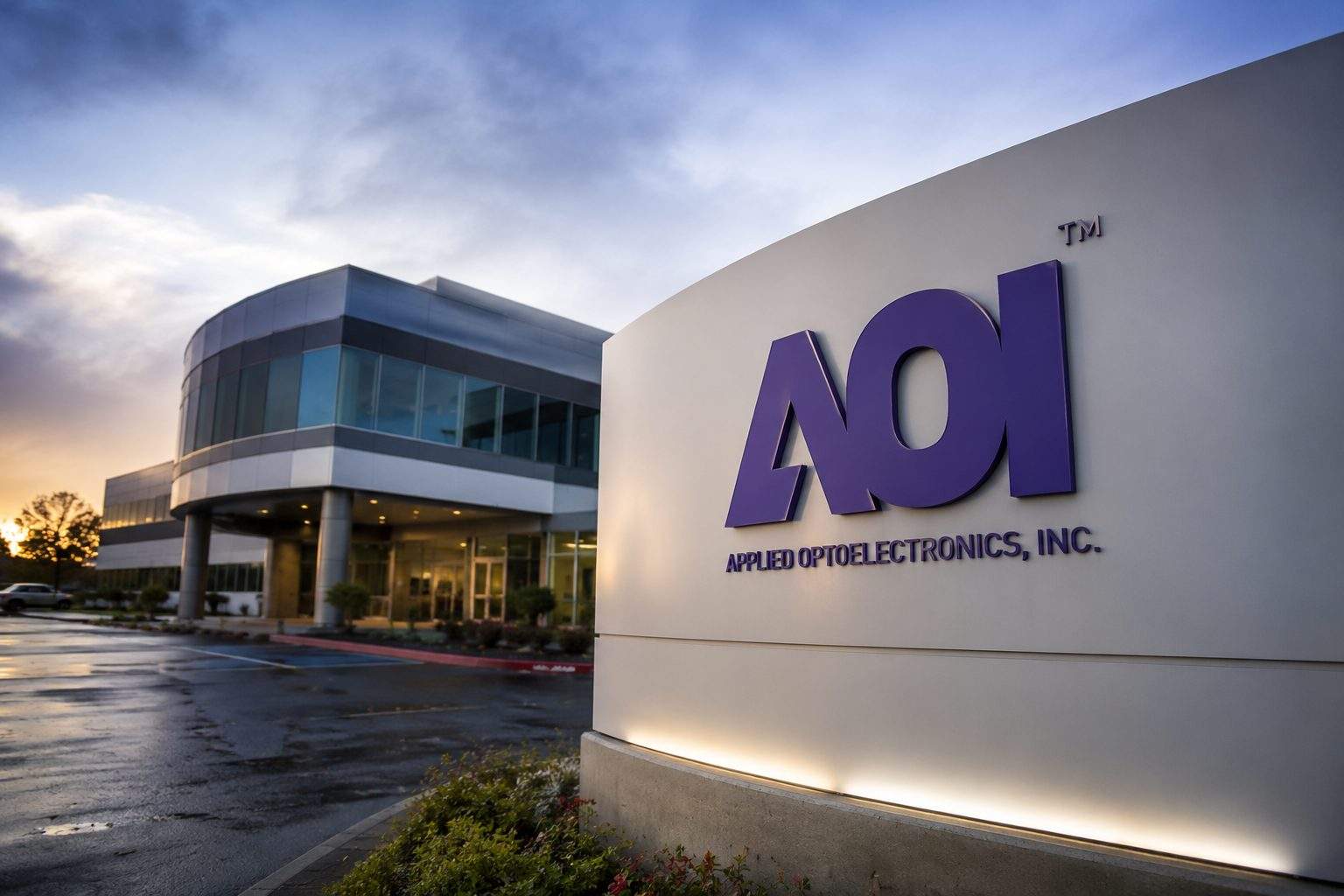
Management has kept the growth message intact. Founder and CEO Thompson Lin said in May the company continued to see “strong customer engagement” around 800G transceivers and 1.6-terabit products. An 800G transceiver moves data at 800 gigabits per second, a speed used in large cloud and AI networks where many chips and servers must exchange data quickly. Applied Optoelectronics, Inc.
Chief Financial Officer Stefan Murry put the constraint more bluntly at a Needham conference hosted by analyst Ryan Koontz. “Demand is not an issue,” Murry said, adding that Applied Optoelectronics had more demand than it could supply and expected that gap to persist into at least mid-2027. That comment is the bull case, and also the execution risk. StockAnalysis
The competitive backdrop is supportive but crowded. Larger optical and photonics names such as Lumentum and Coherent are also tied to the AI-networking buildout; Nvidia said in March it would invest $2 billion each in those companies and make purchase commitments for advanced laser and optical networking products. That validates the category, but it also raises the bar for capacity, customer qualification and balance-sheet scale.
Applied Optoelectronics is not only a data-center story. Earlier this month, the company said Spectrum would deploy AOI’s QuantumLink remote-management software across connected 1.8GHz amplifiers, equipment used in hybrid fiber-coax broadband networks. The cable side gives AAOI another revenue channel, though the market is plainly valuing the stock first on AI optics.
But the downside scenario is not hard to sketch. The company has warned about possible order reductions, shipment delays, supply-chain disruption, pricing pressure, tariffs and reliance on a small number of customers. After such a large run, any slip in the 800G ramp, a slower 1.6T transition, or evidence that customers are spreading orders more widely could hit the shares quickly.
Related articles: NASDAQ:AAOI


![Australia Stock Market Today 24/08/2026 [UPDATE: 10:38 AEST] [Miners Lift ASX as Banks Blunt Opening Gain]](https://ts2.tech/wp-content/uploads/2026/08/AU-market-dashboard-2026-08-24-1038-480x384.jpg "Australia Stock Market Today 24/08/2026 [UPDATE: 10:38 AEST] [Miners Lift ASX as Banks Blunt Opening Gain]")

![Asia Stock Market Today 24/08/2026 [UPDATE: 09:01 SGT] [Samsung Slides as SK hynix Splits Seoul Chip Trade]](https://ts2.tech/wp-content/uploads/2026/08/Asia-market-dashboard-2026-08-24-0859-480x384.jpg "Asia Stock Market Today 24/08/2026 [UPDATE: 09:01 SGT] [Samsung Slides as SK hynix Splits Seoul Chip Trade]")