
NEW YORK, June 22, 2026, 15:01 EDT
- Applied Optoelectronics NASDAQ:AAOI climbed about 7.8% to $174.41 in afternoon trading, outpacing a weaker Nasdaq tape.
- A less obvious catalyst sits in last week’s SEC filing: a China unit doubled a credit line to RMB 500 million, a working-capital signal for the company’s manufacturing ramp.
- The risk is execution. The company remains loss-making under GAAP, gross margin slipped in the first quarter, and its top 10 customers generated 98% of revenue.
Applied Optoelectronics shares rose on Monday as investors bought back into one of the year’s most volatile AI-infrastructure names, even as the broader technology tape weakened. Applied Optoelectronics NASDAQ:AAOI traded at $174.41, up $12.56, with volume above 10.5 million shares in afternoon dealings.
That matters now because the move came on a day when the Nasdaq Composite was down more than 1%, pressured by weakness in megacap technology stocks. Investors are still questioning the cost of hyperscaler infrastructure spending — hyperscalers are the very large cloud companies building AI data centers — but the market is drawing a sharper line between cloud platforms and the component makers that sell into the buildout.
The hidden detail is not a new customer headline. It is funding.
Applied Optoelectronics disclosed on June 16 that its Global Technology unit in Ningbo, China, entered a one-year credit line with Shanghai Pudong Development Bank for up to RMB 500 million, replacing a prior RMB 250 million facility. The line can be used for working-capital loans, fixed-asset loans and bank acceptance bills, which are bank-backed short-term payment instruments often used to pay suppliers.
That filing looks more useful when set beside the company’s March-quarter balance sheet notes. At March 31, the earlier RMB 250 million SPD line had $20.5 million outstanding, $18.0 million of bank acceptance notes issued to vendors, and only $3.0 million of unused credit. In plain terms, the old China line was close to spoken for before the AI-optics production ramp had fully hit its stride.
AOI is trying to turn demand into units, not just orders. In May, Chief Executive Thompson Lin said the company saw “strong customer engagement” around 800G transceivers and 1.6 Tb products. An 800G transceiver is a module that moves data at 800 gigabits per second inside data-center networks. Chief Financial Officer Stefan Murry said AOI exited the first quarter with “nearly 100,000 units” of monthly 800G transceiver capacity. Applied Optoelectronics, Inc.
The company’s first-quarter numbers explain the market’s patience, and its impatience. Revenue rose 51.4% to $151.1 million, with data-center revenue up 154% to $81.4 million, but GAAP gross margin fell to 29.1% from 30.6% a year earlier as manufacturing costs rose during the ramp. Management guided second-quarter revenue to $180 million to $198 million.
AOI also has more balance-sheet room than it had during earlier cycles. It completed an at-the-market stock sale — a program that lets a company sell shares gradually into the open market — on April 2, selling about 4.8 million shares at a weighted average price of $103.51 for roughly $490 million of net proceeds. That is well below Monday’s stock price, and it helped lift cash, equivalents and restricted cash to $449.4 million at the end of March.
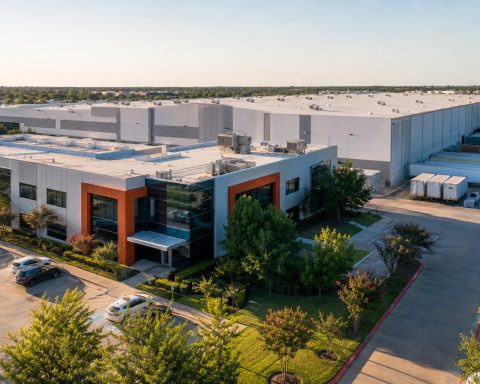
Competitive context is still important. Coherent and Lumentum remain larger optical-component rivals tied to the same AI networking demand, while Ciena is more exposed to network systems. The difference with AAOI is the market is now trading the factory ramp itself — Texas, Taiwan and China capacity, supplier credit, inventory and customer qualification — rather than just a general optical-stock theme.
Bill Northey, senior investment director at U.S. Bank, told Reuters that “some of the strongest fundamentals” remain in the AI data-center buildout, including components that go into that expansion. That view helps explain why AAOI could rally while Amazon, Microsoft and other megacap technology shares fell on Monday. Reuters
The customer backdrop cuts both ways. AOI’s Amazon warrant gives an Amazon affiliate the right to buy up to 7.95 million shares at $23.6956, with most of the warrant vesting over 10 years depending on $4 billion of purchases by Amazon and affiliates. That is a powerful demand signal, but also a reminder that a few large customers can move the story.
The risk is that the stock is now priced for clean execution. AOI’s top 10 customers accounted for 98% of first-quarter revenue, the company posted a GAAP net loss of $14.3 million, and gross margin was hit by higher manufacturing costs and production inefficiency. The new China credit line can also be revoked by the bank under certain conditions, and future capital needs may still push the company toward more debt or equity if demand, timing or supply-chain assumptions slip.
Related articles: NASDAQ:AAOI