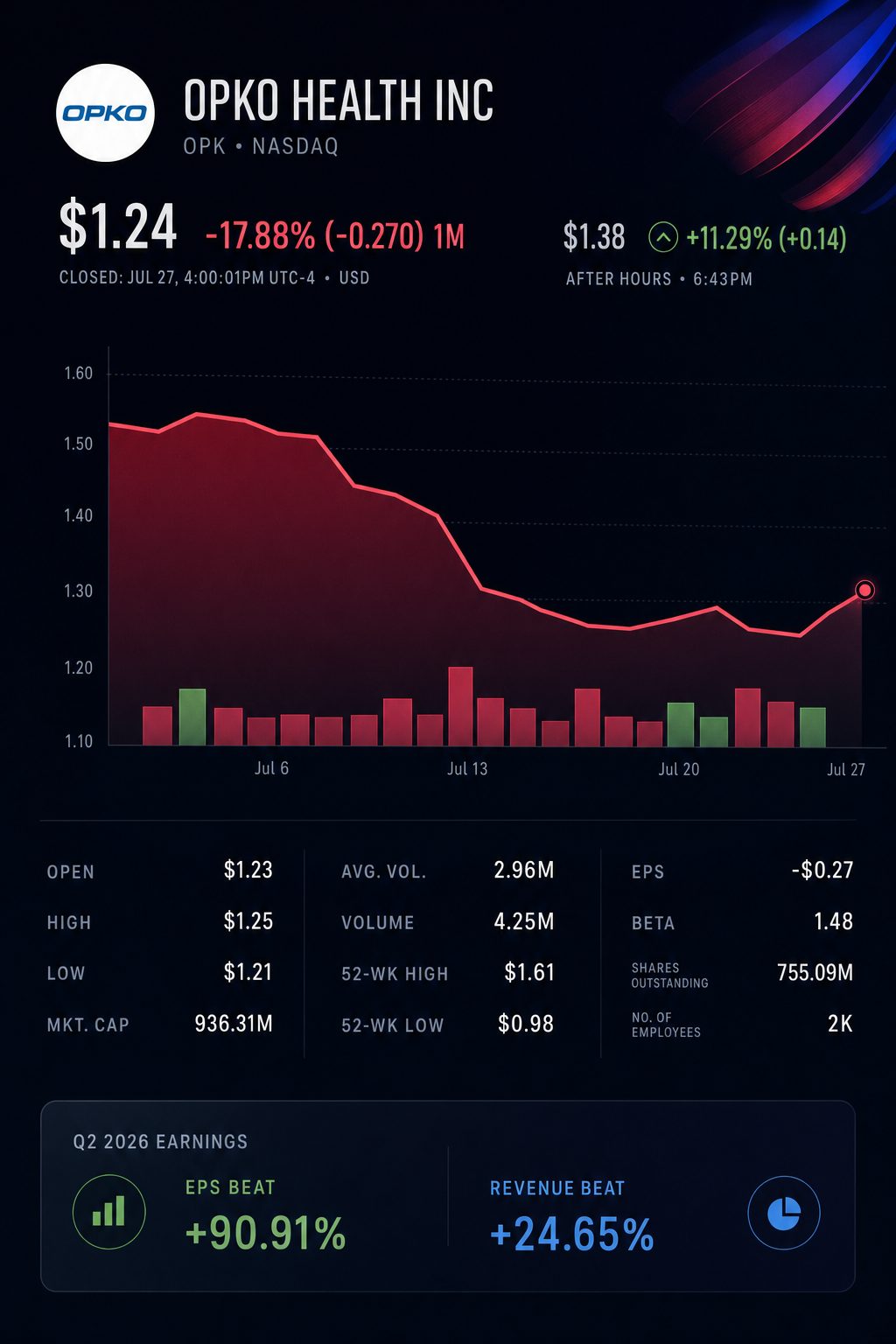
NEW YORK, July 27, 2026, 18:07 EDT — U.S. markets finished regular session, after-hours trading sees heightened activity.
- Shares finished the session up 1.6% at $1.24 and rose approximately 8% in after-hours trading.
- Second-quarter revenue surpassed consensus estimates by $32.35 million.
- Approximately 91% of the beat, or $29.4 million, came from Nicoya preferred shares.
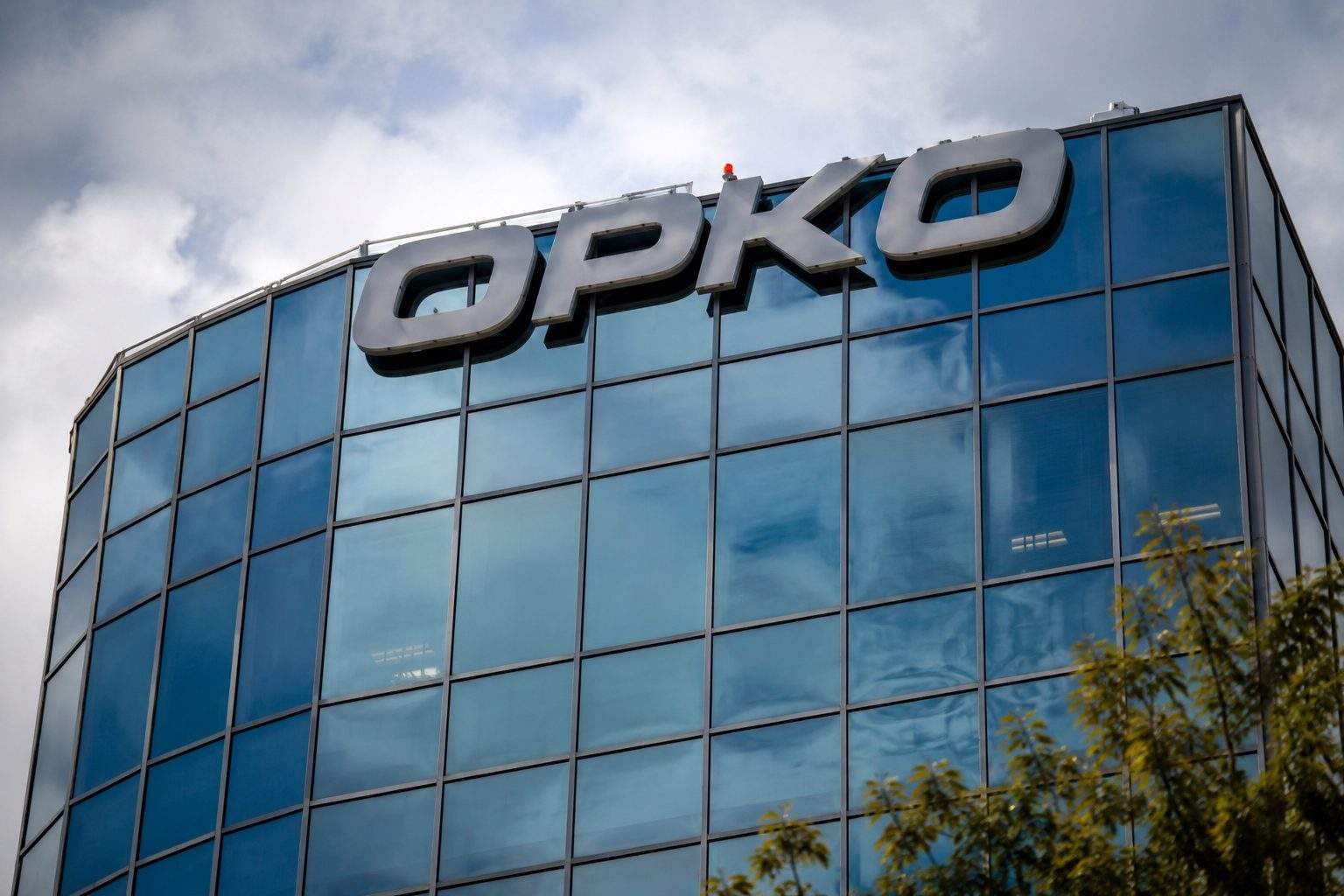
OPKO stock jumped following the close on Monday after the company’s revenue and loss per share surpassed expectations. OPKO additionally increased its full-year sales guidance.
The key concern for investors is the quality of revenue. Much of the unexpected result came from a Greater China licensing amendment, which included a portion of payment in Nicoya shares.
Revenue for the quarter increased by 4.3% to $163.5 million. The operating loss reduced to $7 million from $60 million. Net loss decreased to $8.4 million, compared with $148.4 million previously. The earlier period had included a $91.7 million note-exchange charge.
The reported revenue forecast stood at $131.23 million, with OPKO surpassing this by $32.35 million. Nicoya shares accounted for around 91% of the difference.
Management increased its 2026 revenue outlook to between $560 million and $585 million, up from the previous April estimate of $530 million to $560 million.
The specifics of the bridge are significant.
| 2026 revenue forecast | April interval | July interval | Midpoint variation |
|---|---|---|---|
| Services | $300m-$312m | $296m-$306m | -$5.0m |
| Products | $160m-$170m | $164m-$174m | +$4.0m |
| IP and other | $70m-$80m | $100m-$105m | +$27.5m |
| Total revenue | $530m-$560m | $560m-$585m | +$27.5m |
The midpoint for total revenue rose by $27.5 million, matching the rise in the IP-and-other revenue midpoint. Services dropped $5 million, whereas products gained $4 million.
When the Q2 Nicoya revenue is taken out at the new midpoint, the result is $543.1 million—lower than the midpoint of $545 million in April. This does not represent company guidance.
OPKO independently saw cost improvements, lowering its full-year expense outlook to between $710 million and $740 million, down from the previous forecast of $725 million to $750 million.
However, nearly all the operating gain was accounted for by two items tied to transactions. The Nicoya income, combined with an $18.1 million earnout from Labcorp Holdings Inc. (NYSE:LH), amounted to $47.5 million. That figure represented close to 90% of the $53 million improvement compared to the previous year.
BioReference continues to prioritize “achieving breakeven and operating profitability” in 2026, according to CFO Adam Logal. Meanwhile, retained diagnostics revenue declined by roughly $1.7 million compared to the previous year. Investing.com
Recurring product lines saw enhancements. Product revenue climbed 5.4% to $42.9 million. Rayaldee revenue increased 12.5% to $8.1 million. The NGENLA profit share from Pfizer Inc. NYSE:PFE rose 4.9% to $6.4 million.
For the third quarter, revenue is projected at $131 million to $142 million, with the midpoint representing a 16.5% decrease from Q2 reported sales. Excluding Nicoya on a pro forma basis, this figure would be approximately 1.8% above the prior quarter.
OPKO closed June holding $314.4 million in cash, securities and restricted cash, representing about a third of its current market capitalization. There is also $94.7 million still approved for share buybacks, equating to roughly 10% of the market value.
The stock rose approximately 2.5% last week, finishing Friday at $1.22. It settled at $1.24 on Monday prior to the release. Tuesday’s main trading hours will determine if the after-hours increase remains.
Following the earnings update, the upcoming scheduled milestones are set for later in 2026. OPKO projects that enrollment for MDX2301 will conclude in the third quarter. The initiation of a Phase 1 in vivo CAR-T trial is planned for late 2026 or potentially early 2027.
Risks: Core diagnostics revenue declined to $68.2 million compared with $69.3 million. 4Kscore revenue slipped to $6.3 million from $6.9 million. Multiple major drug programs are still in Phase 1 trials. Reliance on transaction-related income is significant for the earnings bridge.
The rally reflects an improved loss profile and reduced costs. For a sustained re-rating, consistent revenue growth outside of equity and earnout gains is necessary.