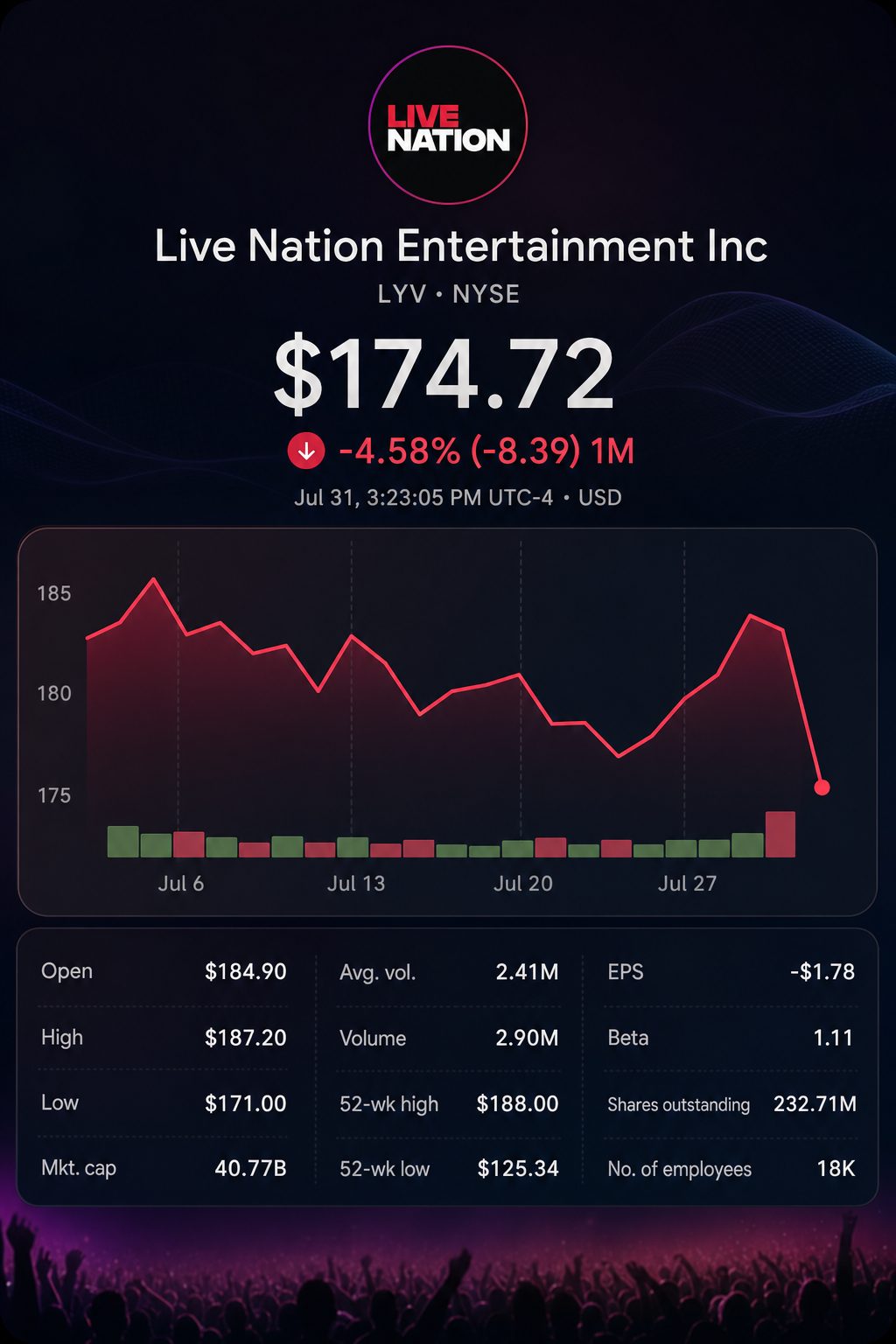
U.S. markets remained open. Live Nation last traded at $173.60, reflecting a 5.4% decline, according to the most recent quote.
Operating margin for ticketing stood at 31.1%, while concerts posted a margin of 2.1%.
Initial estimates indicate that revenue per fee-bearing ticket increased by 6.2%.
Shares of Live Nation declined by 5.4% on Friday even after reporting stronger-than-expected quarterly revenue. The drop renewed scrutiny on Ticketmaster’s business model and ongoing operational challenges.
Ticketing generated 42% of operating income while contributing 11% of total revenue across the three reportable segments. Its operating income was almost double that of the concerts segment, despite accounting for just 13% of its revenue. This highlights the exceptional value of each Ticketmaster transaction.
Q2 segment
Revenue ($m)
Revenue change
Operating income ($m)
Operating margin
AOI ($m)
Concerts
6,444.4
up 8%
134.0
2.1%
309.6
Ticketing
852.2
up 15%
264.7
31.1%
331.0
Sponsorship and advertising
383.0
up 12%
235.5
61.5%
256.9
AOI stands for adjusted operating income. Data has not been audited.
Revenue increased by 9% to $7.667 billion, coming in roughly 1.4% higher than analysts’ expectations. Diluted earnings stood at $1.05 per share, compared with 41 cents previously. Despite this, shares stayed significantly down in afternoon trading.
Earnings measure
Q2 2026
Comparator
Change
Revenue
$7.667 billion
$7.56 billion consensus
+1.4%
Diluted earnings per share
$1.05
$0.41 in Q2 2025
+156%
Fee-bearing tickets
90.051 million
83.349 million
+8.0%
Ticketing GTV
$10.4 billion
$9.1 billion
+15%
Gross transaction value is referred to as GTV.
Chief Executive Michael Rapino stated fans “keep choosing to be in the room” with artists. Ticket sales topped 143 million by mid-July, surpassing last year’s figure by more than 14 million. Live Nation Newsroom
President and Chief Financial Officer Joe Berchtold stated that AI “gets integrated into it in a lot of ways.” He mentioned uses in event discovery and software development, and pointed to fan tools along with pricing data for unsold tickets. investing.com
Leaders did not provide an AI revenue goal or specify a launch timeline. Ticketmaster now expects full-year AOI to grow at a mid-single-digit rate. Deferred GTV climbed 16% to $5.2 billion. Deferred service-fee revenue grew by 23% to reach $390 million.
Ticketmaster monetization
Q2 2026
Q2 2025
Change
Fee-paying tickets
90.051 million
83.349 million
+8.0%
GTV per ticket
$115.49
$109.18
+5.8%
Revenue per ticket
$9.46
$8.91
+6.2%
Operating profit per ticket
$2.94
$2.75
+6.8%
AOI per ticket
$3.68
$3.48
+5.6%
Individual ticket data are early-stage estimates by investors based on overall company numbers. The published GTV is a rounded figure, resulting in approximate calculations.
Early calculations divide volume from revenue generation. Ticket sales increased by 8%, and revenue for each ticket increased 6.2%. Factors such as pricing, fee structure, and region could help account for the increase. Live Nation has not detailed the impact of AI.
The conversion funnel now involves increased identity verification steps. Ticketmaster reports that certain users are required to provide a real-time selfie. In some cases, customers must also present government-issued photo ID via Persona. Ticket purchases are blocked if checks are unsuccessful or left unfinished.
Ticketmaster states that the verification process is aimed at countering bots, scalpers, and misuse of accounts. According to its support page, Persona maintains biometric data from completed verifications for up to 60 days. Data from failed verification attempts could be stored as long as three years.
The outage on Friday introduced an additional execution risk. Users experienced issues such as blank screens, inability to log in, and being locked out of purchases. At the time of publication, Ticketmaster had not released a public statement.
An independent verification at 19:02 GMT showed Ticketmaster.com was accessible. This indicates the issue was temporary or affected only specific features. A homepage test does not confirm account or checkout functionality.
Risks stay localized. While identity controls help limit fraud, they can also increase privacy risks and abandonment rates. Technical outages may result in losing lucrative transactions in brief sales periods. Legal challenges present additional hurdles. Live Nation recorded a $450 million litigation charge for the first half.
The focus shifts to conversion rather than demand. Ticketmaster’s deferred balances indicate a robust backlog. Investors are looking for improved monetization that does not increase customer friction. Friday’s share drop suggests the earnings beat failed to resolve this trade-off.
TS2 TECH • EXTENDED COVERAGE
Further analysis
Editorial insight
Is it possible for investors to purchase Ticketmaster stock outright?
Ticketmaster stock does not trade separately; investors purchase shares of parent company Live Nation. Live Nation is listed on the NYSE with the symbol LYV. At its latest intraday quote on July 31, the stock was $173.43, a decline of 5.5%. The company's market capitalisation was roughly $42.3 billion. Ticketmaster operates as the ticketing arm within Live Nation, not as the entire business. Live Nation Entertainment
What caused LYV shares to decline following its recent earnings release?
Shares of LYV dropped around 5.5% during trading even after surpassing headline forecasts. Second-quarter revenue increased 9% to $7.67 billion, and diluted EPS was $1.05. Analysts had projected revenue near $7.56 billion and EPS of $0.66. However, consolidated AOI rose just 2%, with Concerts AOI decreasing 14%. Investors appeared to focus on margin concerns and expectations for significant profit growth not materializing until late 2026. Live Nation Newsroom
What is the strength of Ticketmaster’s core business?
Ticketmaster delivered the strongest operational gains in the quarter. Revenue climbed 15% to $852 million, and AOI grew 14% to $331 million. Fee-bearing ticket volume increased 8% to 90.1 million. Gross transaction value also rose 15%, reaching $10.4 billion. Deferred service-fee revenue advanced 23% to $390 million. Management continues to anticipate mid-single-digit AOI growth at Ticketmaster for 2026. Live Nation Newsroom
Are higher expenses causing a drop in concert demand among consumers?
Latest data indicates demand remains strong with no widespread decline. Attendance for Q2 increased 10% to 48.7 million fans at 15,258 events. Ticket sales topped 143 million through mid-July, putting results 14 million above last year. Sell-through rates equaled or beat 2025 performance, and cancellation rates held close to typical levels. Deferred revenue from events hit a record $6.4 billion, a 25% rise. Most expected gains in Concerts profit are now reliant on fourth-quarter performance. Live Nation Newsroom
Is it still possible for Ticketmaster to be split from Live Nation?
The federal DOJ agreement does not mandate Ticketmaster’s divestiture. It calls for the creation of a $280 million fund and introduces several operational changes aimed at increasing competition. A federal judge’s approval is needed before the settlement can become effective. In a separate case, remaining states secured an antitrust jury verdict on April 15, and the remedies phase may still seek structural solutions, including a breakup. Live Nation has recorded a $450 million accrual and intends to contest the verdict. The ultimate resolution is still unclear. Live Nation Entertainment
Is Live Nation's cash position sufficient to cover legal expenses and fund growth initiatives?
Liquidity remains strong, though reported cash levels exaggerate immediately accessible funds. As of June 30, cash and equivalents totaled $9.07 billion. Live Nation disclosed $1.93 billion in free cash available after accounting for event-linked liabilities. Total debt was $9.20 billion, up from $8.20 billion at the prior year-end. Current debt amounted to roughly $2.97 billion. The company expects full-year capital expenditures of $1.1 billion, with $800 million allocated for venues. Adjusted free cash flow for Q2 climbed 18% to $516 million. Live Nation Entertainment
How does management project performance through the remainder of 2026?
Management continues to forecast double-digit consolidated AOI growth for 2026. Full-year Concerts attendance is anticipated to increase by 10%. AOI for Concerts and Sponsorship is projected to see double-digit gains, while Ticketmaster AOI is expected to increase at a mid-single-digit pace. The majority of profit growth for Concerts is projected in the fourth quarter. Sponsorship commitments currently account for 95% of the expected 2026 activity. Net interest expense is projected to be about $280 million, with capital expenditures estimated at approximately $1.1 billion. Live Nation Newsroom
Can LYV’s valuation be accurately assessed by looking at its P/E ratio?
The trailing P/E is not considered meaningful, as earnings for the trailing period are negative. Recent market data put EPS around minus $1.13, with a resulting negative P/E ratio. A legal accrual of $450 million significantly reduced first-half GAAP earnings. AOI stood at $817 million in the second quarter, while adjusted free cash flow was $516 million. As a result, investors are focused on AOI and free cash flow figures in addition to reported results. Both figures are non-GAAP and do not include certain costs. Live Nation Entertainment
How do Wall Street analysts predict LYV stock will perform?
Overall sentiment stays positive, but the projected upside is limited. Twenty-six analysts set an average price target at $189.04. Forecasts vary widely, spanning $145 to $222. With shares at $173.43, the consensus target suggests a potential upside of about 9%. On July 31, Oppenheimer reiterated its Outperform rating and a $210 target. Legal outcomes and performance in the fourth quarter are cited as principal risks to expectations. Benzinga
Leokadia Głogulska is a financial and technology journalist at TS2.tech, covering stocks, artificial intelligence, space technology and global market developments. She graduated from Wrocław University of Economics and Business and previously worked in financial analysis before moving into business journalism. Her reporting focuses on helping readers understand the market trends, companies and technologies shaping the global economy.