NEW YORK, July 31, 2026, 3:23 p.m. EDT — U.S. cash equities trading underway. Nasdaq is open for its standard session, which closes at 4 p.m. EDT.
- A delayed quote indicated that Linde was down 5.9% at $478.70, wiping out about $14 billion in market capitalization.
- Linde increased its 2026 capital spending midpoint by 9.5%, while the midpoint for adjusted earnings advanced by only 0.3%.
- Electronics accounted for 10% of gas sales and made up 22% of the contracted gas-project backlog.
Shares in Linde plc NASDAQ:LIN dropped 5.9% to $478.70 on Friday, erasing approximately $14 billion from its market capitalisation. The decline followed second-quarter results that topped sales and adjusted earnings estimates.
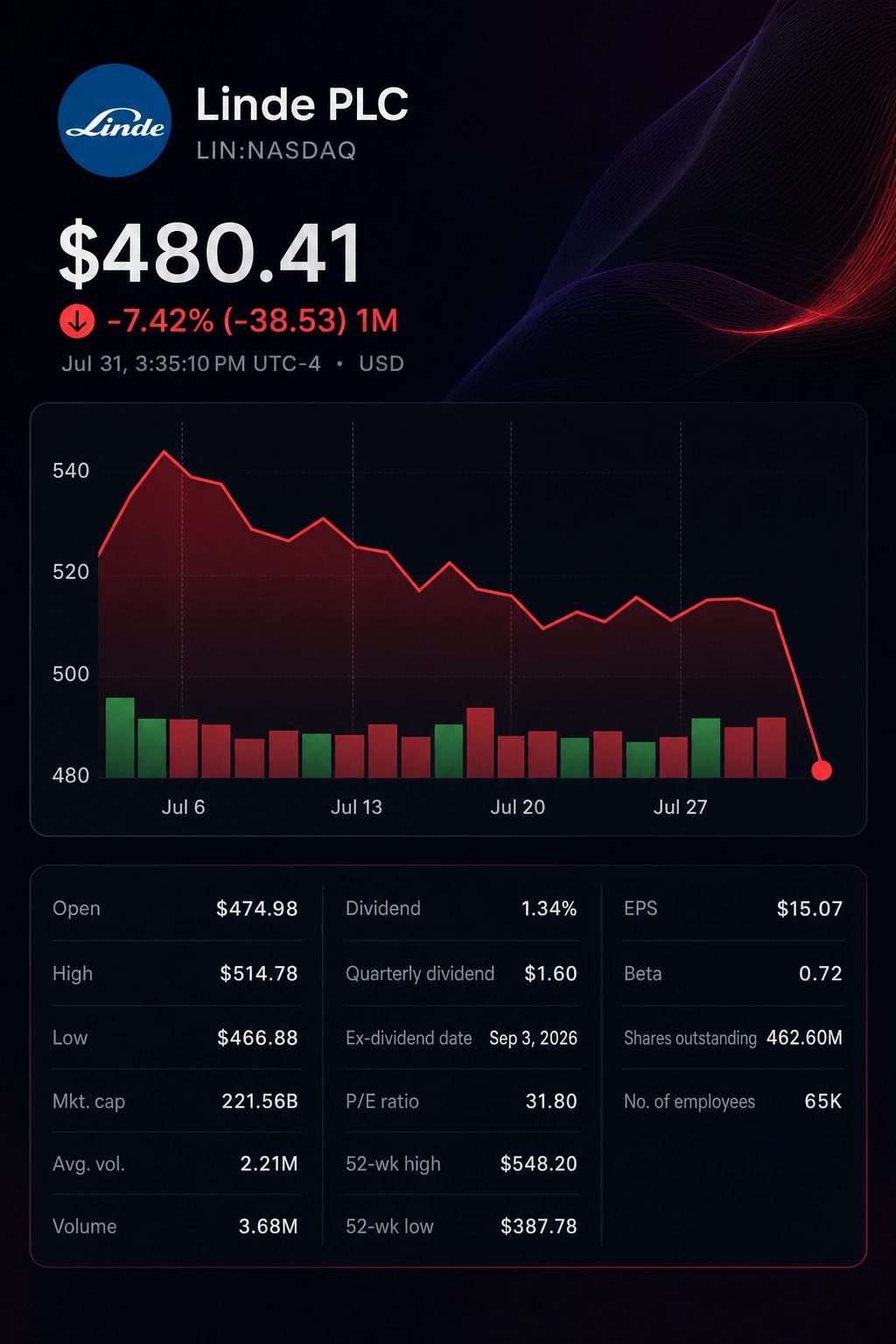
The findings indicated there was no demand shock. The more significant shift related to capital intensity. Linde raised its 2026 capex midpoint by 9.5% compared to May, while the adjusted earnings-per-share midpoint rose just 0.3%.
| 2026 measure | May 1 outlook | July 31 outlook | Midpoint or level change |
|---|---|---|---|
| Adjusted EPS | $17.60–$17.90 | $17.70–$17.90 | +0.3% |
| Capital spending | $5.0–$5.5 billion | $5.5–$6.0 billion | +9.5% |
| Contracted gas-project backlog | $7.1 billion | $8.1 billion | +14.1% |
Changes to the midpoint are based on the ranges released by Linde.
The yearly high is still a cent under FactSet’s average of $17.91. With the midpoint set at $17.80, implied EPS for the second half stands at $8.98, just 1.8% higher than the first half.
| Adjusted EPS Comparison | Linde Value | Reference Value | Change |
|---|---|---|---|
| Implied second-half vs actual first-half | $8.98 | $8.82 | +1.8% |
| Q3 midpoint vs Q2 actual | $4.50 | $4.50 | 0.0% |
| Implied Q4 vs Q3 midpoint | $4.48 | $4.50 | -0.4% |
| Q3 midpoint vs FactSet average | $4.50 | $4.54 | -0.9% |
| Implied Q4 vs FactSet average | $4.48 | $4.54 | -1.3% |
| Full-year midpoint vs FactSet average | $17.80 | $17.91 | -0.6% |
Initial derived estimates: the second-half and Q4 numbers are calculated from Linde’s annual guidance range and do not reflect official company projections. FactSet’s estimates appeared at 3:10 p.m. EDT.
The midpoint for the third quarter is in line with the previous quarter’s outcome. The full-year range equates to $4.48 for the fourth quarter, which is lower than both the Q3 forecast and analysts’ current projections.
The quarter in question surpassed expectations. Revenue topped the LSEG consensus by 3.3%. Adjusted earnings per share were 0.4% above the consensus.
| Metric | Q2 2026 | Q2 2025 | Year-on-year | Street mean | Surprise |
|---|---|---|---|---|---|
| Sales | $9.289 billion | $8.495 billion | up 9.3% | $8.99 billion | 3.3% above |
| Adjusted EPS | $4.50 | $4.09 | up 10.0% | $4.48 | 0.4% above |
| Adjusted operating margin | 29.5% | 30.1% | down 60 bp | — | — |
| Operating cash flow | $2.271 billion | $2.211 billion | up 2.7% | — | — |
| Capital spending | $1.438 billion | $1.257 billion | up 14.4% | — | — |
| Free cash flow | $833 million | $954 million | down 12.7% | — | — |
LSEG supplies consensus figures. All other data provided by Linde; percentage change calculations are included.
Underlying sales increased by 4%, with equal contributions from pricing and volume. The adjusted margin decreased by 60 basis points. Pricing and productivity improvements were matched by inflation. Project capital expenditure surged by 27%, and base capital expenditure was up 2%.
The company’s cash conversion was impacted by the change in mix. Free cash flow dropped 13% to $833 million. Linde distributed $1.59 billion to shareholders via dividends and net share buybacks, representing 1.9 times its quarterly free cash flow. Adjusted net debt increased by $1.98 billion to $23.11 billion. Return on capital declined to 23.5% from 25.1%.
Electronics is a key driver behind the surge in investments. The sector contributed 10% of gas sales and posted an 18% increase in sales, marking the strongest growth among Linde’s reported end markets.
| Semiconductor exposure | Reported or derived value | Investor context |
|---|---|---|
| Gas sales to electronics | 10% | Present revenue composition |
| Increase in electronics sales | +18% | Versus previous year |
| Electronics share in gas-project orders | 22% | Roughly $1.78 billion |
| Investment in Phoenix | $1.0 billion | Represents 12.3% of the current gas-project order book |
| Overall project order book | $11.1 billion | $8.1 billion in gas-projects; $3.0 billion in plant sales |
The amounts of $1.78 billion and 12.3% have been calculated. The gas project backlog shows agreed project investment, not projected revenue.
Chief Executive Sanjiv Lamba stated, “Customer proposal activity remains robust, primarily across the electronics end market.” The expansion in Phoenix involves two air-separation units to support two new chip manufacturing facilities. Linde’s investment will total $1 billion. Its joint venture in Taiwan intends to spend an additional $800 million for the same undisclosed customer. Reuters
Air Products and Chemicals Inc. NYSE:APD offers the most comparable near-term peer reference. On Thursday, the company posted a 12% rise in adjusted earnings per share. Adjusted operating margin improved by 110 basis points.
| Latest reported period | Linde Q2 2026 | Air Products fiscal Q3 2026 |
|---|---|---|
| Sales growth | +9% as reported; +4% underlying | +5% |
| Adjusted EPS growth | +10% | +12% |
| Adjusted operating margin | 29.5% | 25.6% |
| Margin change | -60 bp | +110 bp |
| Full-year adjusted EPS growth guidance | +8% to +9% | +11% to +12% |
| Price divided by guidance midpoint | 26.9 times | 21.9 times |
Accounting periods and non-GAAP metrics vary. Multiples are based on lagged prices and the adjusted EPS guidance midpoint for each firm.
Linde holds a 3.9-point lead in operating margin. Still, its margin narrowed as Air Products’ margin grew. Linde’s guide-based multiple trades at a premium of about 23%.
Risks: The identity of the Phoenix customer has not been disclosed, restricting the ability to assess concentration risk. Inflation in U.S. home-care impacted Americas margins. EMEA volumes declined by 1%, and timing for major projects can move.
The focus now shifts to delivery rather than signing contracts. Linde’s backlog ensures stable growth, yet capital expenditure takes priority. The response on Friday indicates investors seek quicker evidence of free cash flow.