NEW YORK, August 4, 2026, 14:20 EDT
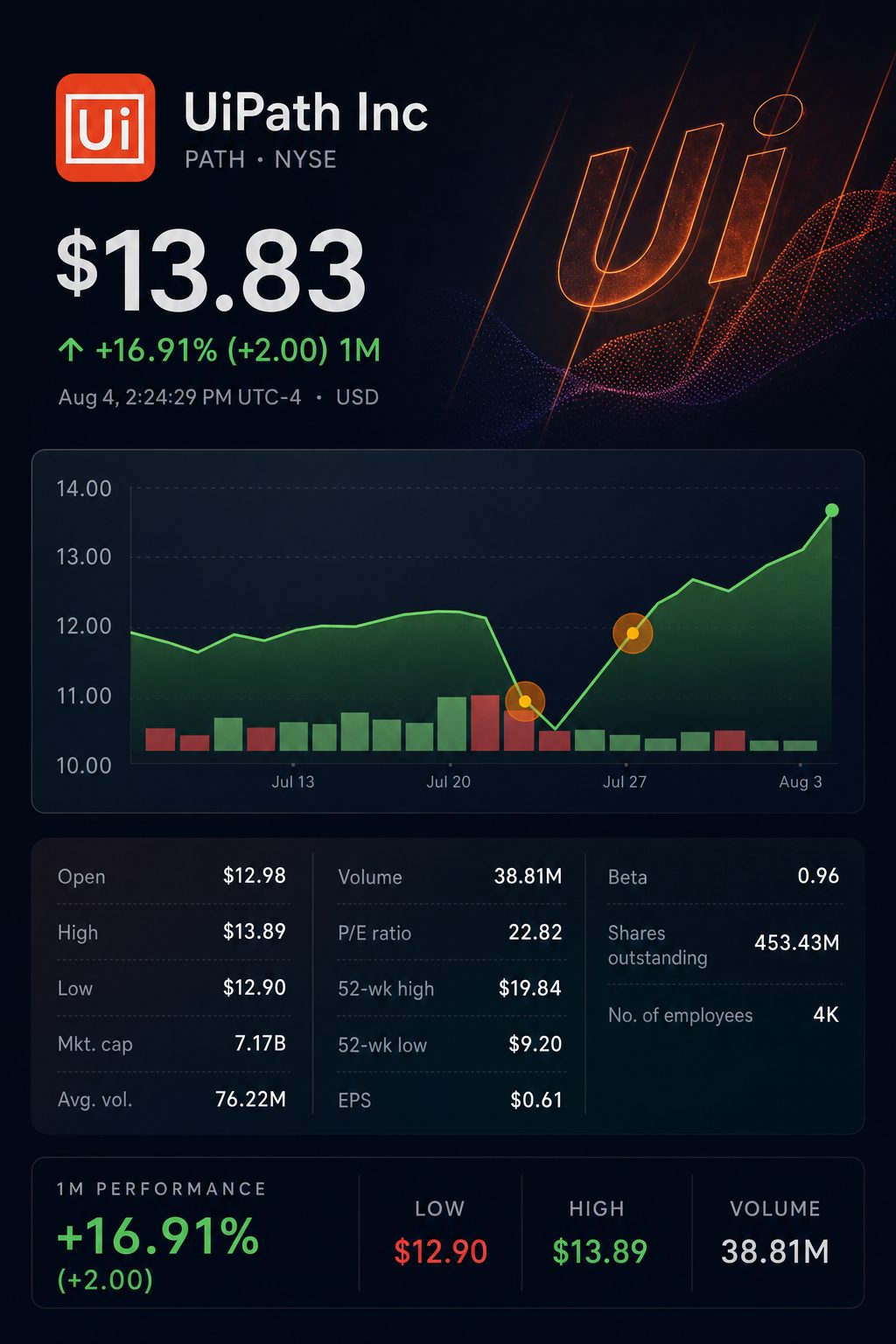
- UiPath was quoted at $13.80, up 5.7%, in the latest available trade.
- Its Q2 guidance implies about $30.5 million of sequential ARR growth.
- The annual midpoint requires $129 million of second-half additions, versus $130 million last year.
UiPath shares rose 5.7% to $13.80 on Tuesday, joining a broad AI-led advance. Markets were still open.
The immediate read-through came from Palantir Technologies NASDAQ:PLTR, not UiPath itself. Palantir jumped 30.4%. Quarterly revenue rose 93%, while its new annual guide implies 82% growth.
UiPath had issued no new investor-relations release since June 16. Its latest 8-K covered the June 25 annual meeting. The timing therefore points to a sector move, not company news.
Latest available quotes showed UiPath outperforming workflow peers. Palantir remained far ahead.
| Company | Latest price | Day move | Market value |
|---|---|---|---|
| UiPath NYSE:PATH | $13.80 | +5.7% | $7.29 billion |
| Palantir Technologies NASDAQ:PLTR | $163.80 | +30.4% | $421.86 billion |
| ServiceNow NYSE:NOW | $116.51 | +2.0% | $120.48 billion |
| Pegasystems NASDAQ:PEGA | $31.73 | +1.1% | $5.45 billion |
| Appian NASDAQ:APPN | $28.15 | +1.6% | $2.08 billion |
That split matters. Investors are rewarding proven AI revenue, not merely product positioning. UiPath’s next evidence must come through ARR conversion.
UiPath’s own guidance sets a harder test. Preliminary midpoint calculations show a clear Q2 step-down.
| Metric | Q1 FY2027 actual | Q2 FY2027 preliminary midpoint |
|---|---|---|
| Revenue | $418.0 million | $397.5 million |
| Year-on-year revenue growth | 17.0% | About 9.8% |
| Sequential ARR addition | $49.0 million | About $30.5 million |
| Non-GAAP operating margin | 22.0% | About 18.9% |
The Q2 midpoint adds about $30.5 million of ARR sequentially. That is roughly 38% below Q1’s addition. Guided non-GAAP margin also falls about three percentage points.
The annual ARR target is more demanding. Its midpoint requires $129 million after July. The full guidance range requires $124 million to $134 million.
| ARR bridge | FY2026 actual | FY2027 preliminary midpoint |
|---|---|---|
| Q2 ending ARR | $1.723 billion | $1.9315 billion |
| Year-end ARR | $1.853 billion | $2.0605 billion |
| Second-half ARR addition | $130 million | $129 million |
At midpoint, Q3 and Q4 must average $64.5 million each. That is more than twice the guided Q2 pace. Last year’s fourth quarter added $70 million.
Chief Executive Daniel Dines said agentic products were “moving from pilot to production.” The ARR bridge will test that claim. UiPath, Inc.
Palantir’s results also expose the valuation divide. The comparison is stark.
| Company | Latest quarterly revenue growth | Guided full-year growth | Equity value/guided revenue |
|---|---|---|---|
| UiPath | 17% | About 10.4% | About 4.1 times |
| Palantir | 93% | About 82% | About 51.7 times |
Ratios use latest available market capitalizations and revenue-guidance midpoints. Fiscal years differ.
Palantir’s ratio is about 12.6 times UiPath’s. The gap tracks a roughly 72-point difference in guided revenue growth. UiPath needs faster conversion to narrow either spread.
“If it’s sustainable, we’re going to have to start to separate the winners from the losers,” said Eric Parnell, chief market strategist at Great Valley Advisor Group. UiPath’s guidance leaves that verdict open. Reuters
UiPath has financial room to execute. It ended April with $1.42 billion in cash and securities. Adjusted free cash flow reached $130 million.
Risks remain. Customer retention could weaken. New AI tools could pressure pricing. A soft second half would break the ARR bridge. Faster agentic deployments are the main upside risk.
A Q2 ARR result above $1.934 billion would reduce the back-half burden. A result below $1.929 billion would raise it. That is the next clean test.
Related articles: NASDAQ:PLTR