
NEW YORK, August 4, 2026, 16:05 EDT Oracle shares advanced for a second session, extending their rebound while investor focus remained on the company’s $260 billion in AI-related leasing obligations and the potential impact on Oracle’s credit outlook.
- Oracle shares last traded up 3.0% at $146.15. The stock has climbed roughly 12.5% over the past two sessions.
- Uncommenced leases account for approximately 61% of Oracle’s market capitalization. The figure is under 9% for Microsoft.
- Oracle’s five-year credit-default swaps climbed to 215 basis points, while similar coverage for peers was around 80 basis points.
Oracle Corporation NYSE:ORCL continued to recover on Tuesday, though some credit investors expressed concerns over its debt-backed expansion into artificial intelligence. The most recent quote stood at $146.15, an increase of 3.0%, as of 15:49 EDT. Since regular trading had closed as of the report, this price remains subject to revision.
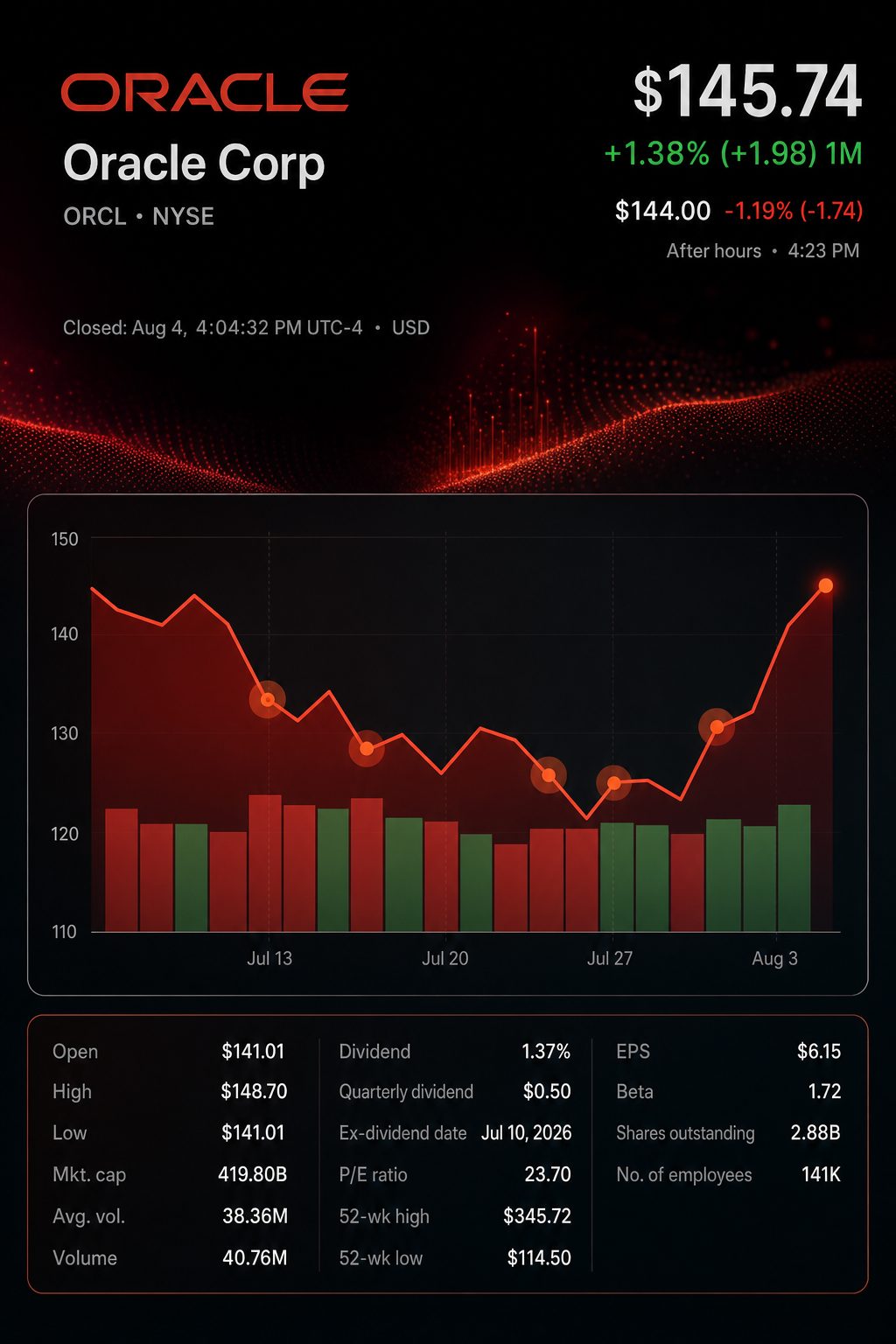
On Monday, shares surged 9.2% to reach $141.85. Oracle shares have rebounded roughly 12.5% since the close on Friday.
The surge in Oracle’s shares stands in sharp contrast to its credit market performance. Its bonds have been offering yields between 7% and 8% recently, and the cost of credit-default swaps is at its highest level in 18 years. The divergence implies that equity and debt investors have differing views on Oracle’s ability to execute its AI plans.
A wide rally in technology shares occurred on Tuesday. The Nasdaq rose 2.69%, and the S&P 500 added 1.90%. Oracle posted outperformance, though the margin was slight.
| Company | Latest price | Tuesday move | Market value |
|---|---|---|---|
| Oracle | $146.15 | up 3.0% | $425.6 billion |
| Microsoft NASDAQ:MSFT | $497.02 | up 1.9% | $3.70 trillion |
| Alphabet NASDAQ:GOOGL | $380.08 | up 1.8% | $4.65 trillion |
| Meta Platforms NASDAQ:META | $592.35 | up 0.4% | $1.52 trillion |
| Amazon.com NASDAQ:AMZN | $278.41 | down 2.0% | $3.04 trillion |
Prices and market values reflect the most recent data as of approximately 15:46–15:49 EDT and may not match final closing figures.
A better metric is to compare lease exposure against equity value. Oracle’s $260 billion lease commitments amount to roughly 61% of its present market capitalization—close to sevenfold Microsoft’s proportion.
| Company | Uncommenced leases reported | Market capitalisation | Leases as share of market value |
|---|---|---|---|
| Oracle | $260.0 billion | $425.6 billion | 61.1% |
| Meta Platforms | $347.0 billion | $1.52 trillion | 22.8% |
| Microsoft | $329.1 billion | $3.70 trillion | 8.9% |
| Amazon | $137.2 billion | $3.04 trillion | 4.5% |
| Alphabet | $85.2 billion | $4.65 trillion | 1.8% |
Meta’s total combines $278.99 billion previously reported and an additional $68 billion in agreements made in July. Amazon’s number encompasses items including warehouses, offices, aircraft and vehicles, which makes direct comparison difficult.
Oracle’s $260 billion in obligations are not immediately added to its debt, as these undiscounted payments are scheduled over a lengthy period. However, since they typically extend over 15 to 19 years, they continue to limit Oracle’s ability to maneuver financially.
Oracle’s use of leverage sets it apart from rival hyperscalers. Its reported debt stands at $129.5 billion, approximately 4.3 times EBITDA. By comparison, Alphabet, Amazon, Microsoft and Meta all have debt levels under one times EBITDA.
| Credit indicator | Oracle | Relevant peer benchmark |
|---|---|---|
| Debt-to-EBITDA | Roughly 4.3 times | Less than 1 time |
| Debt plus recognised leases-to-EBITDA | Approximately 5.7 times | Comparable figure not reported |
| Five-year credit-default swaps | 215 basis points | Near 80 basis points |
| Bond yields | 7%–8% | Alphabet and Amazon: 2.5%–3.5% |
| S&P credit rating | BBB- | One tier above junk status |
Leverage figures depend on the methodology used. The 5.7-times ratio accounts for recognised operating and finance leases.
S&P Global Ratings, a division of S&P Global NYSE:SPGI, lowered Oracle’s rating to BBB- in July. Analyst Andrew Chang outlined the threshold: “We could downgrade Oracle if Oracle sustains leverage exceeding 4.5 times.” Reuters
Growth prospects are still strong. Revenue for fiscal 2026 climbed 17% to $67.4 billion. Cloud infrastructure revenue surged 77%, and remaining performance obligations totaled $638 billion.
Cash conversion remains under pressure. Operating cash flow stood at $32 billion, while free cash flow showed a negative $23.7 billion. Oracle projects capital expenditure for fiscal 2027 as high as $95 billion.
| Operating and funding measure | Amount | Relative to FY2026 revenue |
|---|---|---|
| FY2026 revenue | $67.4 billion | 1.0 times |
| Operating cash flow | $32.0 billion | 0.47 times |
| Free cash flow | -$23.7 billion | -0.35 times |
| Remaining performance obligations | $638 billion | 9.5 times |
| Uncommenced leases | $260 billion | 3.9 times |
| FY2027 capital-spending limit | $95 billion | 1.4 times |
| Possible customer repayments | Up to $25 billion | 0.37 times |
RPO, lease agreements and annual revenues each correspond to distinct timeframes. The main figures for these metrics cannot be directly compared.
Oracle’s position is partly insulated. Customers have already paid for or brought in approximately $75 billion worth of hardware. This lessens how much Oracle needs to invest upfront in GPUs.
The key focus for investors has shifted to conversion rather than demand. Oracle’s remaining performance obligations are about 2.5 times higher than its unstarted leases. Almost 50% of this backlog is linked to OpenAI, while certain customer agreements could be for shorter durations compared to Oracle’s leases.
Oracle’s stock has climbed approximately 21.8% from its July 28 closing price of $119.96. While the rebound is significant, it has not addressed the underlying funding gap.
Oracle does not have any investor-relations events scheduled for the upcoming week, according to its calendar. The next indicators may come from rating updates, bond spread movements or announcements on data centre financing.
Risks: Funding expenses could rise if there are postponed data-centre launches, diminished demand for AI, or customers choose not to renew or downgrade. However, quicker cloud deployment, equipment financed by customers, and improved cash flow conversion may help alleviate such pressures.
Related articles: NYSE:ORCL