
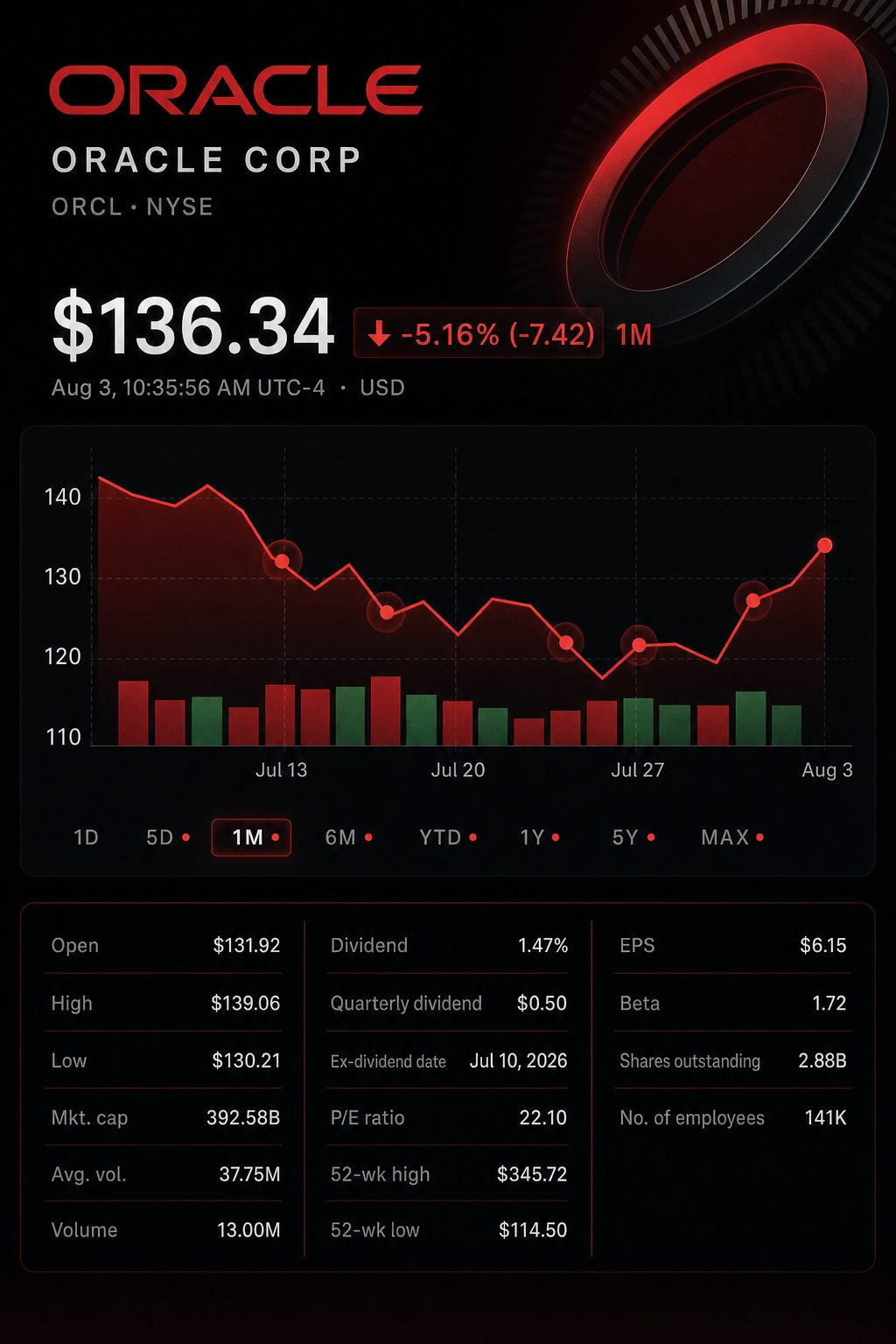
New York, August 3, 2026, 10:20 EDT – Oracle stock climbed 5.6% as the technology giant faces a test to convert its $638 billion backlog into actual cash flow.
- Oracle NYSE:ORCL gained 5.6% to trade at $137.15 as of 10:05 a.m. EDT, standing 16.5% higher than its closing price on July 29.
- Customer cash prepayments covered 8.2% of gross capex in fiscal 2026; when combined with other short-term financing, the offset rises to 14.3%.
- Oracle’s remaining performance obligations stand at $638 billion, which is 9.5 times anticipated fiscal 2026 revenue and 1.6 times the company’s market capitalization, while free cash flow came in at a negative $23.7 billion.
Shares of Oracle Corporation NYSE:ORCL climbed 5.6% to $137.15 during Monday morning trading in New York. The company’s market capitalization hit roughly $399 billion. Oracle participated in a surge among major technology firms driven by AI, as Amazon.com Inc NASDAQ:AMZN reached a $3 trillion market value for the first time.
| Security | Price | Day move | Trailing P/E |
|---|---|---|---|
| Oracle Corporation NYSE:ORCL | $137.15 | up 5.6% | 24.6x |
| Microsoft Corp NASDAQ:MSFT | $489.78 | up 5.4% | 29.1x |
| Amazon.com Inc NASDAQ:AMZN | $284.15 | up 4.6% | 22.9x |
| Alphabet Inc NASDAQ:GOOGL | $372.23 | gained 4.5% | 18.7x |
| SPDR S&P 500 ETF Trust NYSEARCA:SPY | $753.35 | advanced 0.8% | — |
| iShares Expanded Tech-Software Sector ETF (NYSEARCA:IGV) | $97.35 | rose 2.9% | — |
Prices for peers are based on trades as of approximately 10:05 a.m. EDT.
Oracle climbed 16.5% from its July 29 closing price after rising during the following three sessions. Shares, however, remained roughly 60.3% under the 52-week peak of $345.72 reached on September 10, 2025.
| Date | Close or live price | Session move |
|---|---|---|
| July 29 | $117.74 | — |
| July 30 | $127.56 | up 8.3% |
| July 31 | $129.87 | up 1.8% |
| August 3, 10:05 a.m. EDT | $137.15 | up 5.6% |
Oracle and Google Cloud announced on Thursday that Gemini 3.1 Flash Lite and Gemini 3.5 Flash will be available within Oracle AI Agent Studio for Fusion Applications, with the intent to integrate them into Fusion and NetSuite. Chris Leone, executive vice president for applications development at Oracle, stated that customers require “flexibility to choose the AI model best suited to each problem.” Kevin Ichhpurani, president of Google Cloud’s global partner ecosystem, said the companies’ goal is to place AI “directly where business decisions happen.” Oracle
The more challenging concern for investors is cash. In June, Oracle stated that $75 billion of the hardware component in substantial AI deals had either been advanced or provided by customers. The company also anticipates approximately $40 billion in debt and equity financing in fiscal 2027. The $75 billion reflects contracts and consists of equipment delivered as in-kind contributions. This figure does not represent cash collected in a single fiscal year.
Oracle’s cash-flow report for fiscal 2026 showed customer prepayments with a financing element totaling $4.592 billion. Additional short-term financing connected to capex lowered the required cash by $3.345 billion. Out of $55.663 billion in gross capex, these amounts decreased net cash spending to $47.726 billion.
| Backlog and cash metric | Amount | Scale at Monday’s price |
|---|---|---|
| Outstanding performance obligations | $638.0 billion | 9.5 times FY26 revenue; equals 1.6 times market value |
| Prepaid or customer-contributed AI hardware fund | $75.0 billion | 11.8% of outstanding performance obligations |
| Gross capital expenditure for FY26 | $55.663 billion | Represents 82.6% of FY26 revenue |
| Customer cash prepayments for FY26 | $4.592 billion | 8.2% of gross capital spending |
| Other short-term capital spending financing | $3.345 billion | 6.0% of total gross capital allocation |
| Net cash capital expenditure for FY26 | $47.726 billion | 85.7% of gross capital spending |
| Free cash flow for FY26 | -$23.686 billion | -5.9% of market valuation |
| Projected FY27 funding from debt and equity | About $40 billion | 10.0% of total market valuation |
Combined, the two financing facilities cover 14.3% of gross capex for fiscal 2026, rather than $75 billion. This gap does not invalidate Oracle’s contract funding model. Instead, it demonstrates that the contract value and the cash impact within the fiscal year are separate figures. The latter figure more directly affects debt and share sales.
Oracle said 12% of its RPO is set to be recorded as revenue within the next 12 months, with an additional 34% to be booked over the following two years. The company projected that fiscal 2027 capital expenditure could total $95 billion. Out of this, Oracle would contribute $70 billion, with customers anticipated to reimburse $20 billion to $25 billion. Chief Financial Officer Hilary Maxson did not specify a timeline for these repayments. Jacob Bourne, an analyst at eMarketer, said: “The funding question is getting harder, not easier, with capex coming in well above estimates.” Reuters
Oracle’s morning quote showed shares trading at 24.6 times trailing earnings. This valuation was lower than Microsoft’s 29.1, yet higher than Amazon’s 22.9 and Alphabet’s 18.7. The figure signaled a premium compared to its two bigger cloud competitors, even as Oracle reported negative free cash flow.
Credit markets assign a cost to that risk. A Reuters analysis dated July 29 showed that four hyperscalers, among them Oracle, collectively issued around $194 billion in bonds by July 7, marking a 79% increase over all of 2025. Out of 91 similar bonds, 78 saw increased yields as of July 28, with a median increase of 22 basis points. “We’re already seeing fatigue within credit markets in supporting this massive debt issuance,” said Colby Stilson, head of fixed income at Brown Advisory. Reuters
Risks: The timing of RPO conversion could be delayed, and clients may pay after Oracle settles with suppliers. Capital expenditures might surpass $95 billion, and the $20 billion at-the-market share buyback program may limit per-share increases. Oracle did not provide a revenue forecast for the Gemini project.
Related articles: NYSE:ORCL