
NEW YORK, August 8, 2026, 11:04 EDT — Doximity’s stock surged, increasing its market capitalization by $1.2 billion, despite the company providing guidance for lower EBITDA.
U.S. markets did not open Saturday following a sharp 32.5% rally in Doximity shares to $27.40 on Friday. The stock finished the week up 31.0%. Trading volume on Friday totaled 65.3 million shares.
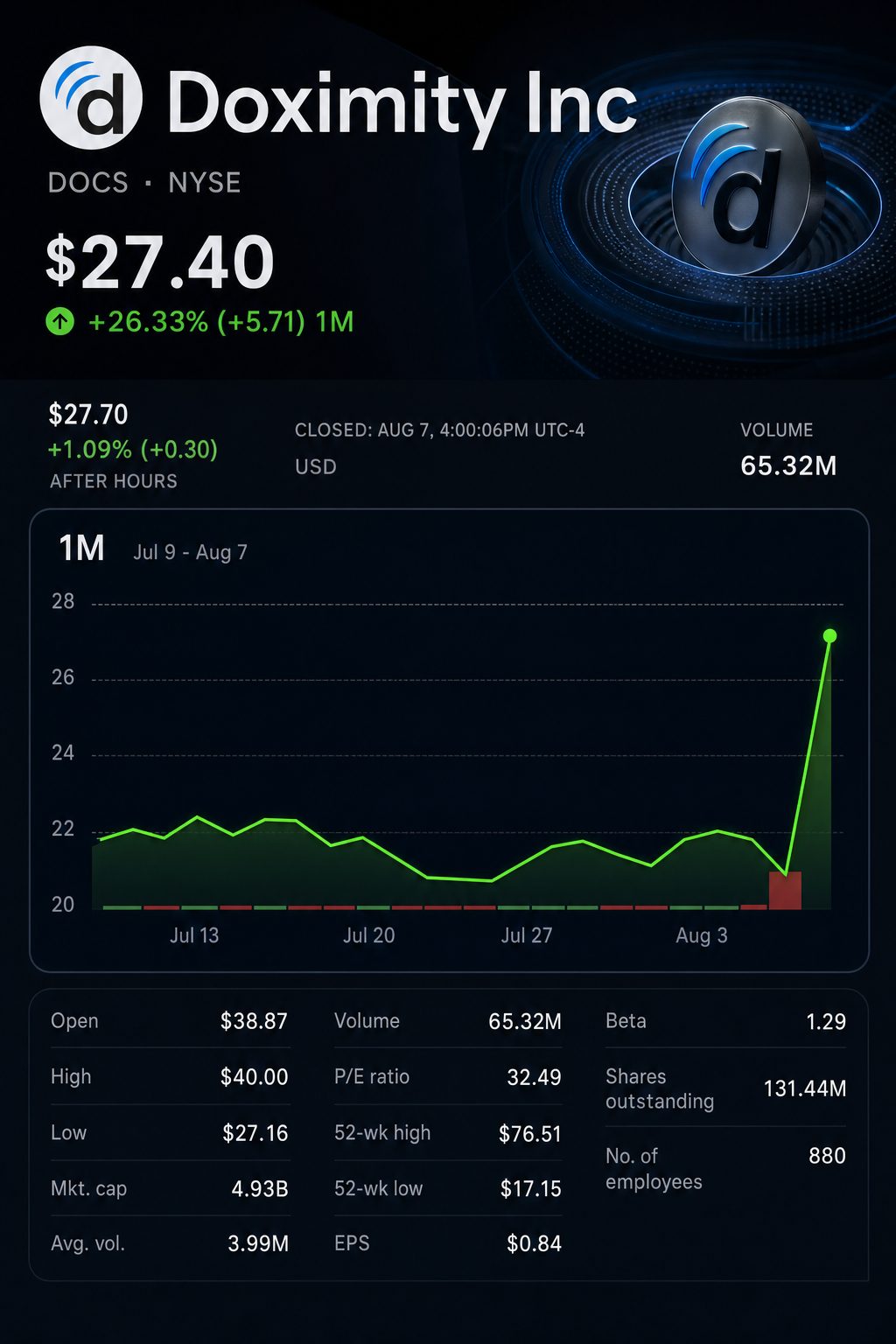
The surge increased preliminary basic equity value by approximately $1.20 billion. Despite this, Doximity lifted the midpoint of its fiscal 2027 revenue guidance by just $6 million, while its adjusted EBITDA midpoint declined by $10 million.
The initial bridge is based on 178.25 million Class A and B shares outstanding as of July 30. Share buybacks, share conversions or further equity issues after this date may impact the final calculation.
| Preliminary valuation bridge | Before results | Friday close | Change |
|---|---|---|---|
| Share price | $20.68 | $27.40 | +32.5% |
| Basic equity value | $3.69 billion | $4.88 billion | +$1.20 billion |
| Fiscal 2027 revenue midpoint | $670 million | $676 million | +$6 million |
| Basic equity value/revenue | 5.5 times | 7.2 times | +1.7 turns |
The gap serves as the main signal for investors. For every extra dollar of increased revenue guidance, close to $200 in equity value was added. This is meant as an example, not a causal relationship. The figures indicate that investors factored in AI-related earnings potential beyond the current year’s forecast.
The quarter delivered mixed results. Revenue surpassed consensus estimates by 3.2%, yet non-GAAP earnings fell short by a cent. Cash flow also declined.
| Fiscal first-quarter metric | Reported | Comparator | Difference |
|---|---|---|---|
| Revenue | $156.6 million | $151.7 million consensus | +3.2% |
| Non-GAAP diluted EPS | $0.29 | $0.30 consensus | -$0.01 |
| Adjusted EBITDA | $74.8 million | $79.8 million year earlier | -6% |
| Adjusted EBITDA margin | 47.7% | 54.7% year earlier | -7.0 points |
| GAAP gross margin | 84.9% | 89.2% year earlier | -4.3 points |
| Free cash flow | $39.6 million | $60.1 million year earlier | -34% |
The impact of AI investment can be seen in higher costs. Research expenses rose 44%, and share-based compensation jumped 68%. Doximity reported an uptick in hosting and software costs, citing AI-related projects.
The company increased its sales guidance while lowering its profit forecast. The midpoint for the adjusted EBITDA margin declined by 1.9 percentage points.
| Fiscal 2027 outlook | Previous range | Updated range | Midpoint change |
|---|---|---|---|
| Revenue | $664 million–$676 million | $671 million–$681 million | +$6 million |
| Adjusted EBITDA | $323 million–$335 million | $309 million–$329 million | -$10 million |
| Adjusted EBITDA margin at midpoint | 49.1% | 47.2% | -1.9 points |
Chief Executive Jeff Tangney stated that Doximity Ask ranked as “the top-performing U.S.-based model in the NOHARM benchmark.” Tangney also noted that AI Search’s revenue per query was more than ten times its current running cost, emphasizing this as a unit-economics figure, not an operating-margin figure. Doximity
Usage trends reinforce the pitch, though retention remains a drag. Quarterly active workflow providers climbed roughly 32% year-on-year. AI Search queries jumped over 25% quarter-over-quarter. The number of customers generating at least $500,000 annually rose to 127 from 119. Net revenue retention dropped to 107% from 118%.
The independent benchmark calls for careful interpretation. Doximity Ask showed a severe-error rate of 4.8%, coming in behind AMBOSS LiSA, which posted 2.9%. According to the July 13 preprint, there were no statistically significant differences seen among the four clinical retrieval-augmented systems.
Friday’s increase far exceeded that of other health-technology peers. Doximity’s rise was nearly 20 percentage points ahead of the second-biggest gainer.
| Selected company | Friday close | One-day move |
|---|---|---|
| Doximity NYSE:DOCS | $27.40 | up 32.5% |
| Tempus AI NASDAQ:TEM | $52.05 | up 12.9% |
| Phreesia NYSE:PHR | $12.51 | up 9.5% |
| Teladoc Health NYSE:TDOC | $7.13 | up 6.7% |
| Veeva Systems NYSE:VEEV | $230.47 | up 5.8% |
Sell-side opinions as of August 7 showed a clear split. Some analysts raised their targets, but negative recommendations persisted.
| Analyst | Firm | Recommendation | Price-target action |
|---|---|---|---|
| Jessica Tassan | Piper Sandler NYSE:PIPR | Buy, rating affirmed | $42 raised to $47 |
| Brian Peterson | Raymond James NYSE:RJF | Buy, rating maintained | $23 raised to $38 |
| Craig Hettenbach | Morgan Stanley NYSE:MS | Buy, rating maintained | $35, no change |
| Elizabeth Anderson | Evercore ISI NYSE:EVR | Hold, rating maintained | $22 raised to $40 |
| Allen Lutz | Bank of America Securities NYSE:BAC | Sell, rating reaffirmed | $20 |
| Glen Santangelo | Barclays NYSE:BCS | Hold, rating maintained | $20 |
The wider survey of 21 analysts shows eight Buy recommendations, 12 Holds, and one Sell. The consensus price target stands at $28.88, representing just a 5.4% premium to Friday’s closing price. Analysts’ targets span from $18 up to $47.
Trading in the cash market resumes on Monday, August 10. Doximity’s calendar shows its next scheduled event is the annual meeting on August 27. Investors are monitoring for additional changes to models and if Friday’s high turnover leads to sustained activity. U.S. retail sales data for July will be released on Friday at 8:30 a.m. EDT.
Risks: AI sales are still in the early stages, but associated expenses have become significant. Gross margin decreased, free cash flow dropped, and there was a slowdown in net revenue retention. The NOHARM study did not find statistically significant differences among the main clinical AI firms. Trading at 7.2 times the revised revenue midpoint, any execution shortfall could undo much of Friday’s repricing.