
NEW YORK, August 7, 2026, 05:11 EDT — U.S. premarket trading Google
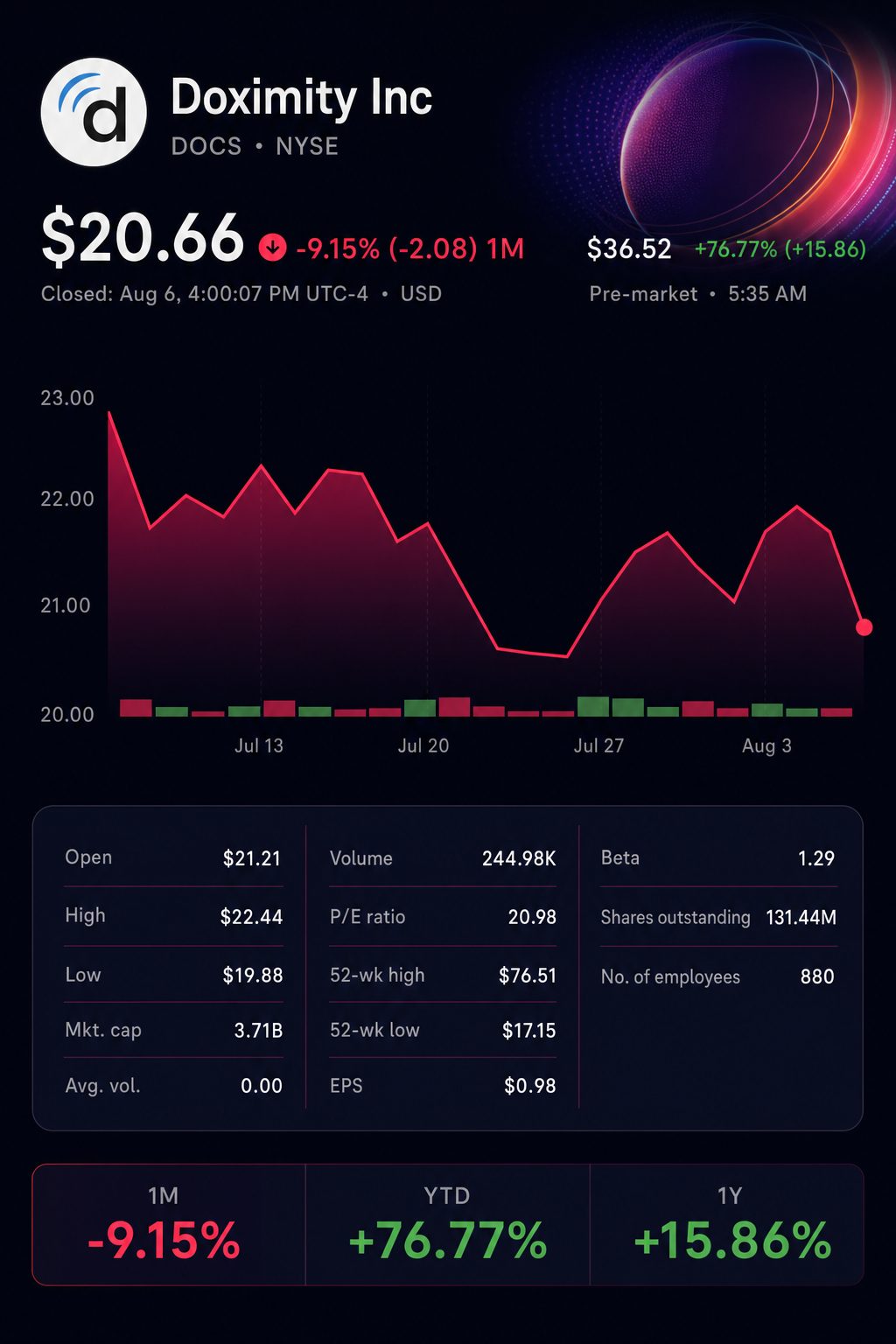
- Shares were set at $35.10, a rise of 69.9% from the $20.66 close on Thursday.
- Doximity increased its fiscal-year revenue midpoint by $6 million and lowered the midpoint for adjusted EBITDA by $10 million.
- In premarket trading, the price was 42% higher than the average analyst target of $24.65.
Doximity stock jumped 69.9% in premarket trading on Friday, pointing to an increase of roughly $2.6 billion in equity value. The surge came after the company raised its annual revenue outlook by $6 million, though the midpoint for annual EBITDA was lowered by $10 million.
The gap stands out. Based on estimates, traders assigned about $430 in equity value for every additional dollar of revenue guidance. This reflects a valuation of an AI growth opportunity, rather than just a single-quarter outperformance.
The option has seen limited uptake so far. Doximity reported zero AI Search revenue for the quarter. Leadership anticipates the majority of contracted revenue will be reflected in fiscal Q3.
The quarter delivered mixed results.
| Q1 fiscal 2027 metric | Result | Comparison | Investor read-through |
|---|---|---|---|
| Revenue | $156.6 million | $151.7 million estimate; $145.9 million prior year | Beats by 3.2%; up 7% |
| Adjusted EPS | $0.29 | $0.30 estimate; $0.36 prior year | Slightly below; down from a year ago |
| Adjusted EBITDA | $74.8 million | $69.5 million guide ceiling; $79.8 million prior year | Exceeds guidance by 7.6%; 6% lower |
| Adjusted EBITDA margin | 47.7% | 54.7% prior year | Decreases 7 percentage points |
| Free cash flow | $39.6 million | $60.1 million prior year | Falls 34% |
Street numbers are projections. Figures are rounded to the nearest percent.
CEO Jeff Tangney stated, “We’re proud that our clinical AI assistant, Doximity Ask, was the top-performing U.S.-based model.” Workflow active prescribers increased by more than 30%, while AI Search queries saw a sequential rise of over 25%. Business Wire
The guidance was mixed. Revenue increased, but projected profit declined.
| Fiscal 2027 outlook | May guidance | August guidance | Midpoint change |
|---|---|---|---|
| Revenue | $664 million-$676 million | $671 million-$681 million | Increase of $6 million, or 0.9% |
| Adjusted EBITDA | $323 million-$335 million | $309 million-$329 million | Decrease of $10 million, or 3.0% |
| Implied EBITDA margin | 49.1% | 47.2% | Down 1.9 percentage points |
Implied margins are calculated from the midpoint within the guidance range provided by each company.
Increased expenditure on AI computing reduced the non-GAAP gross margin to 88% compared to 91%. Management anticipates this trend in investment will persist through fiscal 2027.
Major clients continue to form the core of the business model. The group of 127 customers each paying more than $500,000 represented 83% of total revenue. Net revenue retention for the top 20 stood at 112%, compared with 107% when measured across all customers.
AI Search has started to generate sales rather than just revenue. The initial group of customers includes over 24 programs. As a result, Q3 will be the main performance test for earnings recognition.
External evidence lends support, though it is not conclusive. NOHARM placed Doximity Ask in second position with a score of 84.51. AMBOSS LiSA achieved a score of 86.15. Statistical analysis showed no significant differences among the four clinical-AI specialist systems.
The surge also significantly reduced Doximity’s previous valuation gap.
| Company | Price basis | Market value | Trailing P/E |
|---|---|---|---|
| Doximity NYSE:DOCS, Thursday close | $20.66 | $3.71 billion | 21.0 |
| Doximity, premarket implied — preliminary | $35.10 | $6.30 billion | 35.6 |
| Veeva Systems NYSE:VEEV | $217.80 | $36.15 billion | 38.6 |
| Teladoc Health NYSE:TDOC | $6.68 | $1.21 billion | Not meaningful |
| Health Catalyst (NASDAQ:HCAT) | $2.31 | $171 million | Not meaningful |
Premarket numbers place Doximity’s final valuation at the shown level. Comparable companies operate with varying business models.
Doximity’s initial trailing multiple climbs to roughly 35.6 at $35.10, nearing Veeva’s pre-AI Search revenue multiple of 38.6. Teladoc and Health Catalyst continue to post losses.
The analyst landscape showed caution ahead of widespread post-earnings revisions.
| Analyst or snapshot | Recommendation | Price target | Date |
|---|---|---|---|
| 20-analyst, three-month distribution | 7 rate Buy, 12 suggest Hold, 1 rates Sell | Average target $24.65; low $18, high $42 | Current snapshot |
| Ryan Daniels, William Blair | Buy, reiterated | — | Aug. 6 |
| Craig Hettenbach, Morgan Stanley NYSE:MS | Buy, reiterated | $35 | Aug. 3 |
| Alexei Gogolev, JPMorgan Chase NYSE:JPM | Hold, reiterated | $26 | July 30 |
| Allen Lutz, Bank of America NYSE:BAC | Sell, reiterated | $20 | July 27 |
| Elizabeth Anderson, Evercore NYSE:EVR | Hold, reiterated | $22 | July 20 |
(See Google)
The premarket value was 42% higher than the average target of $24.65. It approached Morgan Stanley’s $35 target, yet stayed under the $42 peak. New adjustments to targets may swiftly change the spread.
The balance sheet provides flexibility for management. Cash and securities stood at $687.8 million, with zero debt. Doximity bought back $91.6 million in shares in the first quarter.
Risks: Premarket advances may unwind due to lower liquidity levels. Q2 revenue outlook is 0.8% below the Street’s midpoint. Free cash flow declined 34%, as stock-based compensation increased 68%. Additional investment in AI might weigh on margins.
The initial test arrives with Friday’s cash session. A more significant test is set for Q3, when AI Search contracts are expected to turn into recognized revenue.
Related articles: NYSE:DOCS