
TORONTO, August 9, 2026, 12:05 EDT — Canadian and U.S. stock markets have finished trading for the day.
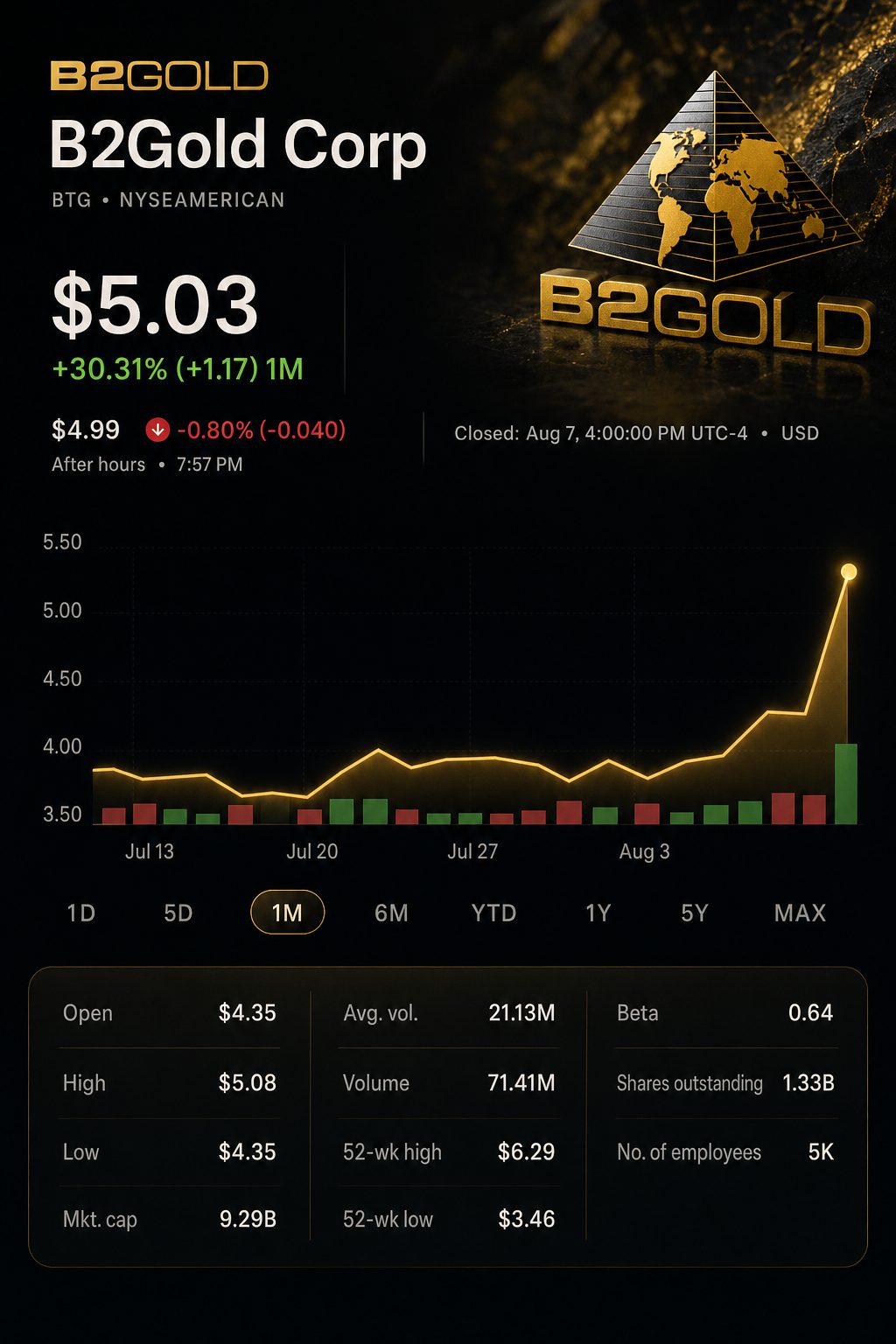
- B2Gold’s U.S.-listed shares ended Friday at $5.03, rising 23.0%. Over the week, the stock advanced 34.1%.
- The Menankoto permit was issued by Mali, authorizing pre-stripping activities at Fekola Regional. Annual production is expected to surpass 150,000 ounces from 2028.
- B2Gold lowered its 2026 production midpoint by 2.8%, while the midpoint for its all-in sustaining cost improved by 1.2%.
B2Gold’s market capitalisation rose by approximately $1.25 billion on Friday, based on the 94-cent increase multiplied by 1.33 billion shares in issue. The stock jump occurred even as the company reported softer core earnings and reduced its production outlook.
The granting of the permit shifted the valuation discussion. B2Gold controls 65% of Fekola Regional, with Mali retaining 35%. With output above 150,000 ounces, B2Gold’s attributable share is at least 97,500 ounces each year. Based on Friday’s gold price, this amounts to more than $423 million in gross metal value, prior to deductions for costs, royalties and taxes.
Gold delivered significant support, with spot bullion climbing 2.3% to $4,336.02 on Friday. The metal advanced over 7% for the week. B2Gold nevertheless surpassed its industry peers by a substantial degree.
| Friday, August 7 | U.S. close | Single-day change | Difference with B2Gold |
|---|---|---|---|
| B2Gold | $5.03 | +23.0% | — |
| Agnico Eagle Mines NYSE:AEM | $178.82 | +6.5% | -16.5 points |
| Kinross Gold NYSE:KGC | $27.64 | +7.9% | -15.1 points |
| Newmont NYSE:NEM | $112.98 | +7.2% | -15.8 points |
Prices and changes for Friday reflect U.S. market closing figures.
An initial sector-adjusted calculation applies the peers’ mean increase of 7.2%. B2Gold’s additional movement equates to approximately $860 million in equity value. This figure is nearly double the attributable gross metal value for one year at Friday’s gold price. This serves as a comparison, rather than a valuation of the project.
Performance in the second quarter was mixed. Production was in line with company forecasts, while adjusted earnings fell short of two consensus estimates tracked. Costs increased significantly compared to the same period last year.
| Second-quarter measure | 2026 | 2025 or consensus | Change |
|---|---|---|---|
| Gold production | 203,648 oz | 229,454 oz | -11.2% |
| Gold revenue | $789.4 million | $692.2 million | +14.0% |
| Adjusted EPS | $0.03 | $0.12 in 2025 | -75.0% |
| Adjusted EPS consensus | $0.03 actual | $0.07 FactSet; $0.09 LSEG preview | Below both |
| Cash cost per ounce produced | $1,201 | $745 | +61.2% |
| AISC per ounce sold | $2,356 | $1,519 | +55.1% |
| Free cash flow | -$257.5 million | +$12.0 million | Decline of $269.5 million |
B2Gold reported its production, financial results and non-IFRS cost metrics, according to the company’s release. Consensus numbers may vary depending on the provider.
The headline profit provided a mixed picture. The attributable result of $417 million was lifted by a $292 million gain from the sale of a mining interest and $135 million in unrealized derivative gains. Adjusted income came to $41 million. Realized losses on gold collars totaled $71 million, with the final settlement scheduled for January 2027.
Management trimmed its 2026 volume outlook. Higher output at Masbate and Otjikoto helped counter some of the expected decreases at Fekola and Goose. The midpoint for costs improved even as production estimates declined.
| 2026 company guidance | Previous range | Updated range | Midpoint change |
|---|---|---|---|
| Total production | 820,000–970,000 oz | 820,000–920,000 oz | -25,000 oz; -2.8% |
| Fekola Complex | 410,000–460,000 oz | 390,000–420,000 oz | -30,000 oz; -6.9% |
| Goose | 170,000–230,000 oz | 170,000–200,000 oz | -15,000 oz; -7.5% |
| Masbate | 170,000–190,000 oz | 180,000–200,000 oz | +10,000 oz; +5.6% |
| Otjikoto | 70,000–90,000 oz | 80,000–100,000 oz | +10,000 oz; +12.5% |
| Consolidated AISC | $2,400–$2,580/oz | $2,370–$2,550/oz | -$30/oz; -1.2% |
Midpoint adjustments are based on B2Gold’s earlier and revised ranges.
The permit was granted a day following the guidance reduction. It authorizes pre-stripping activities and finalizes a regional tolling agreement. Bank of Montreal (TSE:BMO) analyst Brian Quast said the approval is not expected to significantly impact 2026 output. The regional increase is scheduled to continue until the end of 2027.
Chief Executive Mike Cinnamond stated that the permit “secures the future of the operation well into the late 2030s.” He anticipates “significant free cash flow” in the second half and continuing into 2027. B2Gold
The forecast still depends on effective delivery. At the end of June, B2Gold reported $287 million in cash and access to an undrawn $800 million credit line. The company subsequently used $95 million of that facility, primarily to acquire annual fuel for Goose.
Analysts are still mostly optimistic, but many of their targets were set before Friday’s repricing triggered by permits.
| Current analyst recommendation | Number | Share of 14 analysts |
|---|---|---|
| Buy | 7 | 50.0% |
| Overweight | 1 | 7.1% |
| Hold | 5 | 35.7% |
| Underweight | 1 | 7.1% |
| Sell | 0 | 0.0% |
| Consensus | Overweight | — |
The mean price target stands at $6.19, suggesting a 23.1% increase from Friday’s closing price. The median forecast is $6.81, with projections spanning between $4.10 and $7.25.
Two major drivers are expected in the coming week. U.S. consumer inflation data arrives on Wednesday at 8:30 a.m. EDT, followed by producer price figures at the same hour Thursday. Friday’s soft payrolls report boosted gold as prospects for another imminent rate hike eased.
Focus for the company is now on Menankoto pre-stripping and reaching agreement on tolling conditions. Goose crusher repairs are also a key hurdle. B2Gold anticipates completing those repairs in the third quarter.
Risks persist. Mali’s 2023 mining code grants the state a 35% regional stake. Political follow-through and tolling arrangements continue to be significant factors. Goose remediation, higher AISC, gold collars, and bullion price swings may also weigh on cash flow.
Friday’s rally refreshed the stock but left the operational challenge intact. The key test ahead is generating lasting free cash flow from permitted ounces, avoiding further delays.
Related articles: NYSE:BTG