SLINGERLANDS, New York, August 12, 2026, 04:07 EDT — Shares of Plug Power NASDAQ:PLUG finished Tuesday up 5.21% at $2.22, but the stock gave up roughly 74% of its intraday surge following earnings.
The turnaround is significant ahead of Wednesday’s U.S. premarket. Investors responded positively to nearly break-even gross margin and an improved outlook. However, they also faced a 56% decrease in unrestricted cash during the first half and ongoing dilution of shares.
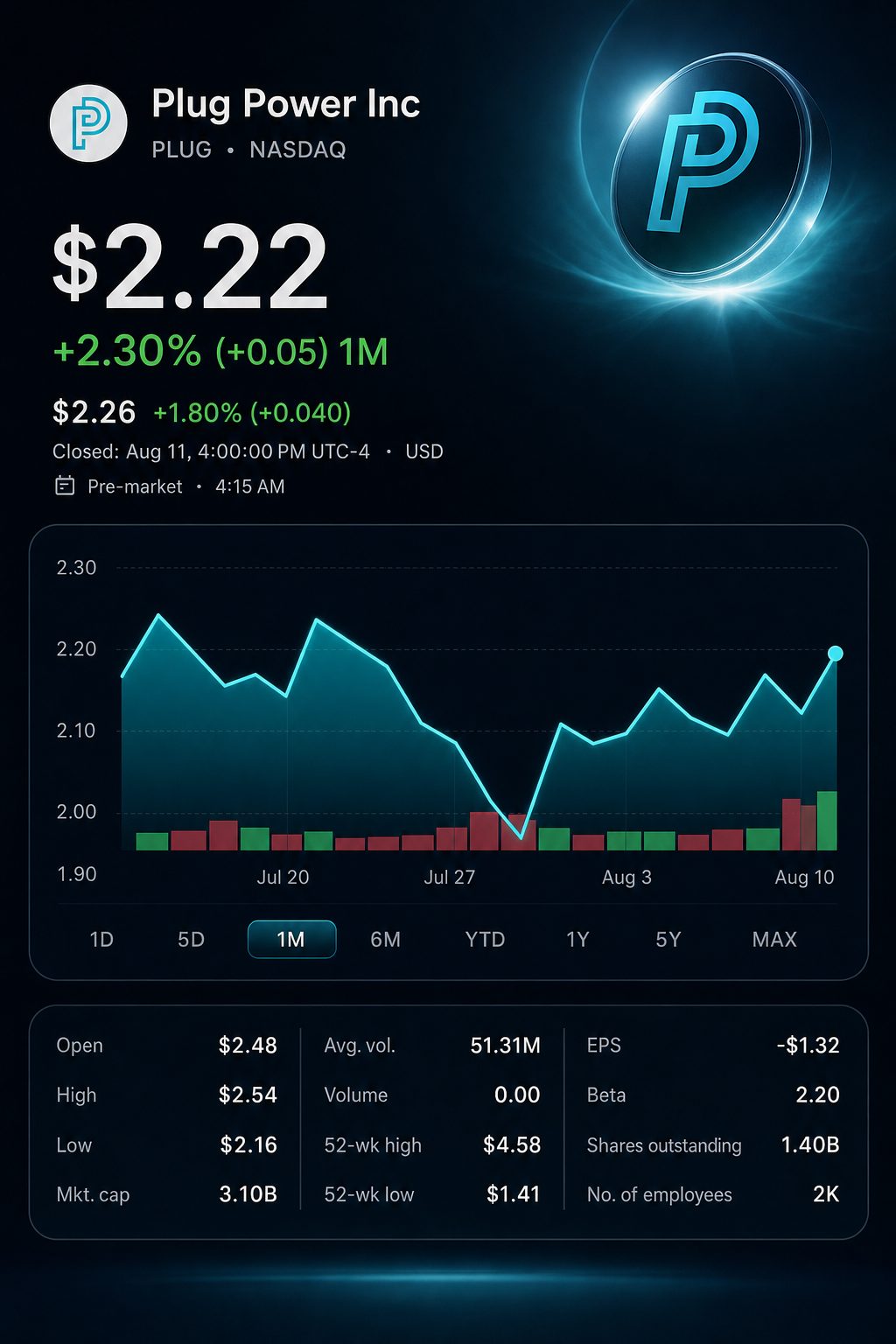
Plug started the session at $2.48, hitting a high of $2.54 following Monday’s earnings. Shares ended the day at $2.22. Compared to Monday’s closing price of $2.11, the stock kept just $0.11 of its $0.43 intraday rise.
| August 11 session | PLUG | Change vs last close |
|---|---|---|
| Last close | $2.11 | — |
| Opening price | $2.48 | +17.5% |
| Session high | $2.54 | +20.4% |
| End of session | $2.22 | +5.21% |
| High-to-close move kept | $0.11 out of $0.43 | 25.6% |
Trading volume was notably high, with approximately 146.6 million shares changing hands—around 2.7 times the 50-day average. Plug posted stronger gains than Ballard Power Systems NASDAQ:BLDP, which rose 1.96%, as the Nasdaq Composite slipped 0.60%.
The stock rose 2.8% between August 4 and Tuesday. However, it remains 51.5% under its October 2025 peak of $4.58. The gain after earnings has yet to offset the broader drop.
Revenue for the second quarter increased by 2.5% to $178.3 million. The gross margin improved to negative 0.9%, compared with negative 30.7% previously. Operating expenses were down 49.4%.
| Second-quarter measure | 2026 | 2025 | Change |
|---|---|---|---|
| Revenue | $178.3 million | $174.0 million | +2.5% |
| Gross margin | -0.9% | -30.7% | Increase of 29.8 points |
| Operating expenses | $62.4 million | $123.5 million | Down 49.4% |
| Operating loss | $64.1 million | $176.9 million | Down 63.8% |
| Adjusted loss per share | $0.07 | $0.18 | $0.11 better |
Chief Executive Jose Luis Crespo stated, “We believe we are on track to achieve our positive EBITDAS target in the fourth quarter of 2026.” EBITDAS is calculated before interest, tax, depreciation, amortization and share-based expense. Plug’s SEC-filed earnings release
Management lifted its 2026 revenue growth forecast to 15%–16%, up from a previous estimate of 13%–15%. Based on 2025 revenue, the updated guidance points to roughly $816 million to $824 million.
| Balance-sheet and outlook test | Latest measure | Comparison |
|---|---|---|
| Unrestricted cash | $161.9 million as of June 30 | $368.5 million as of December 31 |
| Quarterly net cash usage | Roughly $61 million | Decreased 58% from the previous quarter |
| Asset-monetization target | Above $275 million | $52 million realized so far |
| 2026 revenue growth | 15%–16% | Increased from 13%–15% |
| Q4 target | Positive EBITDAS | Set by management |
The increased share count offsets part of the gain. Weighted-average shares increased by 23.5% to 1.391 billion. Based on an initial estimate, revenue per weighted-average share for the quarter declined around 17%, dropping to $0.128 from $0.154.
Wall Street is still split. Recent actions show targets spanning from $1.20 to $5.00, illustrating significant differences in views on liquidity and margin performance.
| Analyst | Date | Recommendation | Target | Versus $2.22 close |
|---|---|---|---|---|
| TD Cowen | July 23 | Hold | $3.00 | +35.1% |
| Susquehanna | July 10 | Neutral | $2.50 | +12.6% |
| Morgan Stanley | July 9 | Underweight | $1.65 | -25.7% |
| B. Riley | May 12 | Buy | $5.00 | +125.2% |
| BMO Capital | May 12 | Underperform | $1.20 | -45.9% |
B. Riley reiterated its Buy rating following the first quarter, highlighting ongoing revenue growth. In July, Morgan Stanley stayed with its Underweight stance. The latest consensus figures continue to list Plug as a Hold.
Two key external data points arrive in the coming week. July CPI is set for release on Wednesday at 08:30 EDT, followed by producer price data on Thursday. These reports carry the potential to influence both borrowing-cost forecasts and investor risk sentiment.
Risks: Accelerated service expansion, reduced hydrogen expenses or higher asset-sale returns might boost cash flow more quickly. Deferred monetization, softer order intake or additional equity offerings could limit per-share improvements, even with higher margins.
Related articles: NASDAQ:PLUG