
Dublin, Ohio, August 12, 2026, 07:16 EDT
- Cardinal Health projects adjusted earnings per share for fiscal 2027 to range between $12.40 and $12.60.
- The midpoint stands 3.5% higher than the $12.08 analyst estimate referenced by The Wall Street Journal.
- At the midpoint of guidance, free cash flow may decrease by 25% following a $5.0 billion result in fiscal 2026.
Shares of Cardinal Health, Inc. NYSE:CAH climbed 3.6% to $245.64 in premarket trade on Wednesday. The gain brought the stock close to an all-time high after the company provided profit guidance ahead of analysts’ expectations. The share movement was seen before the New York market opened.
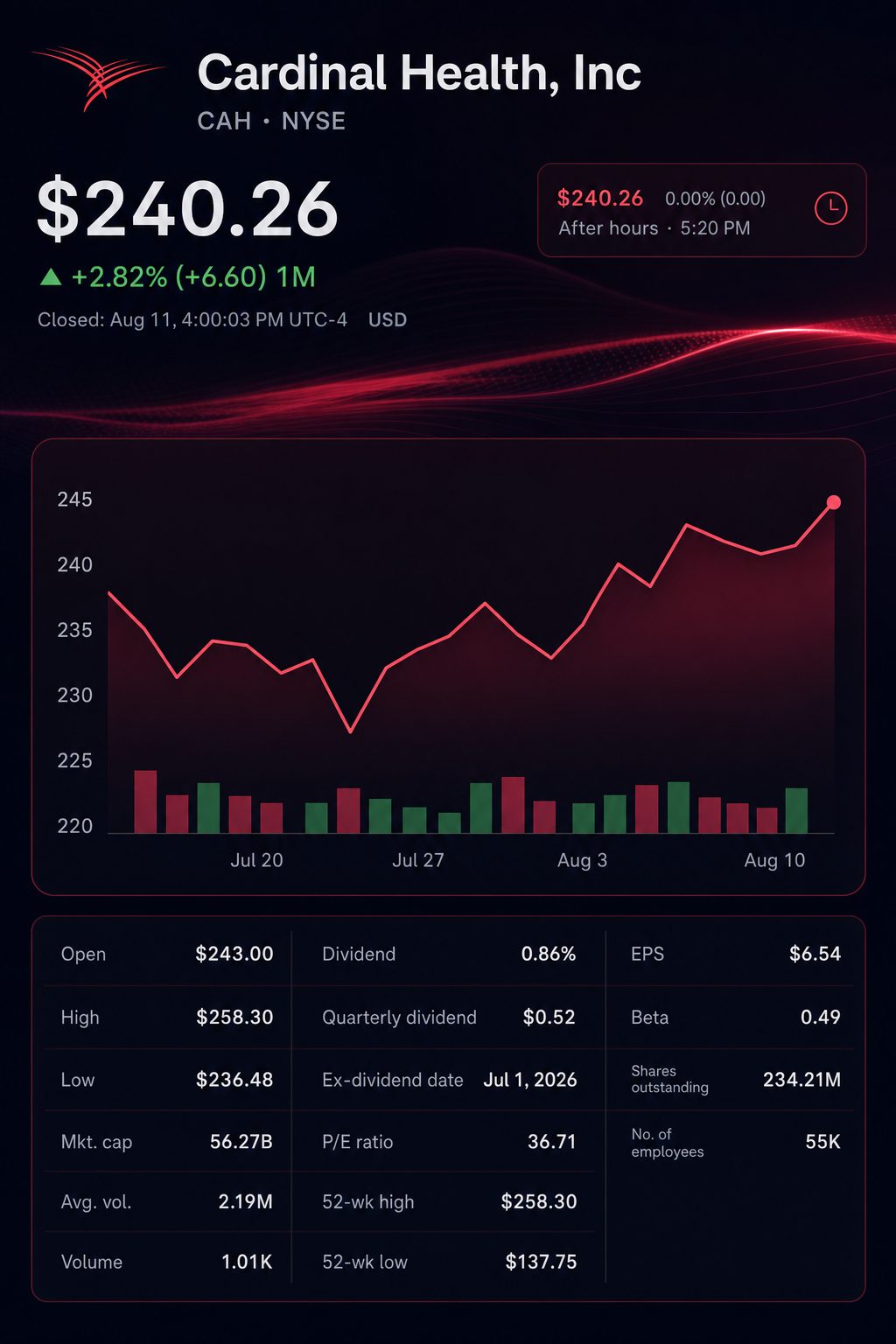
Guidance is of greater importance than the earnings beat in the headline. Cardinal projects adjusted earnings per share for fiscal 2027 between $12.40 and $12.60. The midpoint, $12.50, is 3.5% higher than the $12.08 consensus reported by The Wall Street Journal.
Cash generation presents a tougher picture. Adjusted free cash flow totaled $5.0 billion in fiscal 2026, but management currently anticipates between $3.5 billion and $4.0 billion—a 25% drop at the midpoint. Cash conversion therefore becomes the crucial metric for supporting the increased valuation.
| Fiscal Q4 metric | 2026 | 2025 | Change |
|---|---|---|---|
| Revenue | $63.67 billion | $60.16 billion | +6% |
| Gross margin | $2.56 billion | $2.20 billion | +16% |
| GAAP operating earnings | $729 million | $428 million | +70% |
| GAAP diluted EPS | $1.70 | $1.00 | +70% |
| Reported adjusted EPS | $2.91 | $2.08 | +40% |
Quarterly revenue came in below the $65.15 billion estimate reported by the Journal. Profit figures exceeded projections. Adjusted EPS was reported at $2.91, beating the $2.42 consensus from Barron’s. According to the company, a tariff refund contributed $0.31, resulting in normalized EPS of $2.60.
Margins improved even though revenue fell short of expectations. Gross margin climbed to 4.02% compared to 3.66% in the same period last year. GAAP operating margin advanced to 1.14% from 0.71%. These figures are based on the company’s reported results.
| Operating segment | Q4 revenue | Revenue change | Q4 segment profit | Profit change |
|---|---|---|---|---|
| Pharmaceutical and Specialty Solutions | $58.8 billion | up 6% | $645 million | up 21% |
| Global Medical Products and Distribution | $3.1 billion | down 2% | $150 million | Profit more than doubled |
| Other | $1.7 billion | up 7% | $183 million | up 14% |
Pharmaceutical distribution contributed the majority of revenue and was a key driver of expansion. Specialty drug demand boosted the segment’s profit by 21%. Reuters reported that this demand underpinned the forecast, which exceeded consensus expectations.
Medical products saw a marked improvement, though the comparison should be viewed cautiously. Tariff recoveries boosted fourth-quarter profit for the segment. As a result, the refund enhances both reported adjusted EPS and the segment’s performance.
Chief Executive Jason Hollar said, “Fiscal 2026 was a standout year for Cardinal Health and I am pleased with our strong fourth quarter results.” The company noted that each operating segment achieved double-digit profit growth prior to accounting for tariff recoveries. Cardinal Health results
| Fiscal 2027 measure | Guidance | Fiscal 2026 base | Midpoint change |
|---|---|---|---|
| Adjusted EPS | $12.40-$12.60 | $10.95 not including tariff refund | +14.2% |
| Adjusted free cash flow | $3.5-$4.0 billion | $5.0 billion | -25.0% |
| Capital spending | Roughly $700 million | No direct comparison | Not applicable |
| Share repurchases | Roughly $1.0 billion | $1.4 billion | -28.6% |
The EPS comparison is based on the refund-adjusted fiscal 2026 baseline of $10.95. Using this figure, the updated midpoint suggests growth of 14.2%. Relative to the reported adjusted EPS of $11.26, the growth rate would be approximately 11.0%. The variation is due to the one-off tariff benefit.
Capital returns are still significant. Cardinal bought back $1.4 billion in shares during fiscal 2026. The board approved an additional $5.0 billion for repurchases, bringing total authorization to $6.4 billion. The company expects to repurchase roughly $1.0 billion in shares this year.
| Analyst source | Analysts | Positive ratings | Hold ratings | Average target | Upside from $245.64 |
|---|---|---|---|---|---|
| MarketBeat | 18 | 15 buy | 3 | $251.73 | 2.5% |
| StockAnalysis | 17 | 12 strong buy, 2 buy | 3 | $252.40 | 2.8% |
The most recent public rating data predates the earnings announcement, and updates could follow. Analyst average price targets now imply under 3% potential upside from the initial premarket level, making it less likely for analysts to adjust ratings higher.
Competitors provide additional perspective. McKesson Corporation NYSE:MCK and Cencora, Inc. NYSE:COR likewise gain from specialty pharmaceuticals and intricate distribution operations. What sets Cardinal apart in the short term is its combination of more rapid profit expansion, a significant authorization, and projections for reduced cash flow.
Risks: Margins may rapidly fluctuate due to branded-drug pricing, contract renewals, generic price declines and tariffs. Delays in supply or legal actions could impact cash flow. With the stock trading near its all-time high, a misstep in execution offers limited margin for error.
The upcoming key issue is cash conversion. Specialty profit needs to accelerate sufficiently to support a 14.2% midpoint for EPS growth as adjusted free cash flow approaches $3.75 billion.