
NEW YORK, August 13, 2026, 13:22 EDT — US stock markets were trading.
- The Dow declined by 96 points and the S&P 500 rose 0.43%.
- The price weighting intensified Cisco’s decline and dampened gains from the chip rally.
- July producer prices remained flat, supporting expectations for the Federal Reserve to pause rate hikes in September.
The Dow Jones Industrial Average fell by 96 points on Thursday as the S&P 500 touched an intraday record high. The divergence was driven by index construction, not widespread risk-off sentiment.
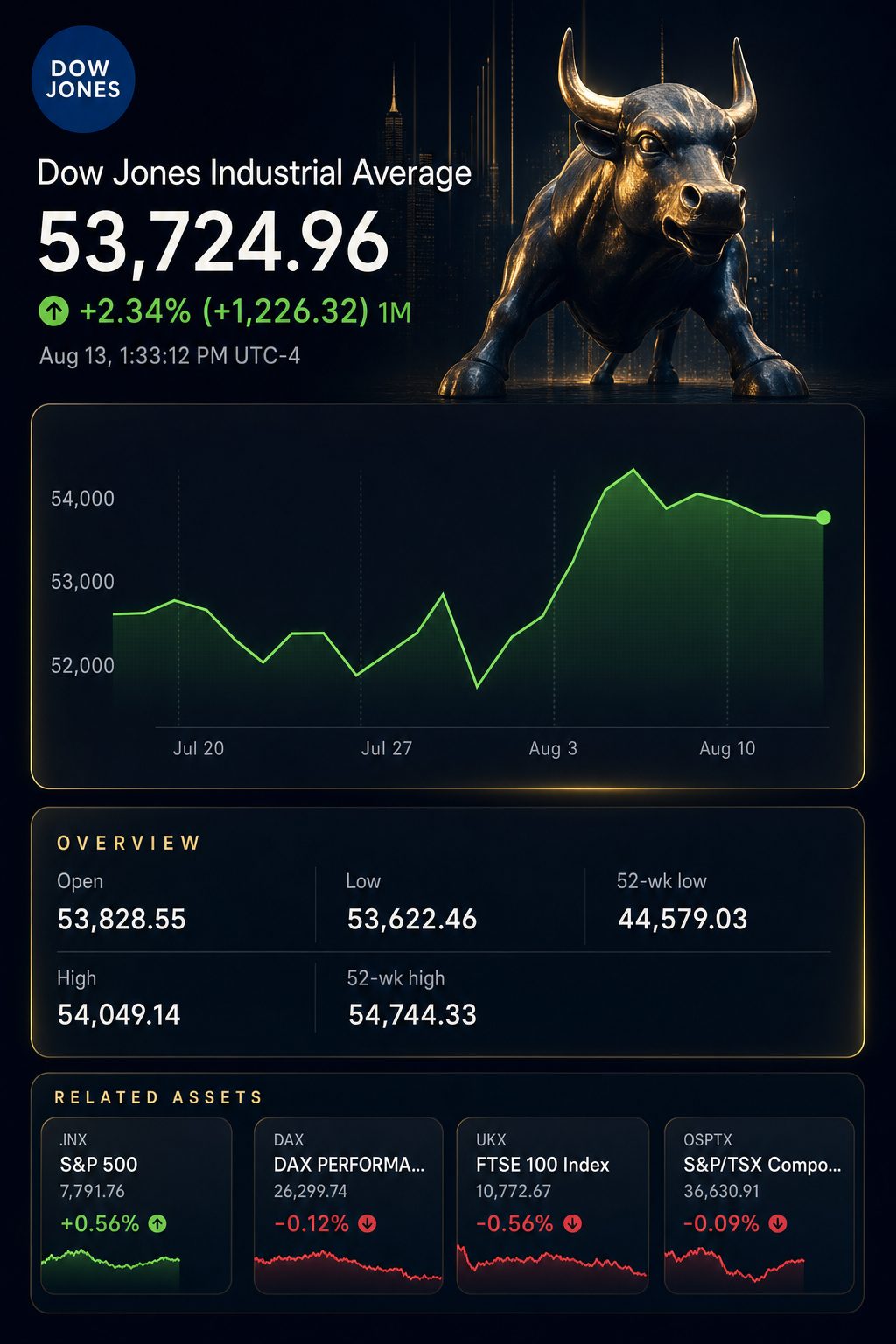
At 12:04 EDT, the Dow was behind the S&P 500 by 0.61 percentage point and was 0.76 point under the Nasdaq Composite. Cisco Systems NASDAQ:CSCO dropped 9%, weighing on the price-weighted index.
| US index | Level at 12:04 EDT | Move | Gap versus Dow |
|---|---|---|---|
| Dow Jones Industrial Average | 53,674.13 | -0.18% | — |
| S&P 500 | 7,781.59 | +0.43% | up 0.61 points |
| Nasdaq Composite | 26,741.66 | +0.58% | up 0.76 points |
The Dow consists of 30 stocks and is weighted by price, making a share’s dollar change have greater impact than its market capitalization. In contrast, the S&P 500 and Nasdaq assign more weight to larger companies.
On Thursday, every $1 shift in a Dow stock moved the index by approximately 5.94 points. Cisco’s drop of $10.77 cut about 64 points from the index. That accounted for two-thirds of the Dow’s 96-point midday fall, according to an initial estimate.
| Dow component signal | Share move | Approximate Dow effect | Index role |
|---|---|---|---|
| Cisco Systems NASDAQ:CSCO | -$10.77 | -64 points | Top decline driver |
| 3M NYSE:MMM | -$2.84 | -17 points | Second-biggest fall |
| Goldman Sachs NYSE:GS | +$17.03 earlier | +101 points earlier | Leading early lift |
| Microsoft NASDAQ:MSFT | +$6.82 earlier | +41 points earlier | No. 2 early boost |
The composition gap favored different results in chips. Sandisk NASDAQ:SNDK surged 15%, while Micron Technology NASDAQ:MU advanced 5.6%. Both stocks are absent from the Dow. The PHLX semiconductor index increased by 1.8%.
The tape showed strength, with advancing stocks leading decliners by a margin of 1.78 to one on the New York Stock Exchange. On the Nasdaq, the ratio stood at 1.41 to one. The S&P 500 recorded 28 new 52-week highs and a single low.
GuideStone managing director Josh Chastant said, “We’re starting to see broad-based earnings really pick up across sectors.” Chastant said value was now expanding from data-center suppliers to those building models. Reuters
| Market breadth | Advancers | Decliners | Ratio |
|---|---|---|---|
| NYSE | Not disclosed | Not disclosed | 1.78 to 1 |
| Nasdaq | Not disclosed | Not disclosed | 1.41 to 1 |
| S&P 500 new 52-week extremes | 28 highs | 1 low | 28 to 1 |
| Nasdaq new 52-week extremes | 129 highs | 68 lows | 1.90 to 1 |
Risk appetite was supported by macro conditions. The Producer Price Index for July showed no change, and yearly inflation eased to 4.7%. Prices for final-demand goods dropped 0.7%, counterbalancing a 0.2% increase in services.
Markets reflected a 65% probability that the Federal Reserve would keep rates unchanged in September. Brent crude declined by 3%. These developments helped reduce valuation pressures, particularly beyond the Dow’s traditional price-weighted approach.
| Named analyst or market view | Recommendation or stance | Evidence |
|---|---|---|
| Mohit Kumar, Jefferies | Recommends overweight on AI sector | Cites robust earnings from infrastructure and ongoing capital expenditures |
| Josh Chastant, GuideStone | Positive outlook for broad AI exposure | Notes earnings strength is shifting to those developing models |
| Rate futures market | Preference for Fed to maintain rates | Market prices in 65% chance for September |
The Dow’s early moves reflected high sensitivity. An initial rise of 184 points was driven by gains in Goldman Sachs and Microsoft. Losses from Cisco and 3M then wiped away roughly 81 points. The index fluctuated, even with encouraging inflation data and strong market breadth.
Risks: Cisco shares may recover ahead of the close, swiftly narrowing the divergence. Oil prices and Treasury yields are also subject to reversal. Intraday readings reported with a delay might not match actual trading prices.
Related articles: NASDAQ:CSCO