
NEW YORK, July 15, 2026, 13:16 EDT
- Cisco shares were down 4.5% at $111.78 near 1 p.m. EDT, cutting roughly $21 billion from the company’s market value.
- Cisco’s target implies about $3.7 billion of fourth-quarter AI orders from large cloud operators, 95% above its third-quarter pace, while higher memory costs are already weighing on product margins.
Cisco Systems, Inc. NASDAQ:CSCO slid 4.5% on Wednesday, sharpening an investor question created by its own artificial-intelligence targets: can record orders from hyperscalers, the largest cloud operators, turn into enough sales and profit to support a roughly $445 billion market value? Cisco booked $5.3 billion of AI infrastructure orders from those customers through fiscal third-quarter 2026 and must add about $3.7 billion in the final quarter to reach its $9 billion full-year goal, nearly twice the prior quarter’s $1.9 billion.
The arithmetic matters because the shares have already absorbed a large valuation jump. They rose 17% after Cisco’s May earnings update, and Wednesday’s market value still equaled about 7.1 times the midpoint of its $62.8 billion to $63 billion fiscal-year revenue forecast. That leaves less room for an execution miss than the order growth alone might imply.
The selloff was not isolated. Arista Networks, Inc. NYSE:ANET fell 7.4%, while Hewlett Packard Enterprise Co. NYSE:HPE lost 7.0%. A Reuters midday snapshot showed the S&P 500 technology sector down 0.8% and the Philadelphia semiconductor index off 2.9%, even as the main U.S. indexes edged higher. The pattern suggests investors were cutting exposure across AI hardware rather than reacting to a confirmed Cisco-specific warning.
| Company | Price near 1 p.m. EDT | Intraday move | Market value |
|---|---|---|---|
| Cisco Systems NASDAQ:CSCO | $111.78 | -4.5% | $445.2 billion |
| Arista Networks NYSE:ANET | $168.99 | -7.4% | $215.1 billion |
| Hewlett Packard Enterprise NYSE:HPE | $46.08 | -7.0% | $66.0 billion |
Market figures were captured around 1 p.m. EDT and remained preliminary because trading was still open.
A fresh warning from International Business Machines Corp. NYSE:IBM should, on its face, favor suppliers of data-center networking equipment. IBM said clients had shifted spending toward servers, storage, memory and networking gear. Chief Executive Arvind Krishna said the company had not anticipated the magnitude of the “capex reprioritization,” or shift in capital spending. Cisco still sold off. That mismatch puts attention on conversion and margin, not whether infrastructure demand exists. Reuters
Cisco’s own figures show why. The $3.7 billion fourth-quarter requirement below is calculated from its reported year-to-date orders and full-year target. Orders and revenue are different measures because contracts can ship in later periods.
| Cisco fiscal 2026 AI measure | Amount | Investor comparison |
|---|---|---|
| Hyperscaler orders through Q3 | $5.3 billion | 58.9% of full-year goal |
| Q4 orders implied to reach goal | $3.7 billion | 41.1% of goal; 95% above Q3 |
| Full-year hyperscaler order target | $9.0 billion | 4.5 times fiscal 2025 |
| Full-year hyperscaler revenue target | $4.0 billion | 6.4% of total revenue guidance midpoint |
The company raised both AI targets in May, lifting the order forecast from $5 billion and the revenue forecast from $3 billion.
A large cloud contract may be recognized over several quarters, while current-year revenue can also come from orders placed earlier. Even so, Cisco must book 41% of its annual AI order target in the final quarter. Its August 12 earnings report will show whether the May target was aggressive or simply matched an uneven order calendar.
The upside case extends beyond the biggest cloud buyers. Networking revenue rose 25% in the latest quarter, data-center switching orders increased more than 40%, and total product orders grew 19% after excluding hyperscalers. Chief Executive Chuck Robbins described demand as “very strong” and “broad-based.” Melius Research said AI inference, the running of trained AI models, represented a “clear secular tailwind” for networking. Cisco Investor Relations
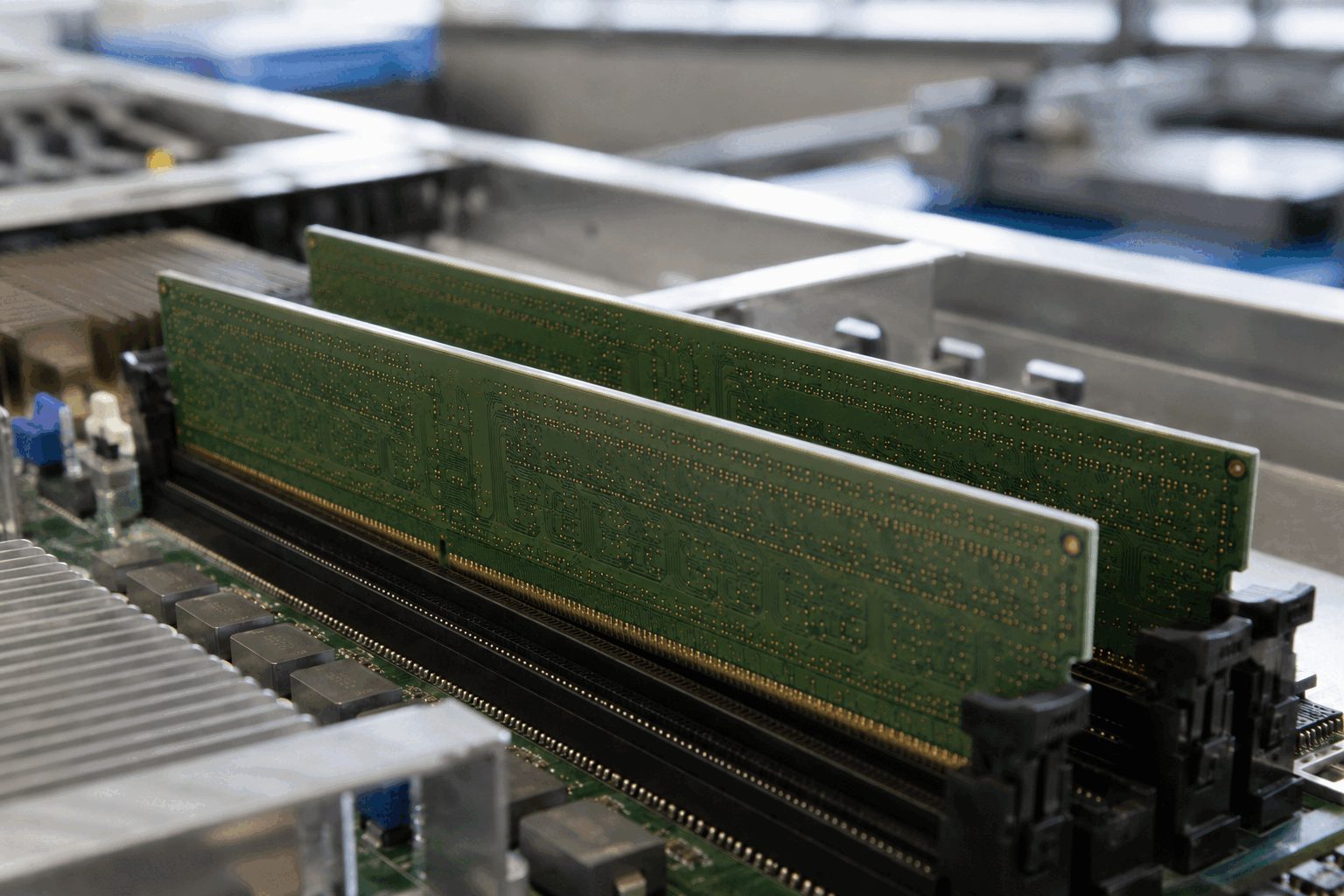
The profit line is less clean. Cisco’s adjusted product gross margin, the share of product revenue left after direct costs, was 64.3%, down 3.3 percentage points because of product mix and higher memory costs. Operating cash flow fell 7% to $3.8 billion as the company invested to meet demand. Kim Sunwoo, an analyst at Meritz Securities, said suppliers were meeting only 75% to 80% of demand for DRAM, the working memory used in servers, and that the rate could fall into the 60% range in 2027. That could keep Cisco’s input costs high.
Elsewhere in the portfolio, security revenue was flat, collaboration declined 1%, services slipped 1%, and observability grew 3%. Remaining performance obligations, contracted revenue not yet recognized, rose 4% to $43.5 billion, slower than the quarter’s 12% total revenue growth. Networking is carrying a growing share of the investment case.
But the setup can break in either direction. Should Cisco reach the $9 billion order target and hold its adjusted fourth-quarter gross margin within the guided 65.5% to 66.5% range, Wednesday’s decline could prove a valuation reset rather than a demand warning. If large orders slip or memory shortages deepen, a stock priced at about 37 times earnings reported over the past year could fall further.
Cisco has four weeks before the August 12 report. The company does not need to prove that AI infrastructure spending exists; IBM has already shown that corporate capital is moving toward hardware. Cisco must show that it can capture the shift fast enough, and at a margin that supports the price investors now pay.


![US Stock Market Today 08/25/2026 [UPDATE: 00:06 EDT] [Micron and Sandisk Turn Green as QQQ Gains Overnight]](https://ts2.tech/wp-content/uploads/2026/08/US-market-dashboard-2026-08-25-0002-480x384.jpg "US Stock Market Today 08/25/2026 [UPDATE: 00:06 EDT] [Micron and Sandisk Turn Green as QQQ Gains Overnight]")