
NEW YORK, August 14, 2026, 06:03 EDT — U.S. cash markets did not open, but premarket trade saw notable activity.
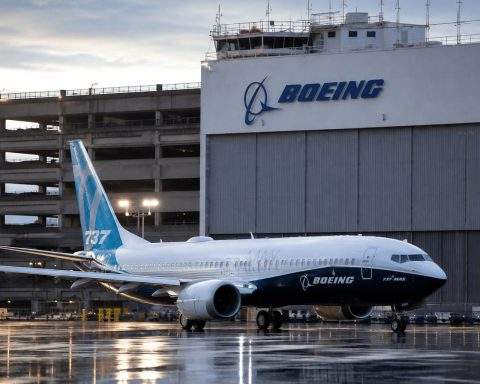
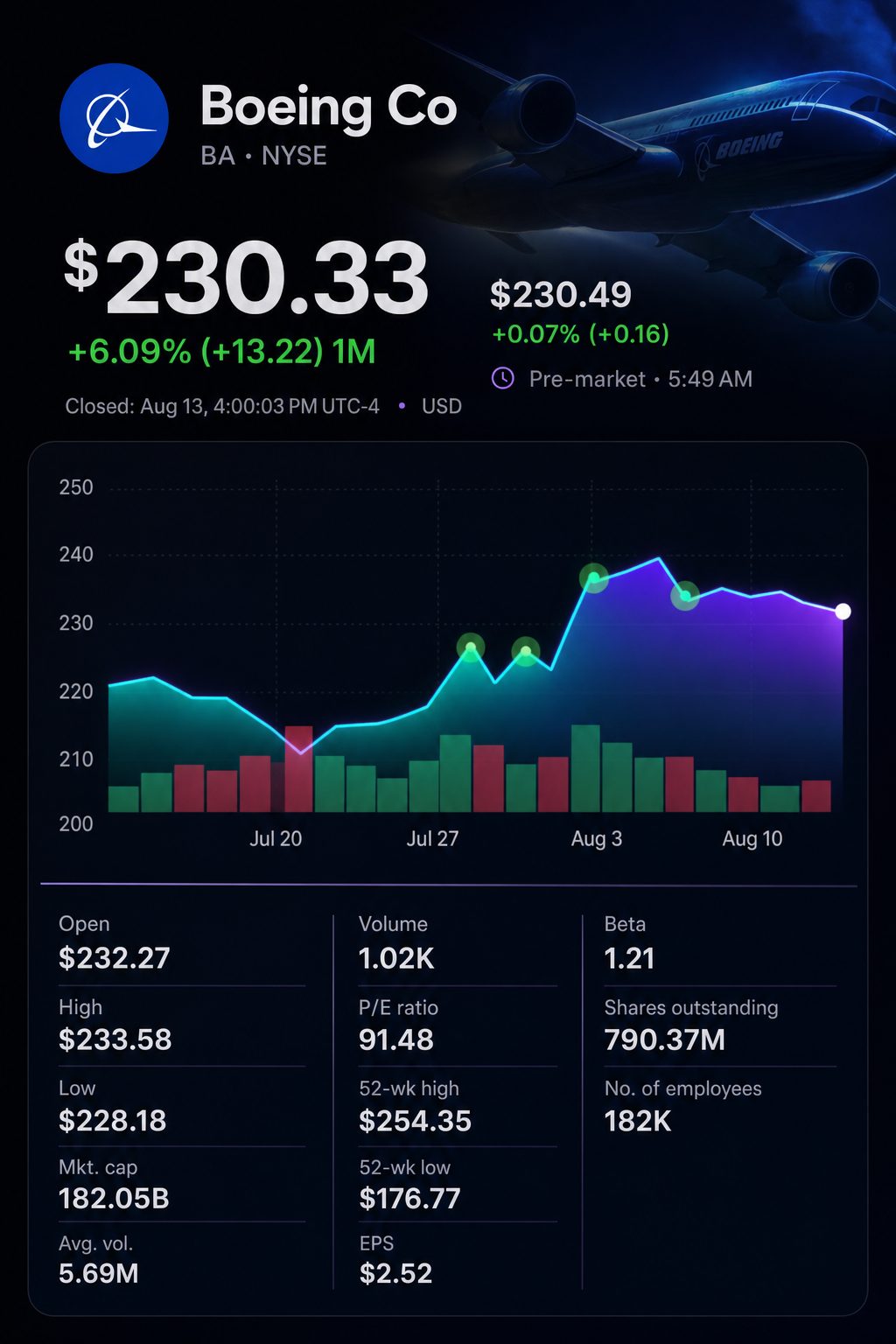
- Boeing ended Thursday’s session at $230.33, declining 0.38%, as the S&P 500 ETF rose 0.70%.
- Investigators discovered bird debris and broken fan blades inside the right engine of the Ryanair aircraft.
- Boeing’s $715 billion order backlog restricts short-term revenue visibility, though the schedule for retrofits continues to pose a risk.
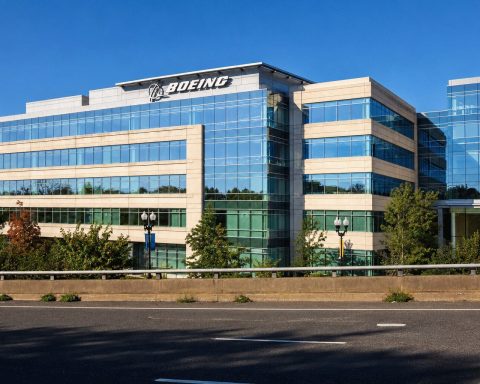
The Boeing Company NYSE:BA declined 0.38% to $230.33 on Thursday. Meanwhile, the State Street SPDR S&P 500 ETF Trust NYSEARCA:SPY gained 0.70%. The resulting 1.08 percentage point difference represents approximately $1.97 billion in relation to Boeing’s $182.05 billion market capitalization. This reflects a comparative measure, not an actual event loss.
The decision came before a late-session investigative update concerning a Ryanair Holdings plc NASDAQ:RYAAY flight. The report was released approximately at 15:52 EDT, just ahead of market close. As a result, it does not account for Boeing’s lagging performance throughout the session.
Nonetheless, the discoveries are significant. Investigators identified bird remains inside the right engine of the Boeing 737 NG. Additionally, they retrieved three separate fragments following the failure of fan blades. This evidence weakens the argument for drawing swift, fleetwide design conclusions.
| Security | August 13 close or latest | Move | Investor read-through |
|---|---|---|---|
| Boeing NYSE:BA | $230.33 | -0.38% | Underperformed compared to wider indexes |
| Ryanair NASDAQ:RYAAY | $59.17 | -0.32% | Airline operating aircraft |
| GE Aerospace NYSE:GE | $360.64 | -1.28% | Partner in CFM engines |
| Safran EPA:SAF | €359.80, August 14 | +0.50% | CFM engine partner; trades in Europe |
| SPDR S&P 500 ETF NYSEARCA:SPY | $777.88 | +0.70% | Benchmark for broad U.S. stocks |
The CFM56 engine that malfunctioned was manufactured by CFM International, a joint venture between GE Aerospace NYSE:GE and Safran SA EPA:SAF. Boeing directed technical queries to the U.S. National Transportation Safety Board. CFM confirmed that it is cooperating with the investigation.
A loud bang was heard soon after departure from Greece on July 10. Debris from the engine shattered a cabin window, severely injuring travelers. The plane landed safely.
The NTSB was aware of four potential bird strikes related to that engine in the previous year. Bird remains were discovered following two of the incidents. Subsequent maintenance inspections showed no damage, the preliminary report said.
| Issue | Verified evidence | What remains open |
|---|---|---|
| July Ryanair event | Bird debris; broken fan blades; three separated pieces | Connection among blade break, cowling impact and fuselage hit |
| Prior Southwest event | 2018 CFM56-7B blade break triggered inlet and cowl loss | If the cases involve an identical material breakdown |
| Regulatory action | FAA retrofit requirement is binding; must finish by 2028 | If regulators speed up or extend new rules |
| Responsibility | Engine manufactured by CFM; airframe is Boeing 737 NG | Overall share between impact, engine and airframe failures |
The 737 NG’s fan cowl forms a key part of the regulatory link. In 2018, a CFM56-7B blade fracture led to a Southwest incident. Following that, the NTSB called for reinforced inlet and fan-cowl assemblies. One passenger lost their life in the accident.
The FAA has ordered related updates to be completed by 2028. Administrator Bryan Bedford noted that initial findings were not the same as the Southwest incident. However, investigators have yet to eliminate possible links. “Way too early to tell,” Bedford said in July. Reuters; FAA airworthiness directives
Boeing has strengthened its financial position. Revenue for the second quarter climbed 8% to $24.56 billion, while free cash flow moved into positive territory, reaching $631 million. Losses in the commercial-airplane segment also decreased.
| Boeing metric | Q2 2026 | Q2 2025 | Change |
|---|---|---|---|
| Revenue | $24.56 billion | $22.75 billion | up 8% |
| Operating cash flow | $1.36 billion | $227 million | increase of $1.14 billion |
| Free cash flow | $631 million | -$200 million | gain of $831 million |
| Commercial-airplane deliveries | 171 | 150 | up 14% |
| Commercial-airplane operating margin | -2.7% | -5.1% | improvement of 2.4 points |
Chief Executive Kelly Ortberg stated that operations had become “more stable,” with major certifications progressing as scheduled. He noted Boeing’s commitment to safety, quality, and on-time delivery. The comments accompanied a total backlog of $715 billion.
The commercial backlog topped 6,200 jets, valued at $597 billion. In the second quarter, Boeing handed over 129 737 aircraft. This delivery volume means a single incident with an aircraft in service does not materially affect short-term revenue.
Wall Street sentiment is positive. According to Google Finance, analysts have issued 17 buy ratings and one hold. The consensus price target stands at $274.67, about 19% higher than Thursday’s closing price. Targets represent opinions, not predictions.
| Analyst | Firm | Rating | Target | Date |
|---|---|---|---|---|
| Sheila Kahyaoglu | Jefferies | Buy | $295 | August 11 |
| Noah Poponak | Goldman Sachs | Buy | $277 | August 11 |
| Kenneth Herbert | RBC Capital Markets | Buy | $265 | August 11 |
| John Eade | Argus | Buy | $265 | August 11 |
| Ronald Epstein | Bank of America | Buy | $270 | August 10 |
| Consensus | 18 analysts | 17 rate buy, 1 hold, 0 sell | $274.67 on average | Most recent |
The upbeat outlook increases the burden of proof. Boeing’s shares currently trade at roughly 91 times trailing earnings. Investors have already priced in ongoing execution, cash flow improvement, and minimal disruptions.
Risks: If this event is connected to fan-cowl weakness, retrofits may be accelerated. Increased inspections or more time on the ground would drive up expenses for both airlines and suppliers. Boeing’s margin for commercial airplanes is still negative at 2.7%, so there is limited tolerance for operational setbacks.
The upcoming indicator is the NTSB’s determination of cause, rather than just Thursday’s price movement. Until that point, the $1.97 billion difference reflects investor caution. It does not establish liability.
Related articles: NYSE:BA