
SANTA CLARA, California, August 14, 2026, 14:50 EDT — U.S. markets remained open.
- Shares of Intel dropped roughly 2% following the chipmaker’s completion of an enlarged equity offering.
- The total agreement comprises 242.1 million shares, representing 4.8% of Intel’s shares outstanding as of June.
- Net proceeds totaling $22.62 billion surpass Intel’s net debt prior to the deal on a straightforward pro forma comparison.
Shares of Intel Corporation NASDAQ:INTC were down 2.0% at $102.51 in Friday afternoon trading. The decline came after the company completed a $22.62 billion equity offering, which included an underwriter’s option that was fully exercised. The transaction raised Intel’s total share count by around 4.8%.
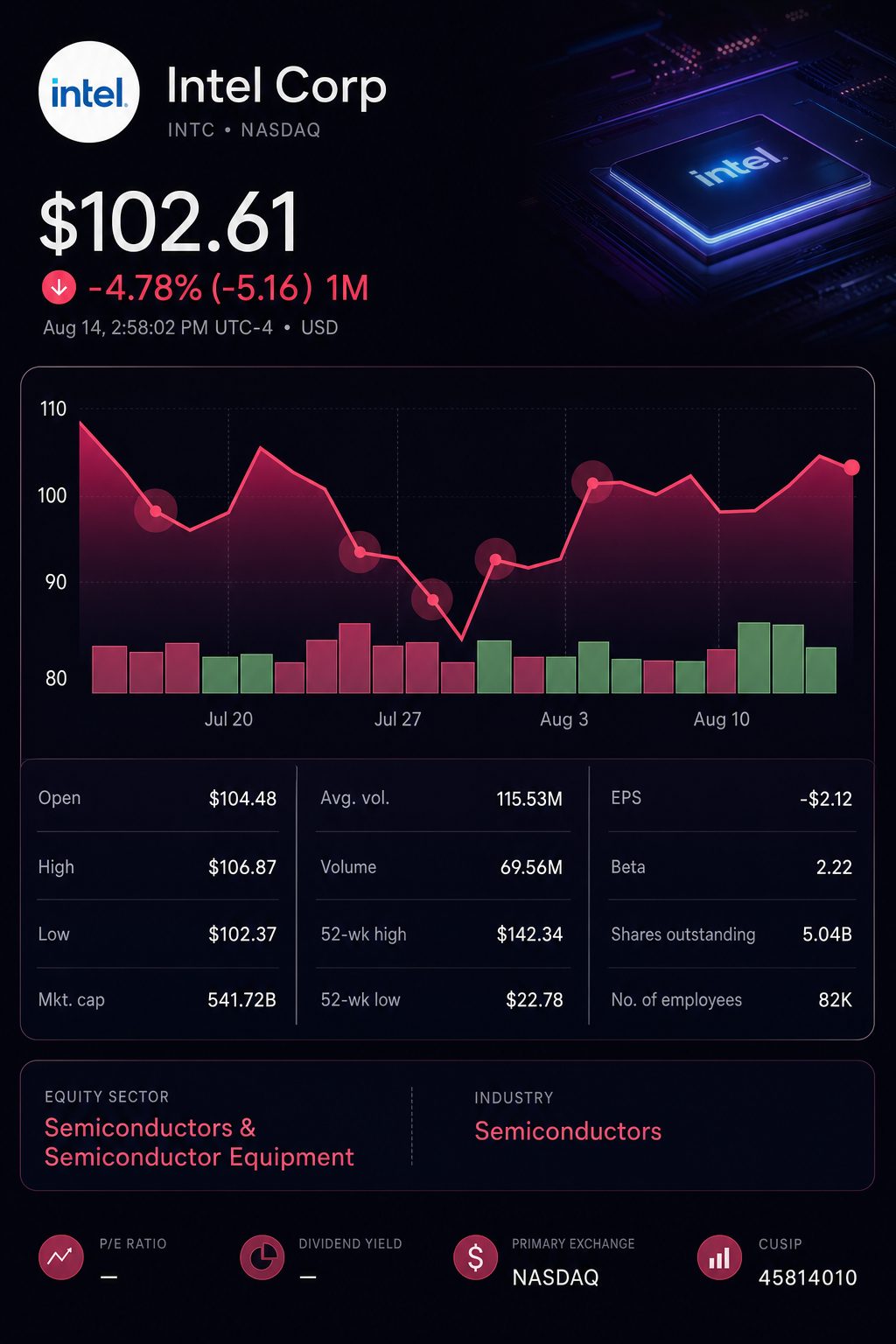
The price action highlights the dilemma investors are up against. While appetite for the offering was robust, each current share now accounts for a smaller portion of Intel. The dilution takes effect right away. Profits from the foundry business are still not expected for several years.
| Trading measure | Value |
|---|---|
| Price at 14:48 EDT on Friday | $102.51 |
| Change on Friday | -2.0% |
| Price of offering | $95.00 |
| Premium to offering price on market | 7.9% |
| Volume traded by 14:48 EDT Friday | 70.7 million shares |
Intel issued 210.5 million shares at a price of $95 apiece. Underwriters subsequently took up their option to purchase an extra 31.6 million shares, bringing the total number of shares issued to 242.1 million.
| Offering and dilution calculations | Value |
|---|---|
| Shares in circulation as of June 27 | 5.043 billion |
| Additional shares including option | 242.1 million |
| Percentage increase from June figure | 4.8% |
| Ownership reduction for current holders | 4.6% |
| Total net proceeds if fully exercised | $22.62 billion |
| CEO and family buy at $95 | About 126,316 shares |
| New share allocation owned by CEO and family | 0.05% |
Chief Executive Lip-Bu Tan and a relative committed to purchasing $12 million in shares, equating to about 126,316 shares at the offering price. While this represents a significant personal investment, it accounts for just 0.05% of the new stock issue.
The broader impact on Intel’s balance sheet is more difficult to overlook. As of the end of June, Intel held $29.73 billion in cash and short-term investments, while its total debt stood at $50.54 billion. Factoring in the raised funds and assuming no expenditures, Intel’s net debt position of $20.81 billion would shift to roughly $1.81 billion in net cash.
| Financial backdrop | Latest reported | Investor read-through |
|---|---|---|
| Q2 revenue | $16.13 billion, +25% | Robust demand |
| Q2 operating income | $1.80 billion | Core earnings strengthened |
| Foundry Q2 revenue | $5.77 billion | Operations expanded |
| Foundry Q2 operating loss | $2.09 billion | Returns continue negative |
| Cash plus short-term investments | $29.73 billion | Liquidity before issuance |
| Total debt | $50.54 billion | Leverage before issuance |
| Simple pro forma net cash | $1.81 billion | Reflects unspent proceeds |
That math is behind some analysts’ willingness to accept the dilution. Intel secures enough funding for over a year’s worth of planned capital expenditures, which exceed $20 billion. The funds will cover advanced fabs, packaging, as well as working capital.
UBS analyst Timothy Arcuri described the increase as lifting a financial “overhang,” Barron’s said. Bank of America stated that foundry scale and customer confidence are likely to offset “modest near-term EPS dilution.” Barron’s; Tom’s Hardware
| Analyst | Firm | Recommendation | Price target |
|---|---|---|---|
| Vivek Arya | Bank of America | Buy | $160 |
| Tristan Gerra | Baird | Neutral | $125 |
| Gil Luria | DA Davidson | Neutral | $100 |
| Joseph Moore | Morgan Stanley | Equal-weight | $84 |
| Harlan Sur | JPMorgan | Underweight | $85 |
| Kevin Cassidy | Rosenblatt | Sell | $80 |
Caution persists among broader Wall Street analysts. According to MarketBeat, there are 17 buy ratings, 29 holds, and three sell recommendations. The average price target is $107.93, roughly 5% higher than the closing price on Friday. StockAnalysis shows a comparable Hold consensus, with input from 49 analysts.
Intel reported better operating performance. Revenue for the second quarter increased by 25% to $16.13 billion. Tan described it as the company’s “strongest revenue growth in more than fifteen years.” Foundry revenue climbed 31%, and the segment’s operating loss decreased to $2.09 billion. Intel Q2 results
However, the economics of foundries remain challenging. The unit posted a loss of around 36 cents per dollar of revenue last quarter. Securing committed demand and improving utilization are necessary for new capacity. Without this, additional equity could end up covering losses instead of generating returns.
Risks: Intel is exposed to execution setbacks, significant capital requirements and tough rivalry from Taiwan Semiconductor Manufacturing NYSE:TSM, Advanced Micro Devices NASDAQ:AMD and Nvidia NASDAQ:NVDA. Prolonged weakness in the chip cycle or sluggish foundry uptake may lead to increased cash burn and greater dilution.
The drop on Friday does not signal a rejection of Intel’s funding. Instead, it reflects a cost for securing certainty. Selling shares cuts financing risk at present, shifting the focus of the valuation discussion to foundry utilization and returns.
Related articles: NASDAQ:INTC