
WARSAW, August 15, 2026, 14:05 CEST — U.S. trading has paused with the markets shut for the weekend.
- Transocean gained 0.7% on Friday, trading at roughly 1.20 times its usual volume.
- Brent climbed 6.0% over the week, while crude stocks saw a sharp increase.
- The analyst consensus of $6.40 implies an upside of roughly 11.2%.
Shares of Transocean Ltd. NYSE:RIG climbed 0.7% to close at $5.76 on Friday. Volume totaled 46.2 million shares, roughly 20% higher than the stock’s three-month average. However, the stock underperformed the S&P 500 energy sector’s 1.4% advance.
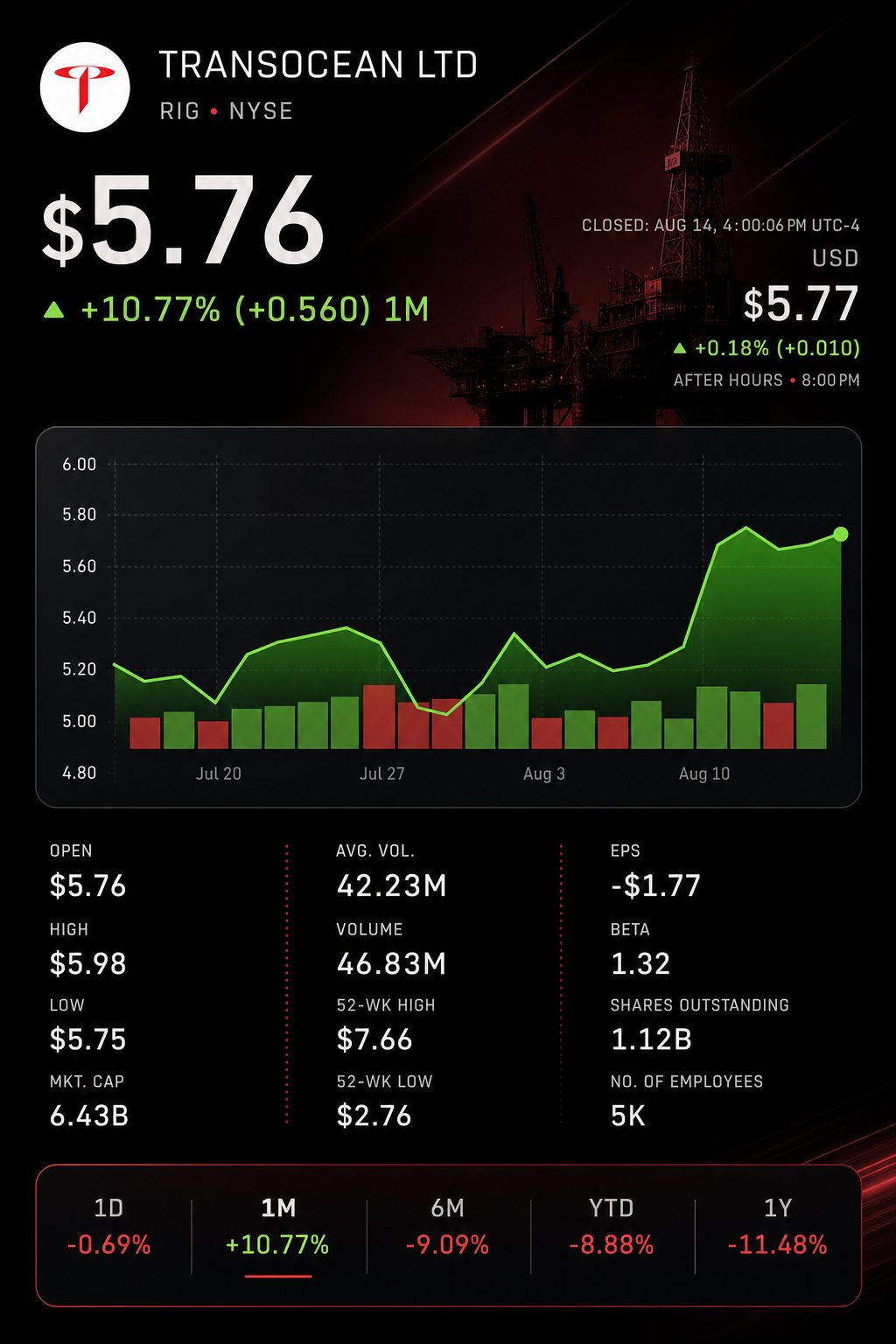
The gap is significant. While oil provided a strong macro boost, investors did not respond with a comparable increase for the offshore driller. RIG’s present share price is just 11.2% under the most recent analyst consensus target of $6.40.
| Friday snapshot | Level | Investor read-through |
|---|---|---|
| RIG closing price | $5.76, up 0.7% | Upbeat, trails sector gains |
| RIG trading volume | 46.2 million | 1.20 times three-month average |
| S&P 500 energy | Gained 1.4% | Oil strength boosts group |
| Brent | $88.52, up 6.0% for week | Boosts offshore economics |
| WTI | $82.40, up 5.4% for week | Improves upstream cash projections |
Brent closed around $88.52 a barrel following tanker attacks and a pause in U.S.-Iran negotiations. West Texas Intermediate finished close to $82.40. The Strait of Hormuz accounts for about 20% of worldwide oil shipments, maintaining high supply risk.
Physical supply acts as the counterbalance. U.S. crude stockpiles surged by 17.4 million barrels to reach 424.4 million last week, marking the largest weekly gain in three and a half years. The rise was fueled by reduced exports along with increased imports.
At Transocean, spot oil prices are only the initial consideration. The impact of higher crude prices on cash flow depends on factors like contract length, dayrates, and utilization levels. As of May, the firm disclosed a backlog of $7.1 billion, reflecting an average dayrate exceeding $450,000.
Chief Executive Keelan Adamson stated the backlog demonstrated appetite for distinct assets. He pointed to an adjusted EBITDA margin exceeding 40% and more rapid debt payoff. Those improvements in operations continue to serve as the main equity benchmark.
| Operating marker | Latest disclosed figure | Why it matters |
|---|---|---|
| Contract backlog | $7.1 billion | Indicates future earnings pipeline |
| Average backlog dayrate | Above $450,000 | Reflects contract pricing strength |
| Q1 revenue efficiency | 97.3% | Shows effectiveness in converting backlog |
| Q1 liquidity | $1.125 billion | Highlights capacity for debt handling and deals |
| 2026 revenue guidance | $3.8-$3.9 billion | Serves as performance target |
The planned takeover of Valaris Ltd. NYSE:VAL introduces a further element to its valuation. Each Valaris shareholder would get 15.235 shares of RIG for every VAL share owned. Based on RIG’s closing price on Friday, this offer values Valaris at around $87.75 per share.
| Valaris transaction metric | Announced terms | Current implication |
|---|---|---|
| Exchange ratio | 15.235 RIG shares for every VAL share | Set equity participation |
| Implied VAL value | Multiply the ratio by RIG’s share price | $87.75, based on $5.76 |
| Combined enterprise value | Estimated at $17 billion | Increased balance sheet capacity |
| Combined fleet | 73 drilling rigs | Expanded deepwater and jackup operations |
| Expected cost synergies | Above $200 million | Potential for synergy delivery |
| Expected closing | Second half of 2026 | Dependent on approval and schedule |
The all-share deal also places the risk of price fluctuations on RIG holders until completion. Following the merger, Transocean shareholders will control roughly 53% of the new entity, while Valaris shareholders will possess 47%. The company aims to reach leverage of approximately 1.5 times within 24 months post-closing.
Analysts hold differing views. The most recent consensus shows five buy ratings, six holds and three sells. In July, Susquehanna maintained its positive stance but cut its target price to $7. Earlier, Barclays and Morgan Stanley lifted their price targets to $8 and $7, respectively.
| Analyst or consensus | Recommendation | Target | Versus $5.76 |
|---|---|---|---|
| Consensus average | 5 buy / 6 hold / 3 sell | $6.40 | +11.2% |
| Susquehanna, July 8 | Positive | $7.00 | +21.5% |
| Barclays, May 7 | Overweight | $8.00 | +38.9% |
| Morgan Stanley, April 15 | Equal-weight | $7.00 | +21.5% |
| Consensus range | Low to high | $4.00-$10.00 | -30.6% to +73.6% |
The spread is significant. RIG has climbed 95.3% in the past 12 months, but still trades 24.8% below its $7.66 peak. Investors are pricing in a substantial rebound, weighing the extent of merger value that will persist after dilution and integration.
Key external data releases are due Tuesday and Wednesday next week. U.S. import price figures may influence movements in the dollar and oil prices. The EIA’s weekly petroleum update on Wednesday will reveal if the recent 17.4-million-barrel increase in inventories was unusual.
Risks: A reduction in tensions near Hormuz may unwind the risk premium on oil. Ongoing inventory accumulation could push crude prices lower even in the absence of a ceasefire. Delays in mergers, reduced dayrates, operational downtime or slower debt paydown could negatively impact RIG.
The arrangement is not as straightforward as “oil up, driller up.” RIG is drawing notice with higher-than-average volume. Its underperformance in the sector and limited consensus upside suggest caution. At this stage, contract fulfillment matters more than Friday’s jump in crude prices.
Related articles: NYSE:RIG