
EL SEGUNDO, California, August 15, 2026, 05:36 PDT — U.S. cash markets are closed for the weekend. Beyond Meat, Inc. NASDAQ:BYND jumped 10.32% to $13.47 on Friday, its first split-adjusted session after a 1-for-30 reverse stock split. The rally lifted the quote. It did not change the company’s value or its Nasdaq compliance test.
- Friday volume reached 3.17 million shares, 2.56 times the 65-day average.
- Beyond Meat must hold a closing bid of at least $1 for 10 consecutive business days.
- Second-quarter adjusted EBITDA remained negative at $27.7 million.
The move looks large beside a weak market. The Nasdaq Composite fell 0.28%, while the Dow declined 0.20%. Yet Beyond Meat still sits 94.2% below its split-adjusted 52-week high. Trading activity, not a new cash-flow event, drove Friday’s headline.
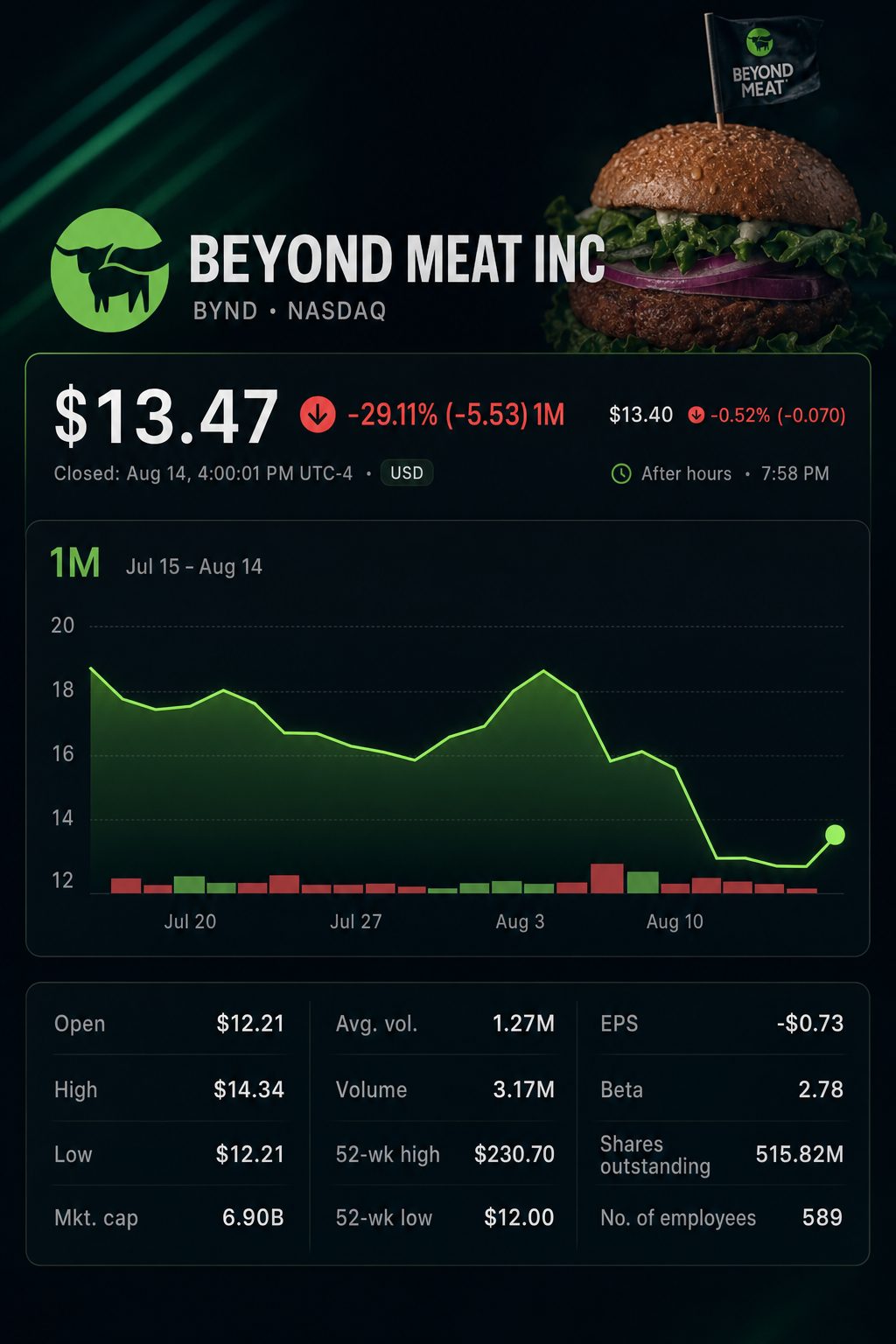
| Friday market measure | Beyond Meat | Comparison |
|---|---|---|
| Close | $13.47 | Up 10.32% |
| Trading volume | 3.17 million | 2.56× 65-day average |
| 65-day average volume | 1.24 million | Baseline |
| 52-week high | $230.70 | Current price 94.2% lower |
| Nasdaq Composite | — | Down 0.28% |
The split became effective late Thursday. Every 30 old shares became one new share. Authorized common shares fell proportionately from 3 billion to 100 million. Ownership percentages were unchanged, apart from minor fractional-share effects.
| Split item | Before | After | Economic effect |
|---|---|---|---|
| Shares combined | 30 | 1 | No value created |
| Authorized common shares | 3.0 billion | 100 million | Reduced proportionately |
| Friday close | $0.449 equivalent | $13.47 quoted | Same underlying value |
| Nasdaq minimum bid | $1 | $1 | Requirement unchanged |
The immediate test is mechanical but important. Nasdaq requires at least 10 consecutive closes above $1 before the August 31 compliance date. Friday supplied the first post-split close. The company warned that continued listing is not assured.
Operations remain the harder test. Second-quarter revenue fell 8.2% to $68.8 million. Product volume dropped 9.5%. Gross margin narrowed to 8.5% from 10.6%, even as operating expenses declined.
| Q2 measure | 2026 | 2025 | Change |
|---|---|---|---|
| Net revenue | $68.8 million | $75.0 million | -8.2% |
| Gross margin | 8.5% | 10.6% | -2.1 points |
| Operating loss | $30.8 million | $37.5 million | Loss narrowed 17.9% |
| Adjusted EBITDA loss | $27.7 million | $24.7 million | Loss widened 12.1% |
Reported net income of $16.4 million needs context. A $57.7 million non-cash debt-extinguishment gain lifted other income. Adjusted EBITDA therefore gives a cleaner view of the operating shortfall. It worsened by $3 million year over year.
Liquidity provides time, not comfort. Cash and restricted cash totaled $186.1 million at June 27. Debt carrying value was $323.8 million, about 1.74 times that cash pool. Six-month operating cash use improved to $23.2 million from $58 million.
Channel data show one genuine bright spot. International retail grew 16.5%. Every other major channel contracted, led by a 27.6% drop in U.S. foodservice.
| Q2 revenue channel | 2026 | 2025 | Change |
|---|---|---|---|
| U.S. retail | $29.6 million | $32.9 million | -9.9% |
| U.S. foodservice | $8.0 million | $11.1 million | -27.6% |
| International retail | $18.5 million | $15.9 million | +16.5% |
| International foodservice | $12.7 million | $15.1 million | -16.0% |
Chief Executive Ethan Brown called the quarter “directional progress.” Revenue beat the company’s own guidance. Still, the mix suggests Europe, Britain and Canada are offsetting only part of the U.S. weakness. Management expects third-quarter revenue of $60 million to $65 million.
Wall Street remains cautious. FactSet’s current tally shows no buy ratings, two holds and three sells. The consensus is underweight. The average target of $20 stands 48.5% above Friday’s close, but the small and bearish coverage set makes that gap less persuasive.
| Analyst recommendation | Current count | One month ago |
|---|---|---|
| Buy | 0 | 0 |
| Hold | 2 | 3 |
| Sell | 3 | 3 |
| Consensus | Underweight | Underweight |
| Target range | $15–$30 | — |
| Average target | $20 | — |
When markets reopen, investors should watch whether volume stays elevated and the bid remains safely above $1. The next fundamental check is third-quarter sales. A result near $60 million would imply another sequential decline from Q2.
Risks: A brief trading squeeze could extend the rebound despite weak fundamentals. Conversely, lower demand, reduced distribution, further note conversions and another margin setback could pressure the stock. Sparse analyst coverage also makes consensus targets unusually fragile.