
FRANKFURT, August 15, 2026, 15:22 CEST — European cash markets remain shut over the weekend.
- The Rhine gauge at Kaub dropped to 8 centimetres early on Saturday.
- The current level stands nearly 90% beneath the industrial threshold of 78 centimetres.
- Studies show that when there is a 30-day period of low water levels, industrial production drops by 1%.
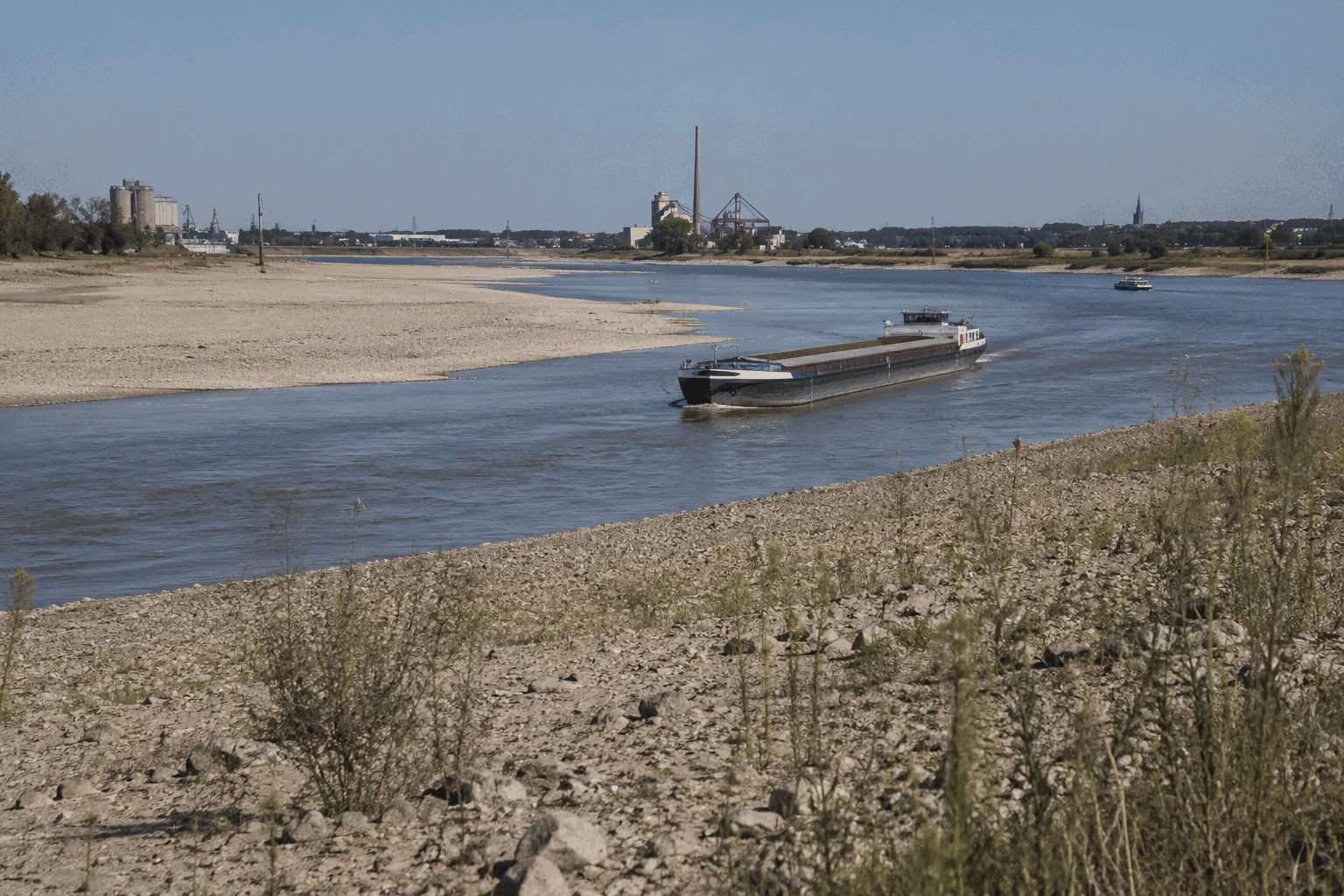
The Rhine hit an all-time low heading into the weekend, escalating a transport issue into a threat to German economic growth. A majority of impacted cargo has transferred to road and rail. This change drives up expenses just as European markets prepare to open on Monday.
The Kaub gauge registered 8 centimetres early on Saturday, following a dip to 6 centimetres late Friday. The previous 2018 record stood at 25 centimetres. Despite this, the river is still roughly one metre deeper than the measurement shown on the gauge.
| Rhine stress gauge | Latest figure | Comparison |
|---|---|---|
| Kaub reading, early Saturday | 8 cm | Lowest weekend level recorded |
| Late-Friday trough | 6 cm | 76% under the 2018 record |
| Previous record | 25 cm | Set in October 2018 |
| Industrial-impact threshold | 78 cm | Gauge is now 89.7% beneath this mark |
The river has become a significant macro variable. According to research from the Kiel Institute, 30 days of low water levels can lower industrial output in Germany by about 1%, assuming all other conditions remain the same. The water level at Kaub last exceeded 78 centimetres in mid-July.
The figure is not a prediction. It reflects past patterns and does not account for present stockpiles or backup strategies. However, the current timing closely matches the 30-day stress period analyzed in the study.
| Freight constraint | Verified measure | Derived investor signal |
|---|---|---|
| Normal barge loads in July disruption | Roughly 20% of standard capacity | Replacing one barge load may take five vessels |
| Rotterdam–Karlsruhe tanker barge charges | €150–€155 per ton | Risen 233%–244% since end-June |
| Trucks needed in place of a single barge | As many as 150 trucks | Road hauling hits maximum capacity |
| Volume to cover refined-fuel flows | Roughly 3,000 tankers every day | Local fuel price premiums may climb |
Before hitting Saturday’s new low, freight rates had surged to three times their previous level. The price for tanker-barge shipping from Rotterdam to Karlsruhe rose to €150–€155 per ton in late July, up from €45 at the end of June.
The surge in costs is impacting sectors in different ways. Chemical producers rely on large volumes of raw materials, utilities depend on water and energy sources, and steel manufacturers transport substantial inputs. Meanwhile, agriculture contends with limited road and rail availability.
| Exposed sector | Verified disruption | Transmission channel |
|---|---|---|
| Chemicals | Covestro (ETR:1COV) announced force majeure for certain polyols | Feedstock supply and outbound logistics |
| Utilities | Uniper ETR:UN0 and EnBW (ETR:EBK) cited reduced hydroelectric output | Limits on generation and cooling |
| Steel | Salzgitter (ETR:SZG) rerouted Rotterdam coal to rail transport | Increased logistics cost for raw materials |
| Agriculture | RWZ moved less than 10% of the usual July–August shipments | Grain storage and distribution bottlenecks |
“Alarm bells are ringing loudly,” said Wolfgang Grosse Entrup, who leads Germany’s chemical-industry association. Firms are citing increased expenses, logistical bottlenecks and reduced output. A single barge could be substituted by as many as 150 trucks. Reuters industry survey
Before the river reached its highest recorded level, equity analysts were already leaning towards defensive chemical makers. In June, Goldman Sachs NYSE:GS pointed to weakened demand and increased exports from China. The current drought introduces another layer of cost uncertainty.
| Goldman analyst recommendation | June action | Current Rhine sensitivity |
|---|---|---|
| Givaudan SWX:GIVN | Upgraded to Buy from Sell | Pricing seen as more defensive |
| Clariant (SWX:CLN) | Lifted to Neutral from Sell | Cyclical exposure seen as mixed |
| Evonik (ETR:EVK) | Lowered to Neutral from Buy | Reports cargo disruption on Rhine |
| DSM-Firmenich (AMS:DSFIR) | Cut to Sell from Neutral | Risk from weak demand highlighted |
| Syensqo (EBR:SYENS) | Downgraded to Sell from Buy | Exposed to cycles, logistics |
Several German states eased Sunday truck rules, helping avert some immediate shortages. However, this move does not instantly provide more rail capacity, drivers, or specialized tankers.
Risks: Intense rainfall may rapidly increase Kaub’s water level, potentially reducing freight premiums. Ongoing high temperatures could further impact output, pushing up local fuel and chemical costs. Soft industrial demand might help balance the logistics disruption.
Next week, investors are advised to monitor Kaub, force-majeure reports, and freight rates closely. Should levels rise above 78 centimetres, the macro signal would see some relief. However, another week lingering in single digits would make it more difficult to rule out the 1% historical output test.