
WOLFSBURG, August 16, 2026, 22:36 CEST
- Volkswagen’s U.S. ADR declined 1.8% over the week from Monday to Friday.
- Automotive net cash flow rose by approximately €4.5 billion compared to a year earlier.
- China’s vehicle sales dropped by 31.6%, maintaining pressure on the valuation.
Volkswagen AG (OTCMKTS:VWAGY) closed the week at $8.61, capping a choppy period. The ADR advanced 1.5% on Friday, though it slipped 1.8% versus Monday’s finish. Preferred shares in Frankfurt retreated 2.3% during the same timeframe.
The fragility highlights a clear choice for investors. Volkswagen generated roughly €4.5 billion in additional automotive cash compared to the previous year. Still, the company’s stated operating margin was only 3.8%.
China is at the center. Group vehicle sales in that market fell 31.6% during the first half. Volkswagen lowered its revenue forecast for the year, but maintained its margin goal.
| European automaker | Primary listing | Aug. 10-14 move |
|---|---|---|
| Volkswagen preferred | ETR:VOW3 | down 2.3% |
| BMW | ETR:BMW | up 0.2% |
| Mercedes-Benz Group | ETR:MBG | down 2.3% |
| Stellantis | NYSE:STLA | down 3.9% |
The peer comparison indicates the issue extends beyond Volkswagen. Meanwhile, BMW AG (ETR:BMW) was largely unchanged. Mercedes-Benz Group AG (ETR:MBG) experienced a drop similar to Volkswagen’s, whereas Stellantis NV NYSE:STLA declined further.
Volkswagen reported first-half revenue holding steady at €158.1 billion. Operating profit dropped 11.6% to €5.9 billion. Profit was lowered by roughly €1 billion in special items.
| Volkswagen Group, first half | 2026 | 2025 | Change |
|---|---|---|---|
| Revenue | €158.1bn | €158.4bn | -0.2% |
| Operating result | €5.9bn | €6.7bn | -11.6% |
| Operating margin | 3.8% | 4.2% | -0.4 point |
| Automotive net cash flow | €3.2bn | -€1.4bn | Up roughly €4.5bn |
| Vehicle sales | 4.0m | 4.4m | -8.4% |
Chief financial officer Arno Antlitz stated “our operating margin of 3.8 percent remains too low.” That direct statement carries more weight than the improvement in cash levels. Cash can fluctuate due to changes in inventories and working capital, while a rebound in margins needs sustained pricing and reductions in costs. Company statement
The cash boost continues to offer Volkswagen some flexibility. The company now anticipates automotive net cash flow between €3 billion and €6 billion this year, supporting product rollouts and restructuring efforts while avoiding comparable pressure on the balance sheet.
| Region | Change in vehicle sales, first half |
|---|---|
| China | -31.6% |
| Western Europe | +1.3% |
| Central and Eastern Europe | +9.6% |
| South America | +5.2% |
| North America | +0.9% |
China offset advances in other regions. Volkswagen’s vehicle sales have dropped there amid the rise of local electric competitors. The changing landscape also weighs on prices, which means increased sales volume may have less impact if heavier discounts are required.
Europe provides a balance. Volkswagen’s order book in the region climbed by 12%. Orders for battery-electric vehicles jumped 50%, with electric variants now making up over 30% of the total orders. The forthcoming urban electric-car lineup has received upwards of 70,000 orders.
However, the mass-market brand continues to generate only modest profits. Volkswagen Passenger Cars reported an operating margin of 2.4% for the first half, while Skoda achieved 8.5%, highlighting that some of the group’s earnings disparity is internal.
| Research firm | Latest rating | Price target | Date |
|---|---|---|---|
| UBS | Neutral | €80 | July 6 |
| Jefferies | Buy | €120 | June 29 |
| Barclays | Overweight | €120 | June 23 |
| Citi | Buy | €94 | June 23 |
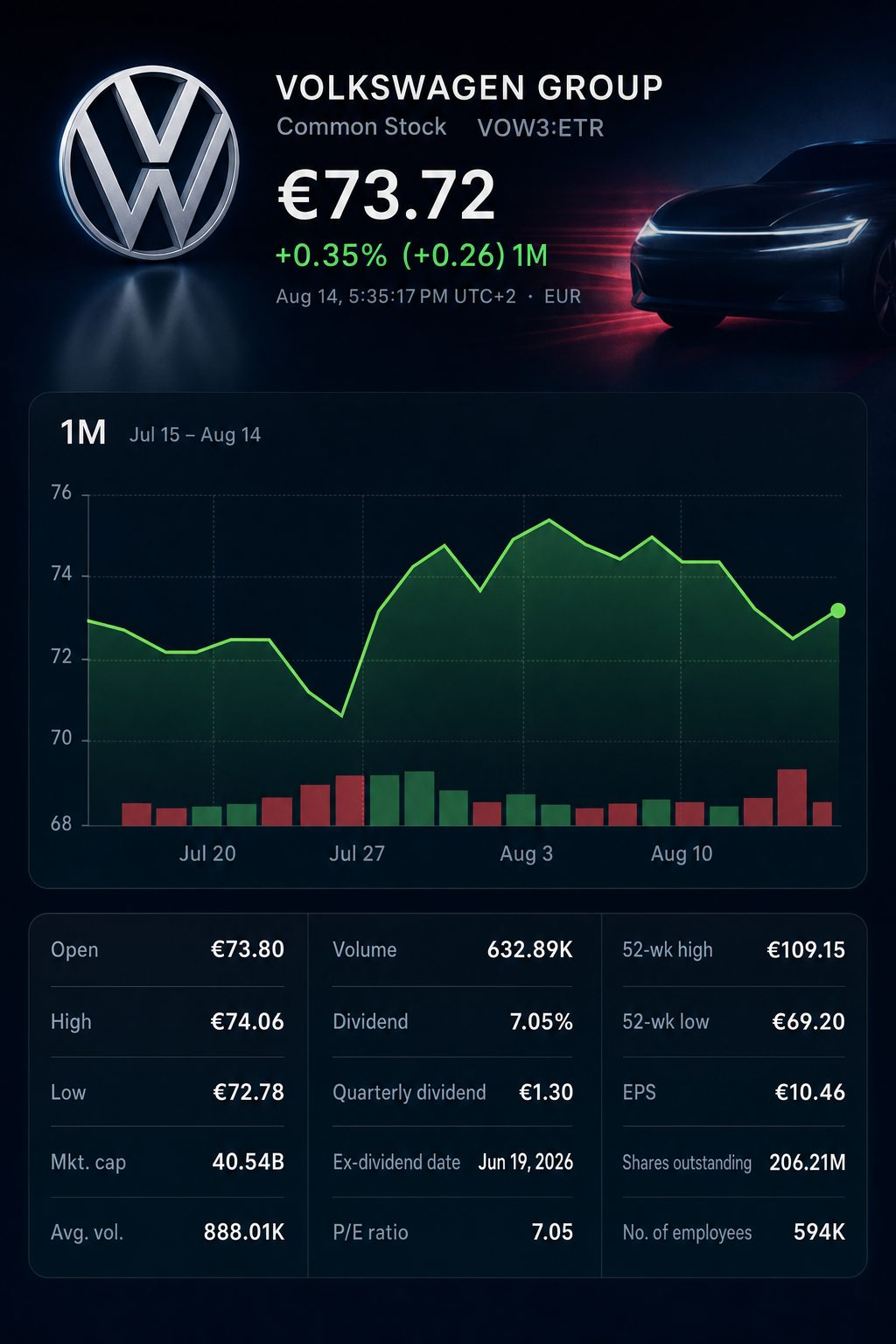
The overall outlook stays positive. Twenty-two analysts have a consensus Buy recommendation for the preferred shares. Their mean price target stands at €109.99, compared with Friday’s closing price of €73.72.
That potential relies on delivery. Volkswagen’s new forecast for 2026 revenue ranges from a 3% drop to flat. The group continues to target an operating margin of 4.0% to 5.5%. The shortfall between the current 3.8% margin and that guidance highlights the challenge for the second half.
This week, investors will monitor if shares remain close to their 12-month lows. The ADR’s 52-week low stands at $8.07, while Frankfurt-traded preferred shares hit a low of €69.20. A further decline would indicate that a low valuation is not sufficient to regain investor confidence.
Risks: Quicker reductions in costs or higher electric sales may improve margins earlier. However, greater weakness in China, the impact of tariffs or further price reductions could offset gains in cash flow.
The investor proposition is specific yet quantifiable. Cash conversion has seen gains. Further margin proof is needed for the stock.