
NEW YORK, August 24, 2026, 14:00 EDT — Sandisk stock slid 7% as investors weighed the potential AI-driven premium in light of fresh risks to its Apple supply relationship and memory sales in China.
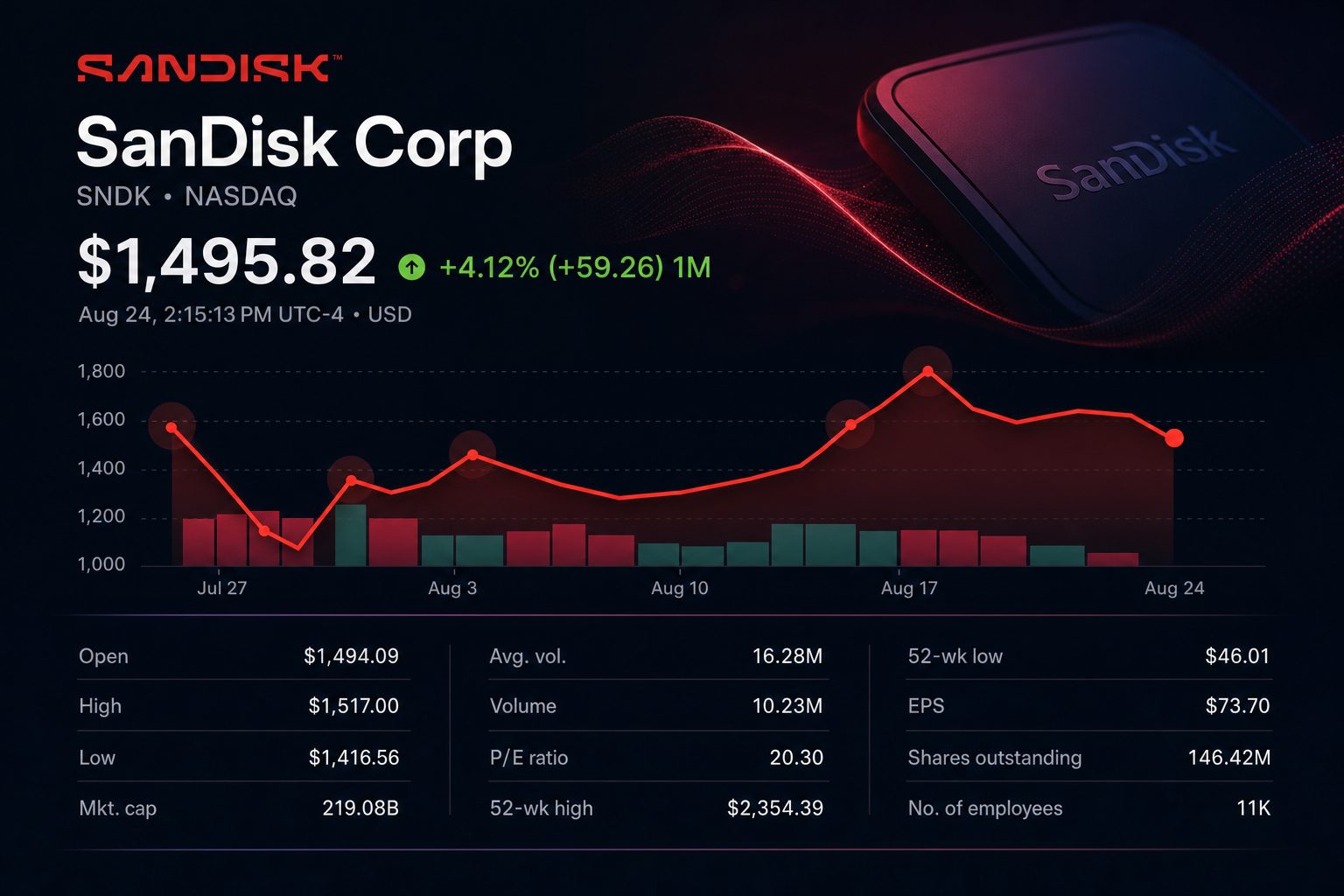
- Sandisk was down 7.27% at $1,480 in Monday’s opening session.
- Last week’s rally, sparked by policy, was undone by reports suggesting Apple may turn to Chinese memory suppliers.
- By 14:00 EDT, the drop had wiped out roughly $17.0 billion in equity value.
- Sandisk’s extended contracts help mitigate volume risk, though pricing may face pressure from Chinese supply.
Sandisk Corporation NASDAQ:SNDK dropped 7.27% to $1,480 as of 14:00 EDT on Monday. The stock rebounded after touching an intraday low of $1,416.56 but continued to rank among the steepest fallers in the memory sector. Regular trading was underway on the Nasdaq.
The change came after reports indicated that the U.S. might permit Apple Inc. NASDAQ:AAPL to obtain DRAM chips from China’s CXMT and NAND flash memory from YMTC. Such a move would restore a supply line that Commerce Secretary Howard Lutnick had voiced opposition to as recently as last week. There has been no announcement of any sourcing deal.
Sandisk’s loss exceeded the drops seen at other storage peers. Tape action indicates investors targeted NAND pricing risk rather than a general pullback from tech.
| Company | Price | Move | Quote time |
|---|---|---|---|
| Sandisk NASDAQ:SNDK | $1,480.00 | -7.27% | 14:00 EDT |
| Micron Technology NASDAQ:MU | $907.68 | -6.11% | 13:38 EDT |
| Western Digital NASDAQ:WDC | $433.90 | -5.56% | 13:35 EDT |
| Seagate Technology NASDAQ:STX | $793.26 | -6.68% | 13:33 EDT |
The hit to market capitalization was significant. Sandisk’s shares dropped $116.08, and with 146.42 million shares in circulation, roughly $17.0 billion in equity value was wiped out. Nonetheless, the stock rebounded 4.48% from its lowest point during the session.
KC Rajkumar from Lynx Equity Research described the selloff as an “overreaction.” He stated that current qualification gaps and constrained capacity reduce the immediate risk posed by Chinese suppliers. Analyst note coverage
The policy outlook is still unclear. Apple requested approval from Washington to purchase CXMT chips amid higher memory prices pressuring product margins. Reuters stated in June that Apple, the White House and CXMT all declined to comment on the request.
YMTC competes more directly with Sandisk, as both firms offer NAND flash products. The company’s parent aims to raise $4.9 billion in a Shanghai IPO, planning to invest the funds in boosting manufacturing capabilities and research. While Apple may face delays in qualifying the chips, the move highlights the future supply implications.
| Sandisk metric | Latest reported | Comparison or outlook |
|---|---|---|
| Fiscal Q4 revenue | $8.965 billion | Up 51% from the previous quarter |
| Fiscal Q4 gross margin | 84.6% | Increase of 6.2 percentage points quarter over quarter |
| Fiscal Q4 datacenter revenue | $2.977 billion | Grew 103% against the prior quarter |
| Fiscal Q1 2027 revenue guide | $10.3-$10.8 billion | Midpoint value of $10.55 billion |
| Fiscal Q1 2027 adjusted EPS guide | $44-$46 | Midpoint is $45 |
The earnings foundation is notably robust. Datacenter sales in the fiscal fourth quarter rose twofold from the previous quarter, and gross margin climbed to 84.6%. The revenue outlook for the current quarter, at its midpoint, suggests sequential growth of 17.7% from $8.965 billion.
Management aims to limit the industry’s typical swings between boom and bust. Eight separate negotiated business structures account for approximately half of bit shipments projected for fiscal 2027, and close to two-thirds for fiscal 2028. The agreements feature mechanisms for both volume and pricing.
Chief Financial Officer Luis Visoso stated that Sandisk plans to “return 100 percent of excess cash” following investment in the business. The company is aiming for annual revenue growth in the mid-to-high-teens range between fiscal 2028 and 2030.
| Broker | Recommendation | Target | Date |
|---|---|---|---|
| Bernstein SocGen | Buy | $3,000 | August 17 |
| Citi | Buy | $2,100 | August 14 |
| Mizuho | Buy | $1,900 | August 14 |
| RBC Capital | Hold | $1,600 | August 14 |
| Wells Fargo | Hold | $1,550 | August 14 |
Wall Street maintains a bullish stance, though estimates vary considerably. The consensus price target from 24 analysts stands at $2,126.17, suggesting 43.66% potential gain from Monday’s $1,480 close. The gap between recent Hold ratings and Bernstein’s $3,000 projection underscores how much hinges on ongoing strength in NAND pricing.
Risks: Chinese suppliers might qualify sooner, expand capacity, or offer lower contract pricing. A wider slowdown in AI spending could dampen demand further. Sandisk’s contracts help reduce the risk related to volume, although they may not shield all products or customers from a drop in NAND prices.
The following key point is if Sandisk remains above Monday’s $1,416.56 low. Should it finish below that mark, the day’s recovery would be nullified. Confirmation that Apple has locked in Chinese supply would refocus the market from policy developments to contract prices and client risk.
Related articles: NASDAQ:SNDK