
NEW YORK, August 26, 2026, 09:40 (EDT) – Shares of Boston Scientific fell 4.1% after the company disclosed that a cyberattack may endanger as much as $369 million in third-quarter sales.
- Boston Scientific stock dropped 4.11% to $47.81 following a cyberattack that impacted operations worldwide.
- The systems responsible for processing and shipping customer orders were also impacted.
- An analyst estimates that $316 million to $369 million in third-quarter revenue could be affected under a 600–700 basis-point scenario.
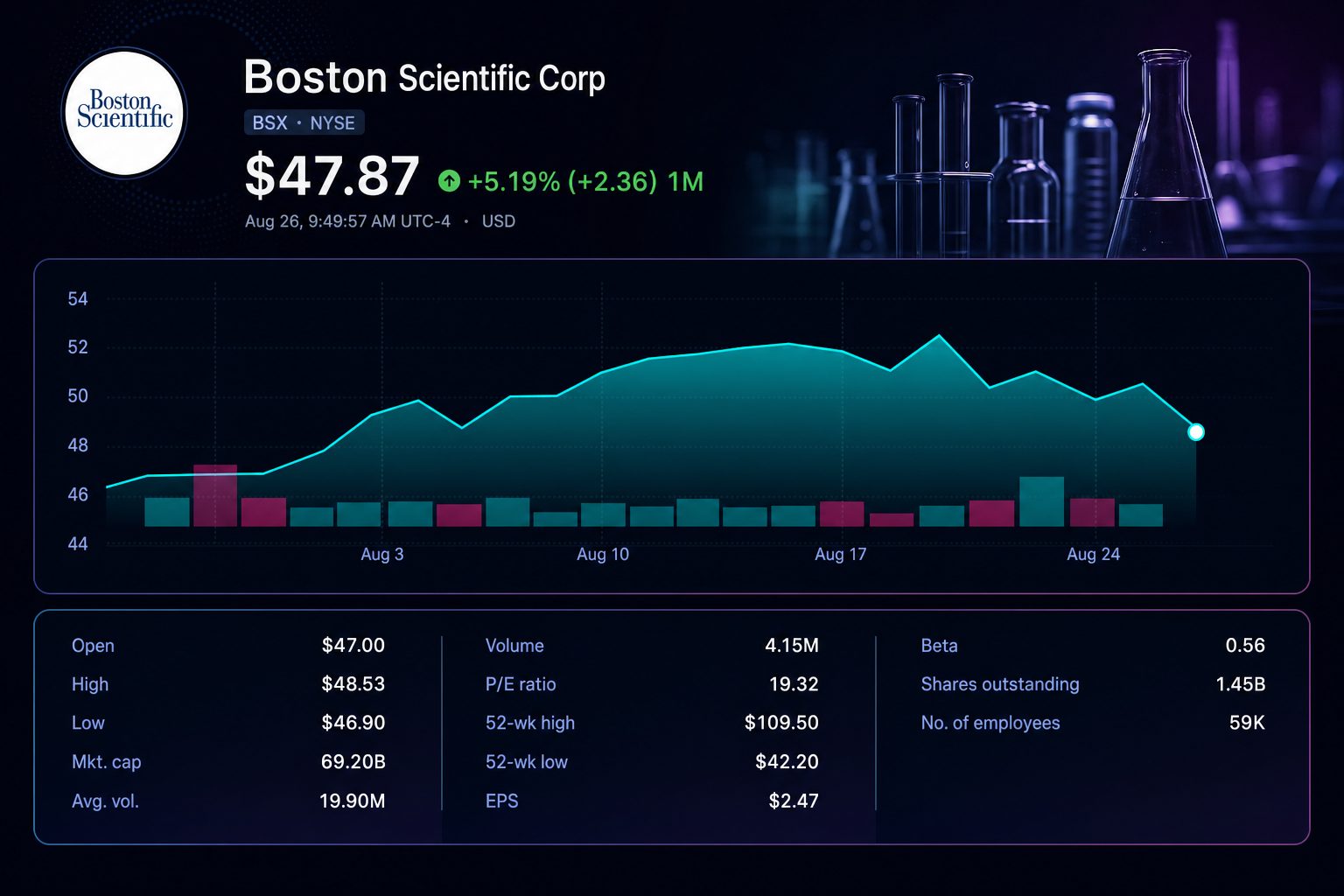
Shares of Boston Scientific Corporation NYSE: BSX dropped 4.11% on Wednesday following a cyberattack that disrupted order processing and shipments. The drop wiped roughly $2.97 billion in market value as of 09:40 EDT.
The decline in share price significantly exceeds the initial revenue impact suggested for the outage. According to Evercore ISI analyst Vijay Kumar, a bounce-back similar to Stryker’s previous episode might lower third-quarter revenue by 600 to 700 basis points. For Boston Scientific’s outlook, this translates to an estimated $316 million to $369 million Reuters.
By the halfway mark, the market-value decline was roughly 8.7 times higher than the projected revenue impact. The disparity highlights uncertainty surrounding recovery timelines, margin pressures and potential disruptions for customers.
| Investor measure | Value | Basis |
|---|---|---|
| BSX price | $47.81, drops 4.11% | 09:40:21 EDT, Aug. 26 |
| Quoted value lost | Roughly $2.97 billion | $2.05 decrease × 1.45 billion shares |
| Q3 revenue guide | $5.22 billion–$5.32 billion | 3%–5% increase over Q3 2025 sales |
| Analyst outage scenario | $316 million–$369 million | 600–700 basis points from guide midpoint |
| Value loss / revenue risk | Roughly 8.0×–9.4× | Market loss divided by outage scenario |
The company identified the incident on August 25. It initiated response protocols and engaged external cybersecurity experts. Some operations are likely to continue experiencing disruptions during the recovery process.
Boston Scientific reported that certain affected systems are involved in customer order processing and shipping. The company has yet to assess if the event could have a significant material effect on its business. The investigation is still ongoing and has not clarified the entire extent or character of the incident.
The stock began trading at $47.00, moving within a range of $46.90 to $48.53. As of 09:40 EDT, 1.89 million shares had changed hands, compared to the typical daily volume of 19.90 million Google Finance.
Kumar selected Stryker Corporation NYSE: SYK as the benchmark for recovery, referencing its previous cyber incident that was resolved in about three weeks. The comparison reflects an analyst scenario and is not guidance from Boston Scientific.
Boston Scientific reported second-quarter sales of $5.442 billion, up 7.5% year-on-year. Adjusted earnings climbed to $0.86 per share from $0.75. company results.
Cardiovascular sales totaled $3.624 billion, an increase of 8.3%. MedSurg revenue amounted to $1.818 billion, rising 5.9%. As the larger segment, cardiovascular represents the main operating exposure if shipment constraints persist.
The company forecasts third-quarter sales will rise by 3%–5%, which equates to approximately $5.22 billion to $5.32 billion, compared with last year’s $5.065 billion. It projects adjusted earnings of $0.80–$0.82 per share.
Before the incident, Wall Street sentiment was mostly positive. Thirty-one analysts held a consensus Buy recommendation, with a mean price target of $62.69 StockAnalysis. That average target stood 31% higher than Wednesday’s early price.
Risks. The revenue projection is based on Boston Scientific recovering in line with Stryker. A swifter recovery could reduce revenue loss, but an extended disruption may weigh on revenue, margins, and ties with customers. The company has yet to reveal if data was taken.
The following valuation assessment is focused on operational factors. Investors require a timeline for recovery, proof that shipments have restarted, and information about whether postponed orders can be fulfilled before the end of the quarter.