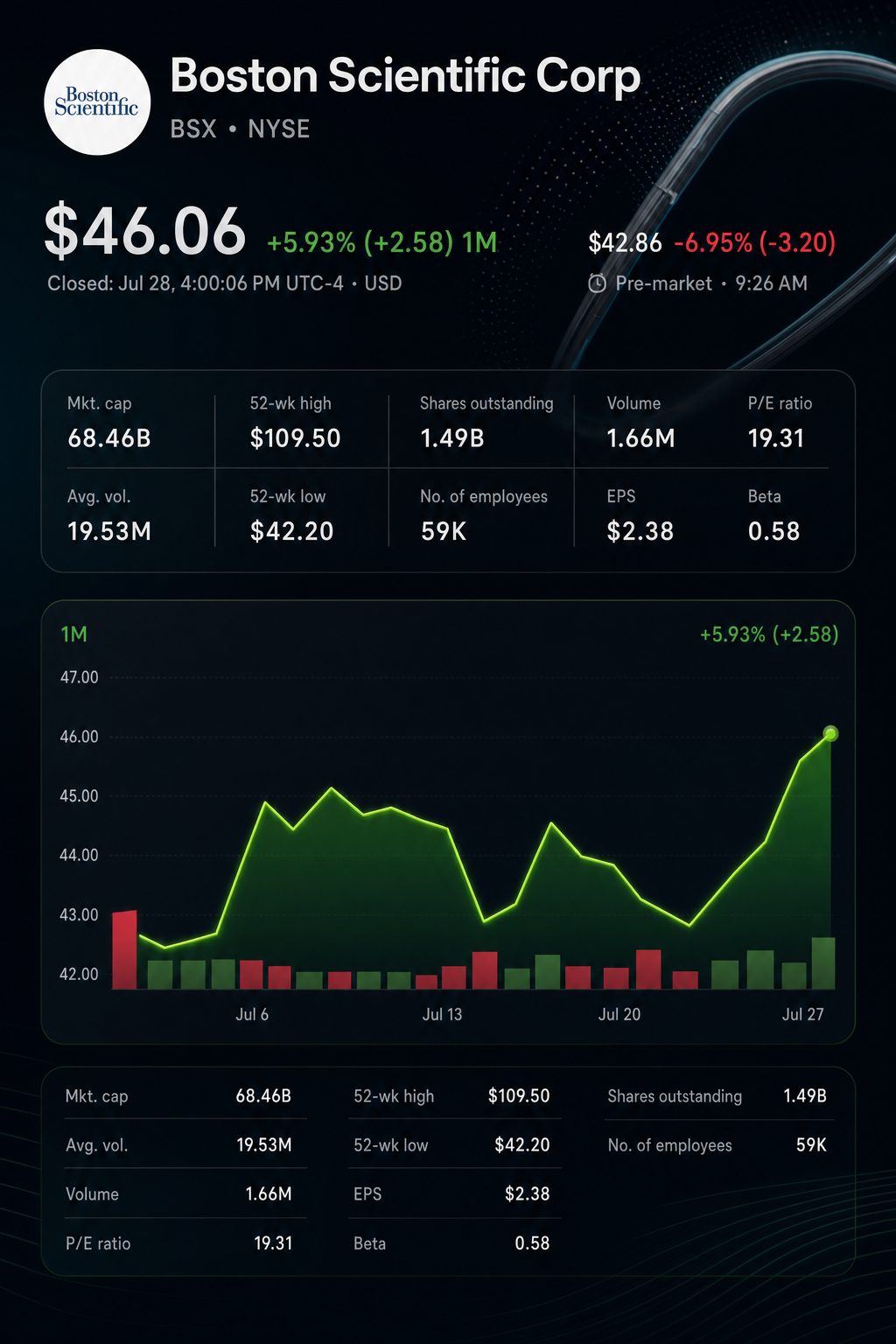
NEW YORK, July 29, 2026, 09:00 EDT — Boston Scientific NYSE:BSX shares declined after the medical device maker’s strong overseas results helped balance a downturn in its U.S. cardiac business.
Shares of Boston Scientific NYSE:BSX fluctuated by almost 10 percentage points in premarket trading on Wednesday. The stock dropped 5.1% to $43.71 as of 8:47 a.m. EDT, after previously rising 4.6%.
The reversal came after a second downgrade to the 2026 outlook since April. A quarterly beat failed to sway investors as Watchman concerns weighed on the second-half view.
The primary indicator for investors is found within two cardiac franchises. Roughly 68% of the combined dollar growth for Watchman and electrophysiology came from international markets.
Only 25% of their current-quarter sales accounted for that contribution. The figures are rounded, according to the company.
Q2 combined Watchman and electrophysiology
United States
International
Sales
$1.065 billion
$358 million
Increase over last year
$32 million
$66 million
Growth rate
3.1%
22.6%
Derived using Boston Scientific’s disclosed geographic sales data.
The divide indicates that international demand is mitigating, rather than resolving, weakness in the U.S. Both franchises saw domestic growth hold close to 3%.
Quarterly earnings surpassed expectations. Adjusted earnings per share came in at $0.86, compared to the $0.83 projected by LSEG.
Revenue increased by 7.5% to $5.44 billion, surpassing analysts’ forecasts of $5.36 billion.
Metric
Q2 result or new guidance
Prior guidance or consensus
Q2 revenue
$5.44 billion
$5.36 billion consensus
Q2 adjusted EPS
$0.86
$0.83 consensus
2026 organic sales growth
5.0%–6.0%
6.5%–8.0% previous
2026 adjusted EPS
$3.28–$3.32
$3.34–$3.41 previous; $3.36 consensus
Figures represent company forecasts alongside LSEG consensus projections.
Organic growth guidance was reduced by 1.75 percentage points at the midpoint. The midpoint for adjusted EPS declined 2.2% compared with April’s range.
Boston Scientific attributed Watchman weakness to a decline in standalone procedures. Physicians are more often implanting the device alongside other heart treatments in a single session.
Chairman and CEO Mike Mahoney described the results as a “solid quarter” despite a “dynamic environment.” He stated that Boston Scientific will focus on investments with the greatest impact. Boston Scientific
Profitability increased even as growth slowed. Adjusted operating margin rose to 28.4%, an increase of 70 basis points.
Free cash flow for the second quarter came in at $1.29 billion. The firm projects approximately $3.8 billion for 2026.
The restructuring provides an additional opportunity to impact earnings. Expected pretax charges are between $700 million and $800 million. Yearly gross savings may amount to approximately $500 million.
When fully implemented, this represents 1.4 to 1.6 years’ worth of gross savings compared to the charge. This does not constitute a profit forecast.
A significant portion of the savings is earmarked for growth initiatives. The strategy calls for a reduction in workforce, with completion targeted by end-2029.
Risks: U.S. Watchman and electrophysiology performance could remain subdued. Cost savings might be delayed, and reinvestments could restrict improvements in margins.
The upcoming Q3 test is next. The forecast projects sales growth of 3% to 5%, and adjusted EPS between $0.80 and $0.82. Continued strength from international demand remains important.
What caused BSX’s premarket movement to shift direction so abruptly?
BSX was down 5.1% at $43.71 as of 8:47 a.m. ET. Earlier, Reuters reported the shares climbed by nearly 4% before they reversed direction. The decline appeared linked to another reduction in full-year guidance, despite posting an earnings beat. S&P 500 futures traded close to unchanged, suggesting the reaction was primarily related to the company. Premarket movements often shift rapidly ahead of the opening auction.
Were second-quarter results above expectations?
Revenue for the second quarter was $5.442 billion, up 7.5% from a year earlier, surpassing the $5.36 billion analyst forecast from Reuters. Adjusted EPS came in at $0.86, exceeding the analyst consensus by three cents. GAAP EPS increased to $0.61 from $0.53 in the previous year’s quarter. Adjusted operating margin widened by 70 basis points to reach 28.4%. Free cash flow as defined by the company stood at $1.29 billion for the quarter.
By how much did management reduce its 2026 forecast this time?
The company now forecasts full-year reported sales growth in a 5.5% to 6.5% range, down from the previous 7.0% to 8.5% provided in April, marking a 1.75 percentage point reduction at the midpoint. Adjusted EPS guidance was trimmed to $3.28-$3.32, compared with a prior range of $3.34-$3.41—representing a midpoint about 2.2% lower. Third-quarter EPS guidance is $0.80-$0.82, below the consensus of $0.84, which could drive additional analyst estimate downgrades this week.
Has Watchman’s condition steadied, or is it continuing to decline?
Watchman generated $507 million in the quarter, achieving 4.2% organic growth in Q2. The product accounted for approximately 9.3% of Boston Scientific’s overall revenue for the period. Organic growth in the U.S. rose 3%, while growth internationally reached 17.7%. Management cited reduced LAAC referrals and evolving physician procedure patterns as reasons. Standalone use is falling as doctors increasingly combine Watchman with other procedures. Previously, management indicated that dollar sales would likely be steady from Q1 through Q3. A significant rebound in Q3 remains unclear.
What companies are compensating for the Watchman slump?
Interventional Cardiology and Vascular Therapies topped the list, delivering $1.333 billion in revenue. Organic growth was 12.1%, driven by robust demand for AGENT DCB. Electrophysiology revenue came in at $916 million, with worldwide organic growth of 9.1%. International EP increased by 23.1%, while growth in the U.S. was limited to 3.1%. Neuromodulation posted growth of 12.2%, and Endoscopy rose by 7.0% organically. Urology remained weak at 0.8%, and CRM fell by 1.6%. The overall mix remains strong, though multiple U.S. franchises continue to see slower momentum.
What are the financial implications of the restructuring plan?
The initiative seeks approximately $500 million in yearly gross pretax cost reductions. Pretax charges are estimated at $700 million to $800 million. Anticipated cash outlays are projected at $600 million to $700 million until the initiative is finished. Work is set to begin in 2026, with substantial completion targeted for 2029. Boston Scientific plans to cut some jobs but did not specify numbers. A significant portion of the savings is allocated for reinvestment in growth initiatives. The entire $500 million will not translate to operating profit.
Is BSX considered undervalued at these levels?
BSX is priced at $43.71, equating to approximately 13.2 times the $3.30 midpoint in its guidance. When the market closed on Tuesday at $46.06, the multiple was close to 14.0 times. These figures are based on adjusted EPS, which is not the same as GAAP earnings. The premarket price was just 3.6% above the $42.20 52-week low, and still roughly 60% under the 52-week peak of $109.50. Whether the stock is a bargain depends on if the guidance reductions have concluded.
Are analysts likely to lower their estimates and price targets this week?
Consensus estimates still reflected a 2026 adjusted EPS of $3.36, along with a Q3 adjusted EPS of $0.84 before recent updates. The company’s new guidance points to approximately $3.30 and $0.81, respectively. This discrepancy suggests analysts are likely to revise estimates downward in coming sessions. The average price target stood at $71.27 from 32 analyst ratings, with 24 issuing Buy, four assigning Overweight, and four recommending Hold. These ratings may not reflect the guidance reduction announced on Wednesday.
Does the buyback along with the Penumbra agreement enhance the risk-reward profile?
Boston Scientific’s $2 billion buyback took in around 40 million shares, representing about 2.7% of its diluted share count. Management projected an adjusted EPS boost of $0.02 for 2026. Approximately $3 billion remains accessible under its current buyback authorization. Boston Scientific The $14.5 billion acquisition of Penumbra calls for around $11 billion in cash financing. The company expects the first year post-deal to bring an adjusted EPS hit of $0.06-$0.08. Boston Scientific’s debt stood at $12.624 billion, or 2.0x adjusted EBITDA. Penumbra shareholders have voted in favour of the merger, but approvals from regulators are pending.
Iwona Majkowska is a financial markets journalist at TS2.tech. She covers stocks, artificial intelligence and technology, with a focus on the stories moving U.S. and global markets. Before turning to financial journalism, she worked in equity research and financial analysis. She is a graduate of the Warsaw School of Economics. Follow Iwona Majkowska on Google News.
Surprising starts and permits data can impact homebuilders, mortgage-sensitive stocks, Treasury yields, and the dollar if results deviate significantly from consensus estimates.
#02
Home Depot Q2
The results and outlook provide key insights into housing turnover, renovation demand, professional customer activity, and U.S. discretionary spending.
#03
09:15 ET industrial production
A robust or disappointing factory or utilities report can shift expectations for economic growth, cyclical stocks, bond yields, and the Federal Reserve’s policy direction.