
MINNEAPOLIS, August 27, 2026, 10:30 (EDT)
- Shares of Best Buy dropped 5.4% to $82.73 during Thursday morning trade.
- The drop wiped out an estimated $995 million in quoted equity value.
- Comparable sales grew by 4.1% in the second quarter, with adjusted EPS up 15%.
- A tariff refund of $34 million accounted for roughly 63% of the increase in the domestic gross-margin rate.
Best Buy Co. stock dropped 5.4% even after reporting quarterly results that topped estimates and raising its full-year forecast. Shares were last at $82.73 as of 10:29:49 a.m. EDT, with trading volume hitting 3.52 million shares NYSE:BBY market data.
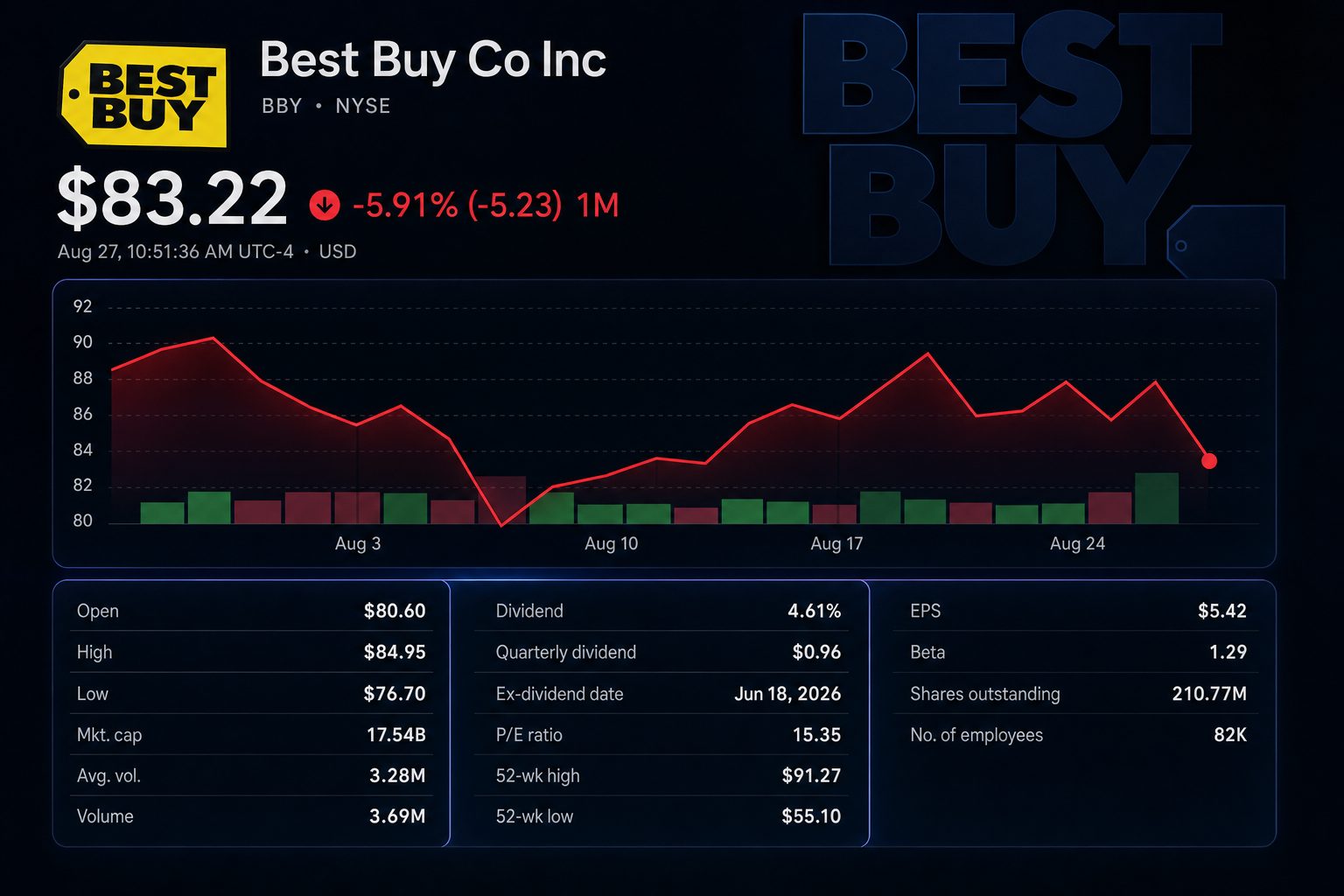
The drop reduced Best Buy’s market capitalization to roughly $17.47 billion, wiping out about $995 million since Wednesday’s close. The loss was greater than the $900 million boost in the midpoint of revenue guidance.
Best Buy posted second-quarter revenue of $9.78 billion, a 3.6% increase. Comparable sales advanced 4.1%. Adjusted diluted earnings per share climbed 15% to $1.47 Best Buy’s results.
The retailer increased its full-year revenue outlook to $42.3 billion to $42.8 billion, up from the earlier projection of $41.2 billion to $42.1 billion. Forecast for comparable sales was lifted to a range of 1.9% to 3.0%, compared to the previous guidance of negative 1% to positive 1%.
The company raised its adjusted EPS guidance to a range of $6.70-$6.90, up from $6.30-$6.60. The midpoint increased by 35 cents, or 5.4%. Thursday’s share price is approximately 12.2 times that updated midpoint.
| Measure | Current | Prior / year earlier | Change |
|---|---|---|---|
| Q2 revenue | $9.779B | $9.438B | up 3.6% |
| Comparable sales | up 4.1% | up 1.6% | increase of 250 bps |
| Adjusted operating margin | 4.3% | 3.9% | gain of 40 bps |
| Adjusted diluted EPS | $1.47 | $1.28 | up 14.8% |
| FY revenue midpoint | $42.55B | $41.65B | rise of $0.90B |
| FY adjusted EPS midpoint | $6.80 | $6.45 | increase of $0.35 |
The margin improvement came under examination. Domestic gross margin increased by 60 basis points to reach 24.0%. According to Best Buy, a $34 million tariff refund played a role in the rise.
Using 60 basis points on $9.07 billion in domestic revenue suggests an increase of $54 million. The refund thus accounted for about 63% of that margin gain. The drop in the stock’s value was 29 times greater than the refund.
Product economics continue to be uneven. Higher memory expenses drove average selling prices up by a mid-single-digit percentage, while unit sales declined by a high-single-digit percentage, incoming CEO Jason Bonfig said Reuters.
Growth was driven by computing and home theater. AI glasses and trading cards contributed as well. Traditional gaming and international comparable sales were down.
Departing CEO Corie Barry stated that shoppers continue to purchase high-priced items “when there is technology innovation.” Demand for appliances continues to be under pressure due to challenges in the housing market. Increased fuel prices could impact margins in the latter half.
The decline also highlights concerns over valuation. Best Buy shares had climbed roughly 30% in the year to Wednesday. According to a consensus from 25 analysts, the stock is rated Hold, with an average price target of $83.40 analyst consensus.
Risks: Declines in unit sales could accelerate if high food, fuel and housing expenses limit discretionary purchases. Product margins may face pressure due to memory inflation. The one-off refund is not expected to recur unless more claims are approved.
Third-quarter comparable sales are expected to rise 1%-3%, marking the next performance milestone. Investors are monitoring unit volumes and advertising revenue. These indicators will help determine if the improved outlook is backed by lasting demand.