
NEW YORK, Sept. 5, 2026, 12:08 a.m. EDT — BorgWarner (NYSE:BWA) reaffirmed a closely watched AI infrastructure power target after Friday’s closing bell. The company still expects turbine-generator production in 2027, initial installed capacity of 2 gigawatts and more than $300 million of first-year sales.
The number is material, but not transformative yet. It equals about 2.1% of the midpoint of BorgWarner’s $14.0 billion to $14.3 billion 2026 sales guide.
Friday’s Form 8-K was unusually direct. BorgWarner said it filed the statement “in response to questions” and repeated the timing, capacity and sales figures. It did not add a second customer, a margin target or a larger order.
BorgWarner climbed into the close
Friday intraday price, U.S. dollars, sampled every 30 minutes
Close as of . Source: Yahoo Finance market data. The $65.96 figure was the last recorded extended-hours trade near 8:00 p.m.; thin after-hours prints can be noisy.
The stock closed Friday at $67.54, up 2.8%. That move occurred before the filing at 4:30 p.m. EDT, so it cannot be cleanly attributed to the 8-K. Yahoo Finance later recorded a $65.96 extended-hours trade, which erased most of the regular-session gain.
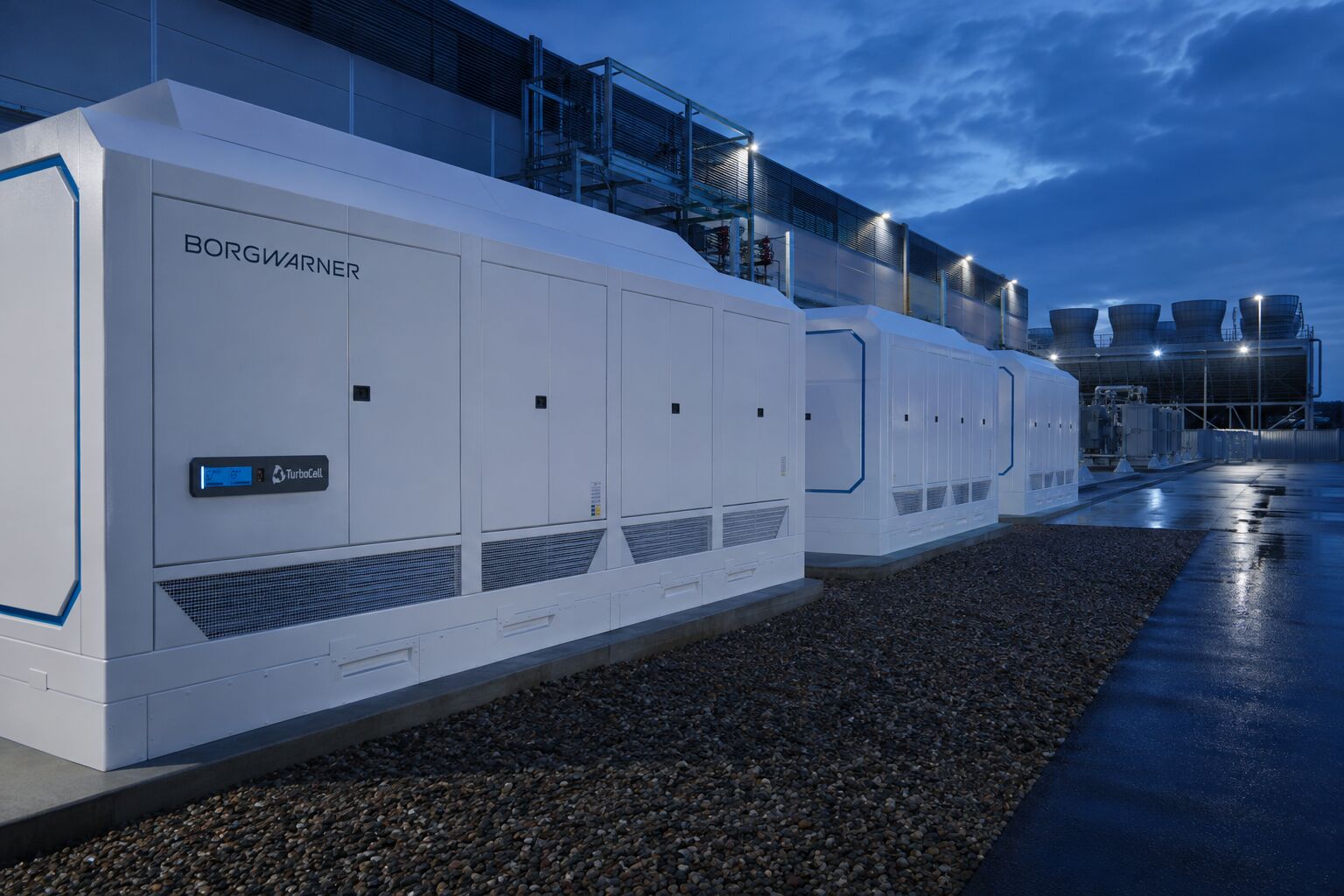
The project began as a February supply agreement with TurboCell, an Endeavour subsidiary. BorgWarner has worked on the modular system for more than three years. The machines are designed for prime, backup and peak-shaving power at AI campuses and microgrids.
A real growth leg, still small beside the core
Management targets and TS2 calculations; dollars refer to sales
Sources: BorgWarner’s Sept. 4 Form 8-K, its TurboCell announcement and second-quarter guidance. The 2.12% ratio uses $300 million and the $14.15 billion guide midpoint.
The product reaches outside BorgWarner’s car business. It can run on natural gas, propane, diesel or hydrogen, according to the company. BorgWarner also claims efficiency above 36% across 60% to 90% load.
Vertical integration is the more interesting detail. BorgWarner expects to control roughly 65% of the system’s content, using its turbocharging, thermal-management, power-electronics and software operations. That could give the project more economics than a simple contract-manufacturing job.
Chief Executive Joseph Fadool said in February that the system could “open avenues for further profitable growth.” The new filing preserved the sales target, but offered no gross-margin bridge. Investors still lack the number needed to test that profit claim.
The existing business supplies a sturdy base. Second-quarter sales were $3.65 billion and adjusted operating margin reached 11.3%. Adjusted earnings rose 17% to $1.42 per share.
Yet organic sales fell 1.2% in that quarter. BorgWarner expects its weighted light-vehicle markets to range from a 3% decline to flat this year. Data-center power therefore brings something the portfolio needs: a demand cycle not tied to vehicle production.
Wall Street prices a larger runway — with a wide spread
Published 12-month targets versus Friday’s $67.54 close
$62Current
$67.54Average
$80.13High
$95
Source: S&P Global analyst data compiled by StockAnalysis, last updated Aug. 31, 2026. Targets range from $62 to $95. They predate Friday’s 8-K and are opinions, not forecasts from BorgWarner.
Analysts already carry that optionality in their numbers. The S&P Global consensus tracked by StockAnalysis shows 11 positive ratings and five holds. The $80.13 average target stands 18.6% above Friday’s close.
The range tells the better story. Published targets run from $62 to $95. Argus cut its target to $67 this week, while RBC recently began coverage at $87. The market has not agreed on how much non-auto growth deserves to be valued today.
Risks: The $300 million figure is management’s expectation, not recognized revenue. Production can slip, customer deployment can change, and the filing disclosed neither margin nor purchase-volume protection. Fuel, permitting and grid-connection rules can also slow data-center projects.
U.S. exchanges are shut through Monday for Labor Day. When BorgWarner trades again Tuesday, the key question is modest: does the 8-K merely steady confidence, or can management turn 2 GW of factory capacity into a second customer and a disclosed profit stream? The filing answered the timing question. It did not answer the economics.