
Published Thursday, November 13, 2025
Fresh observations today keep 3I/ATLAS—the third confirmed interstellar object—firmly in the “strange but natural comet” camp. Meanwhile, a different ATLAS‑discovered comet in our solar system, C/2025 K1 (ATLAS), is visibly fragmenting. Here’s what changed today, what didn’t, and how to tell these two “ATLAS comets” apart. ScienceAlert+2NASA Science+2
What’s new today (Nov. 13)
- No, it’s not an alien probe: A new analysis published today underscores that 3I/ATLAS’s recent “radio signal” is classic comet chemistry, not technology. The signal detected by South Africa’s MeerKAT radio array is due to hydroxyl (OH) produced when sunlight breaks up water from the comet—textbook outgassing. ScienceAlert+1
- Loeb posts “still a single body” claim: Harvard’s Avi Loeb today highlighted images from Nov. 11 (Nordic Optical Telescope) arguing 3I/ATLAS remains intact after perihelion and shows a prominent sunward “anti‑tail,” renewing his speculation about non‑natural explanations. Most astronomers counter that the features are consistent with comet physics and geometry. Medium+1
- A different ATLAS comet is breaking up: Don’t confuse the interstellar 3I/ATLAS with C/2025 K1 (ATLAS), an Oort‑cloud comet that did show clear fragmentation today in new images from the Virtual Telescope Project. Multiple sub‑components are visible in its inner coma in animations captured on Nov. 13.
The science behind the week’s biggest talking points
The “radio signal” explained.
MeerKAT detected OH absorption at the familiar radio frequencies used to trace water loss in comets. That’s direct evidence that 3I/ATLAS is venting water as it warms—exactly what a coma should do. The detections match natural chemistry seen in Solar System comets and do not imply technology. Live Science
A tail that keeps lengthening.
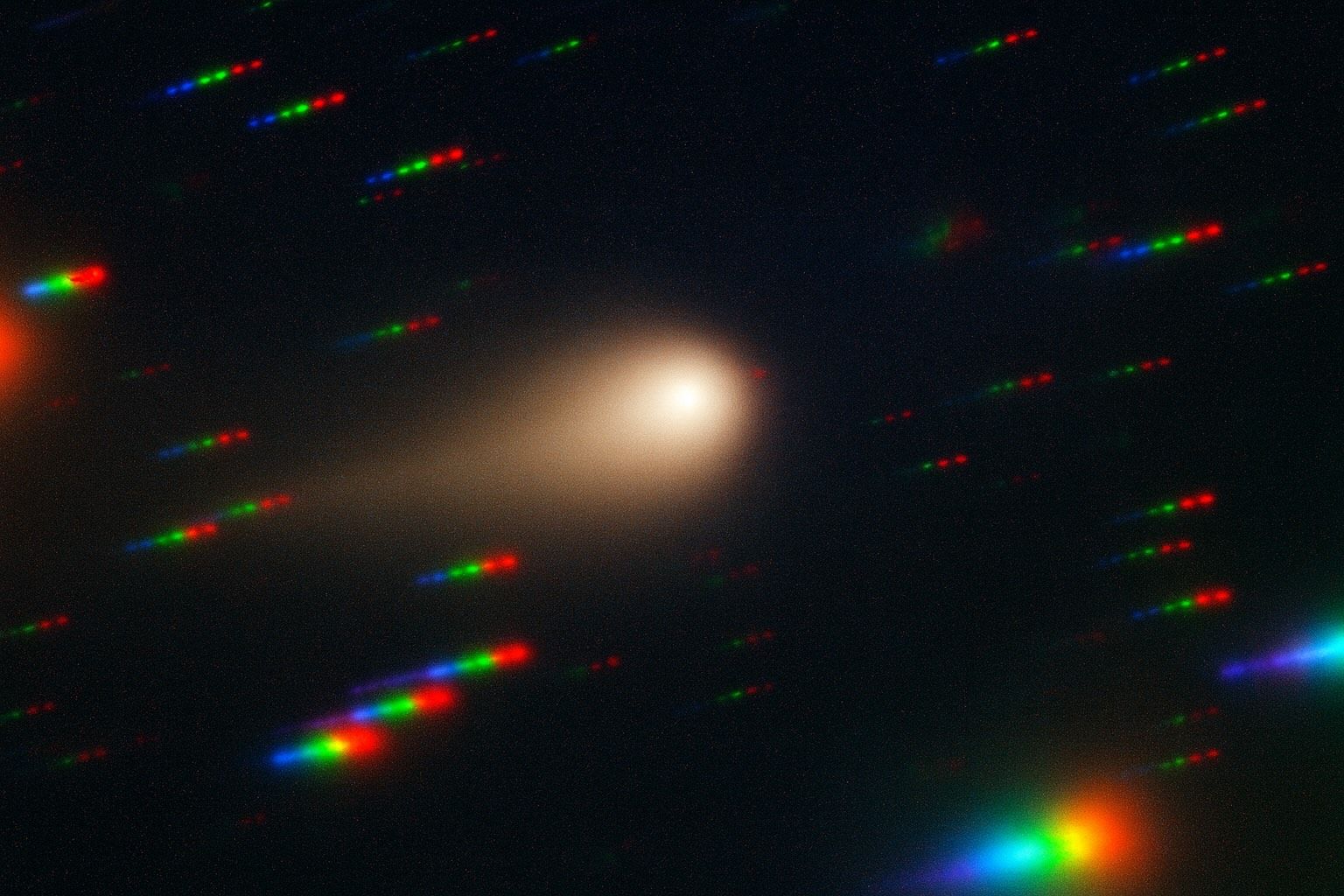
As 3I/ATLAS re‑emerged from behind the Sun, astrophotography this week shows a brighter, more structured ion tail and even a perspective‑driven anti‑tail (dust aligned along the orbit that can appear to point sunward). An image captured Nov. 10–11 shows the ion tail stretching roughly 0.7 degrees—evidence of intensifying outgassing after perihelion.
Where 3I/ATLAS is, and whether it’s dangerous.
NASA reiterates that 3I/ATLAS is on a hyperbolic, one‑time pass through the inner solar system and poses no threat to Earth. It reached perihelion around Oct. 30, 2025 (~1.4 AU) and remains no closer than ~1.8 AU from Earth—tens of millions of miles beyond the Moon’s orbit by a vast margin.
How to see it (for experienced observers)
On Nov. 13, 3I/ATLAS is a faint, telescopic target low before dawn, plotted in Virgo on star‑chart services today. You’ll want a small telescope, dark skies, and patience; it’s not a naked‑eye object. Expect a thin ion tail and, depending on viewing geometry, hints of an anti‑tail.
Why astronomers care
3I/ATLAS is only the third interstellar visitor we’ve been able to study, after 1I/‘Oumuamua and 2I/Borisov. Unlike ‘Oumuamua, 3I/ATLAS is unambiguously cometary, giving scientists a rare lab to compare ices and dust from another planetary system with those in our own. NASA lists a wide campaign of assets (Hubble, Webb, SPHEREx, Mars orbiters, and more) following the object through early December and beyond; ESA’s JUICE spacecraft is also attempting coordinated observations in November 2025.
About that “alien thrusters” narrative
Loeb’s posts continue to frame several observed oddities (rapid brightening, complex tail structure, anti‑tail) as potential signs of propulsion or fragmentation‑driven surface area, but the bulk of peer commentary points to normal—if unusual—comet behavior: strong volatile ices, changing viewing geometry, and ion‑tail dynamics. Today’s coverage again stresses that the radio detections and current imaging fit the comet hypothesis.
Meanwhile: C/2025 K1 (ATLAS) is fragmenting
Separate from the interstellar comet, C/2025 K1 (ATLAS)—discovered by the same survey but originating in our Oort Cloud—continues a post‑perihelion outburst and fragmentation episode. New Nov. 13 imagery resolves multiple pieces in the inner coma and evolving plumes across just 24 hours. It’s a reminder that fragile, Sun‑scorched nuclei can (and often do) come apart naturally.
Key facts at a glance
- Object: 3I/ATLAS (a.k.a. C/2025 N1 ATLAS), interstellar comet on a hyperbolic trajectory. Status: active, reappearing in the morning sky after late‑October perihelion. Risk to Earth: none; closest ~1.8 AU.
- Today’s headlines: Radio detection = OH from outgassing (natural); images show growing ion tail and anti‑tail; a separate comet, C/2025 K1 (ATLAS), is fragmenting.
- What’s next: Continued ground‑ and space‑based monitoring; ESA JUICE has a November window for opportunistic observations; 3I/ATLAS heads outward and past Jupiter in March 2026.
Editor’s note on naming: “ATLAS” refers to the University of Hawai‘i–run Asteroid Terrestrial-impact Last Alert System sky survey that discovered both objects. 3I/ATLAS is the interstellar comet; C/2025 K1 (ATLAS) is a separate, solar‑system comet. The similar labels have generated confusion in social posts; today’s fragmentation reports apply to C/2025 K1, not to 3I/ATLAS. NASA Science+1