Updated: Nov. 7, 2025 — This roundup focuses on developments reported today (7.11.2025).
Key updates at a glance
- Fresh Lowell Discovery Telescope image shows 3I/ATLAS glowing green; the “missing tail” is a line‑of‑sight trick, not an anomaly. Live Science
- Scientists push back on viral claims that the comet “changed color.” There’s no evidence the gas coma itself shifted hues; what you see depends on filters and gas emissions. Space
- Back in amateur telescopes: 3I/ATLAS has re‑emerged in the predawn sky, trackable with small backyard scopes in early November. Space
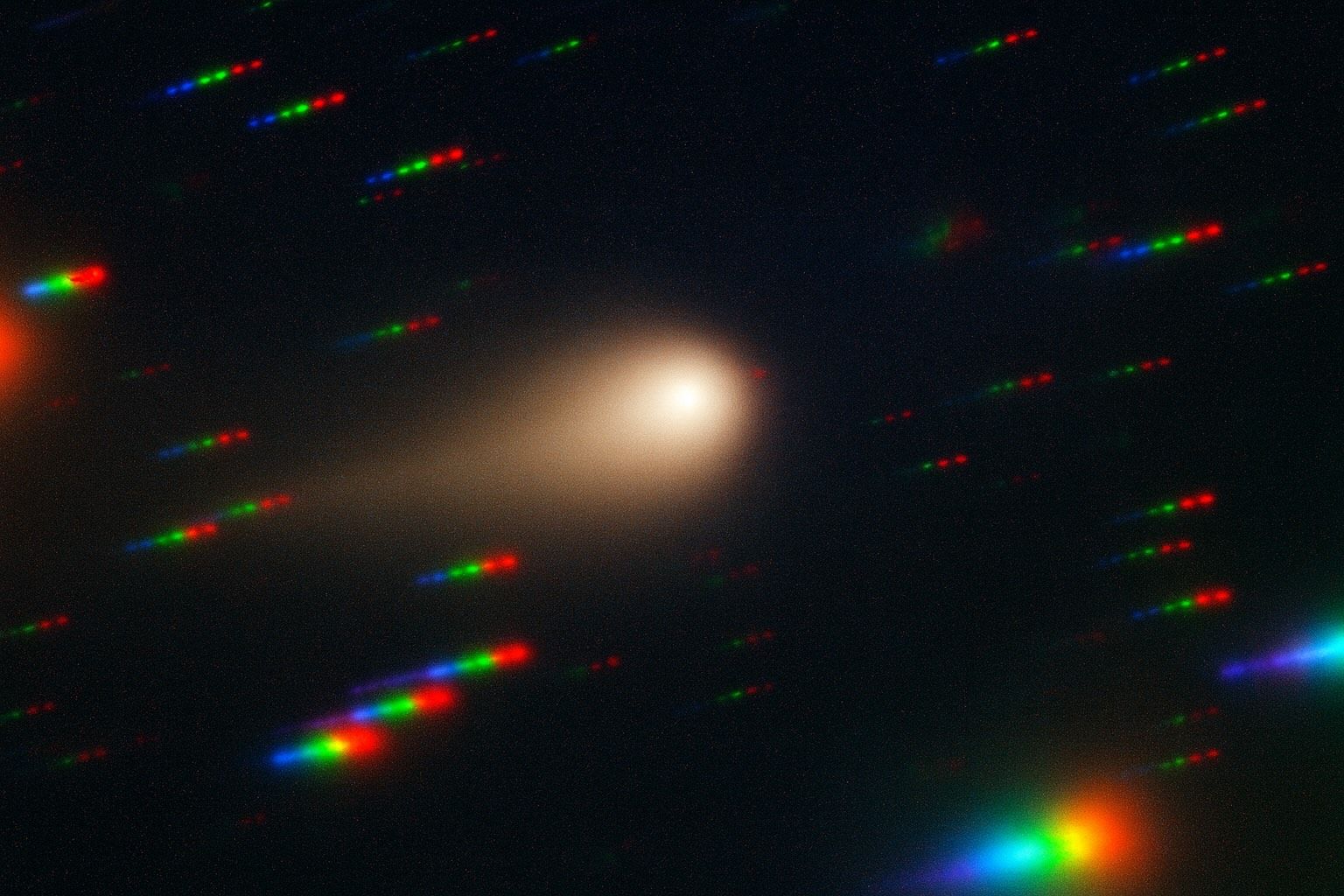
- New tonight: The Virtual Telescope Project published a Nov. 6 image (posted today) confirming a visible coma under tough observing conditions. The Virtual Telescope Project 2.0
- Observer community mobilizes: The International Asteroid Warning Network (IAWN) closed registration today for a Nov. 27–Jan. 27 astrometry campaign focused on 3I/ATLAS; workshop on Nov. 10. IAWN
What scientists reported today
Green glow, “hidden” tail—here’s the physics. A new image captured with the Lowell Discovery Telescope shows 3I/ATLAS brightest through a filter sensitive to diatomic carbon (C₂), which fluoresces green in sunlight. The dust tail isn’t gone—you’re seeing it almost head‑on, so it blends with the coma and appears subdued. That geometry explains images where the tail seems to “disappear.” Live Science
No, it hasn’t “changed color.” A preprint that compared sun‑skirting observations led to headlines about dramatic hue shifts. Co‑author Qicheng Zhang clarified: “We don’t have any evidence for the gas coma changing colors.” Differences arise from which wavelengths instruments emphasize and how much the gas coma contributed at the time. Space
Another independent check: Italy’s Virtual Telescope Project posted a Nov. 6 frame (published today) with a clear coma, supporting the standard comet interpretation and today’s visibility window. The Virtual Telescope Project 2.0
Where (and how) to see 3I/ATLAS now
- When: Early predawn over the next few days.
- Where: Low in the eastern sky in Virgo, with Venus shining beneath as a bright guide.
- Gear: A small backyard telescope can pick it up as a fuzzy “star.” Long‑exposure images help. Visibility is improving as it climbs away from the Sun’s glare, but comets are fickle; catch it soon. Space
Reality check: trajectory, safety, and timing
- Interstellar origin: 3I/ATLAS is only the third known interstellar object to visit our solar system (after 1I/ʻOumuamua and 2I/Borisov). Its hyperbolic path confirms it’s a passer‑by, not a long‑term resident. NASA Science
- Perihelion: The comet reached closest approach to the Sun around Oct. 29–30, 2025 at ~1.4 AU (inside Mars’s orbit). NASA Science+1
- Closest to Earth: Mid‑December; ~270 million km (1.8 AU) on Dec. 19, 2025. No threat to Earth at any point. European Space Agency
Broader science context (what matters beyond tonight)
- Radiation‑toughened exterior: JWST‑supported modeling suggests billions of years of galactic cosmic rays have transformed the comet’s outer ~15–20 m, enriching CO₂ and masking pristine interior material—key context for interpreting spectra collected now that it’s observable again. Live Science
- Global observing push: With 3I/ATLAS so rare, agencies are turning every available eye. China’s Tianwen‑1 released Mars‑orbit images this week; ESA and NASA assets have also targeted the comet before and after perihelion. Space+1
- Coordinated community campaign: IAWN’s astrometry exercise (Nov. 27–Jan. 27) will help refine comet‑tracking techniques on a high‑value, low‑risk target. Registration closed today; materials and observing window details are public. IAWN
Quick FAQ
What is 3I/ATLAS (sometimes written “3i/atlas”)?
An interstellar comet discovered July 1, 2025 by the ATLAS survey in Chile—only the third known interstellar visitor. The “3I” means “third interstellar”; “ATLAS” credits the discovery team. European Space Agency
Why does it look green?
Many comets glow green in specific filters because sunlight excites C₂ molecules in the coma. That’s what today’s Lowell image isolates. Live Science
Does it really have no tail?
It has a tail; viewing geometry can place the tail nearly behind the coma from Earth’s perspective, making it hard to separate in images. Live Science
Is Earth safe?
Yes. Minimum distance is about 1.8 AU (~270 million km) on Dec. 19, 2025—farther than the Sun is from Earth. European Space Agency
Where should I point my telescope?
Try the eastern horizon before dawn in Virgo. A small telescope suffices; long exposures help reveal the fuzzy coma. Space
The bottom line
On Nov. 7, 2025, the story of 3I/ATLAS is clear: a natural interstellar comet back in view, sporting a green‑emitting gas coma, with a tail mostly hidden by perspective—and a worldwide observing community ramping up to squeeze every drop of science from a once‑in‑a‑generation visitor. Watch the predawn sky this week, and expect a steady cadence of results as the campaign begins later this month. IAWN+3Live Science+3Space+3
Sources referenced today: Live Science reporting and image analysis; Space.com visibility guide and color clarification; ESA FAQ for naming, dates, and distances; NASA’s 3I/ATLAS overview for safety/orbit basics; The Virtual Telescope Project’s Nov. 6 image published today; and Space.com’s Nov. 6 report on Tianwen‑1’s images. Space+6Live Science+6Space+6