
NEW YORK, August 4, 2026, 05:07 (EDT)
Alphabet NASDAQ:GOOGL has leveraged its balance sheet to secure more favourable financing for AI chips. Data centers supported by Google borrowed at a median rate of 7.1%, while those involving Nvidia NASDAQ:NVDA chips faced a 9.3% rate. The related maximum credit exposure totaled $43.8 billion.
The 220-basis-point difference has the potential to boost external sales of Google’s tensor processing units. Alphabet does not have to control each chip or facility. However, a significant portion of the reported $200 billion financial structure relies on lease payments from Anthropic.
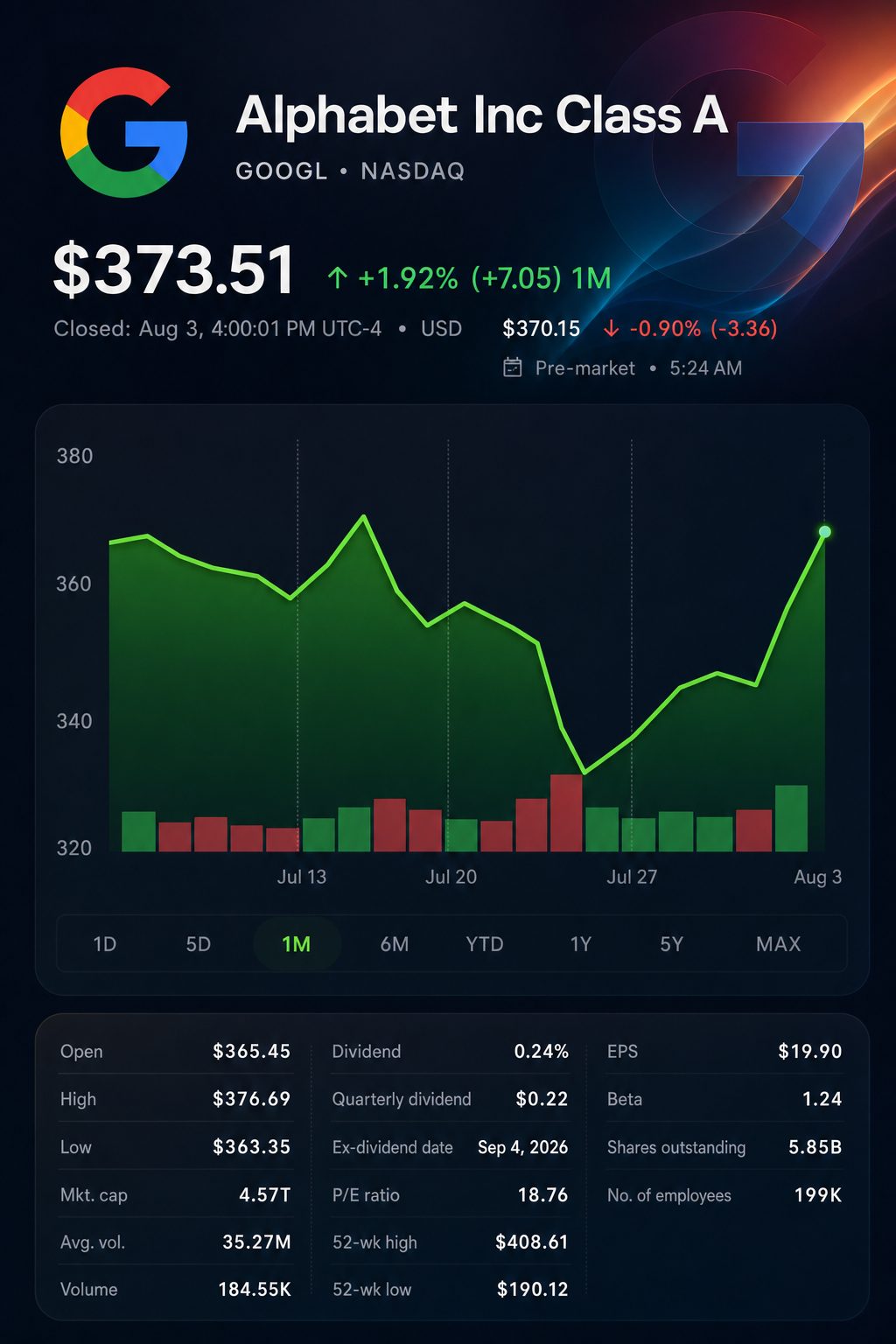
U.S. regular trading was yet to open when measured at the dateline. Premarket activity was underway. Alphabet most recently traded at $373.51, marking a 4.9% increase from its prior close.
According to SEC filings, the credit backstop has increased at each reporting date. The ratios listed below are based on reported fair-value liabilities.
| Reporting date | Maximum credit notional | Booked liability | Approximate notional/liability |
|---|---|---|---|
| September 30, 2025 | $6.5 billion | Not material | — |
| December 31, 2025 | $16.9 billion | $69 million | 246 times |
| March 31, 2026 | $28.4 billion | $339 million | 84 times |
| June 30, 2026 | $43.8 billion | $815 million | 54 times |
The June notional rose 571% compared to September. The recorded liability amounted to 1.9% of that peak figure. Both metrics do not reflect a projected cash loss.
Alphabet states that notional represents the maximum it could be liable for in the event of certain defaults. Some agreements can last up to 15 years. The company has the option to take over or sublet the properties, which could lower its final net loss.
Gross exposure remains significant in addition to primary financial metrics. The comparison factors in a single quarterly flow and a pair of balance-sheet stocks.
| Alphabet financial benchmark | Reported amount | $43.8 billion as a percentage |
|---|---|---|
| Q2 capital expenditure | $44.9 billion | 98% |
| Cash and liquid assets | $242.5 billion | 18% |
| Total long-term liabilities | $98.2 billion | 45% |
Alphabet posted a negative free cash flow of $5.9 billion for the quarter. Chief Financial Officer Anat Ashkenazi stated “demand still outpaces that investment.” The company increased its 2026 capital spending outlook to a range of $195 billion to $205 billion. Alphabet Investor Relations
Third-party capacity is set to increase in the third quarter. Management anticipates this will create slight near-term pressure on cloud margins.
This renders external funding strategically advantageous. By doing so, Google can boost TPU shipments as investors cover hardware and building expenses. The Financial Times identified roughly $200 billion in associated agreements. Over $150 billion were tied to TPUs designated for Anthropic.
Median project rates illustrate the competitive dynamic. These figures are not reflective of either company’s overall corporate borrowing expense.
| Project group | Median borrowing rate | Gap against Google-backed projects |
|---|---|---|
| Google-supported data centers | 7.1% | — |
| Nvidia-chip neocloud projects | 9.3% | 220 basis points |
Broadcom NASDAQ:AVGO plays a major role in the supply chain. According to its May-quarter report, the company reported $128.1 billion in binding purchase obligations. The majority of these commitments are due in fiscal 2027 and 2028.
| Broadcom fiscal timing | Purchase commitments | Share of total |
|---|---|---|
| 2027 | $55.2 billion | 43.1% |
| 2028 | $72.9 billion | 56.9% |
| All other periods | Roughly $0.03 billion | Under 0.1% |
| Total | $128.1 billion | 100% |
Broadcom, Google and Anthropic stated the startup expects to utilize approximately 3.5 gigawatts beginning in 2027. According to their SEC filing, use of this amount relies on Anthropic maintaining commercial viability. This clause places demand risk on a single factor.
Alphabet’s performance reflects strong demand. Google Cloud revenue climbed 82% to $24.8 billion for the second quarter, while backlog increased to $514 billion. The majority of revenue tied to current TPU-system contracts is projected for 2027.
Additional financial guarantees bring in $7.6 billion on top of existing credit derivatives. Alphabet projects $24.1 billion more in potential future backstops, though this figure is early and contingent on final agreements. Taken together, the straightforward gross sum across these instruments totals $75.5 billion, equal to 31% of liquidity as of June.
Risks: A slowdown at Anthropic might result in surplus capacity or lead to more claims. Jefferies Financial Group NYSE:JEF analyst Jonathan Petersen described declining buyer demand as “the big macro risk.” Delays in power supply and rising interest rates might also reduce Google’s funding advantage. Financial Times
Related articles: NASDAQ:GOOGL