
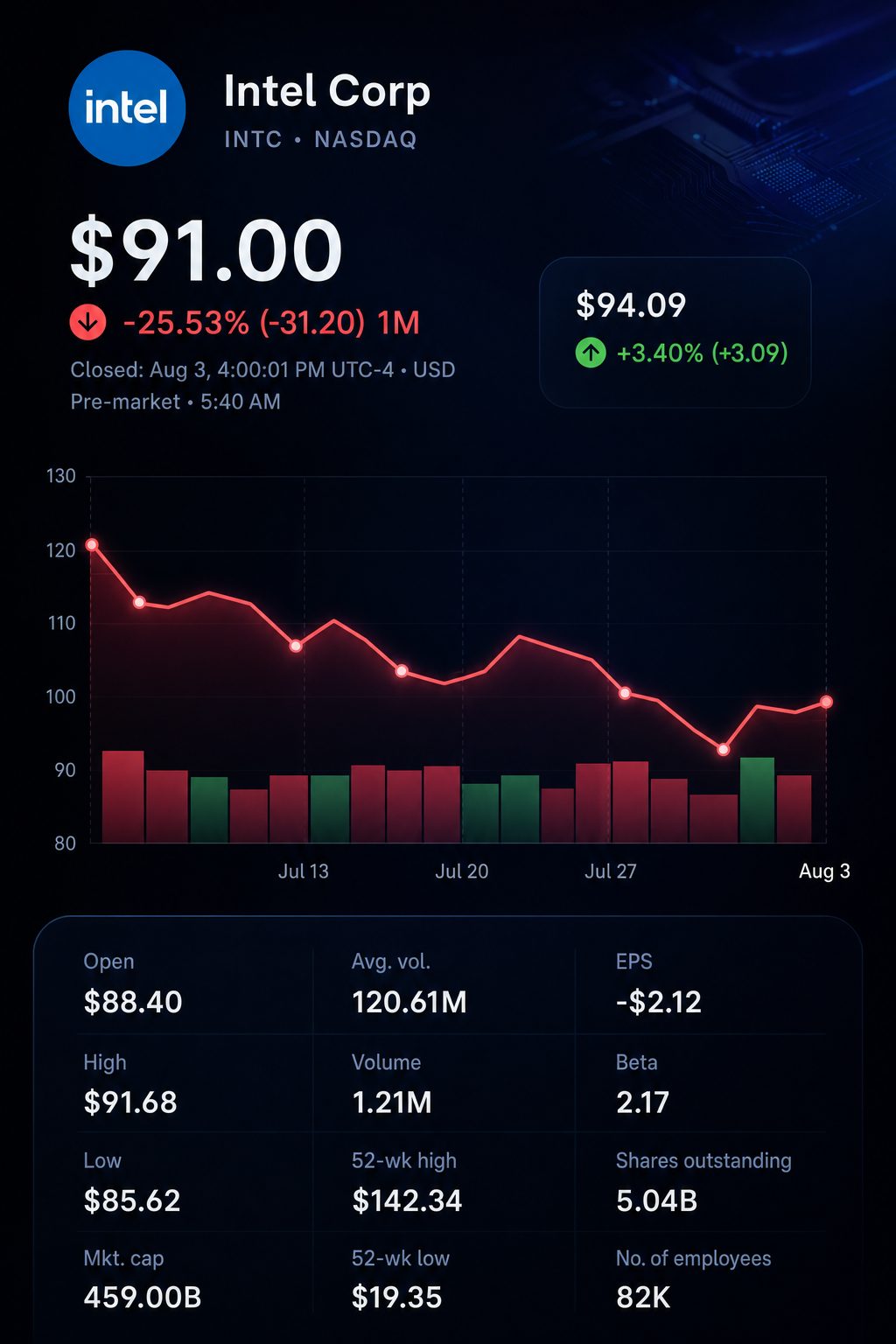
NEW YORK, August 4, 2026, 05:08 EDT – Intel (INTC.O) finished trading at $91 on Monday, as strong growth in its AI server business contrasted with weaker performance in its foundry unit, which continues to trail the sector.
- Intel finished Monday at $91.00, rising 0.9%, as the Nasdaq advanced 2.1%.
- Only 5.1% of the foundry segment’s revenue in the second quarter came from external customers.
- Foundry reported a $2.09 billion loss, amounting to 84% of DCAI’s operating profit.
Intel Corporation NASDAQ:INTC ended Monday’s session at $91.00, up 0.9%. The gain lagged behind the Nasdaq Composite, which rose 2.1%. When published, standard U.S. trading had ended and premarket activity was taking place.
The pace of progress is crucial. Intel’s data-center division is seeing rapid growth. However, the economics of the foundry business are still key to the company’s upcoming turnaround phase.
On Monday, peer movements highlighted that Intel lagged behind the primary beneficiaries of AI chips.
| Company | Last regular-session price | Daily move |
|---|---|---|
| Intel Corporation NASDAQ:INTC | $91.00 | up 0.9% |
| Advanced Micro Devices NASDAQ:AMD | $484.64 | rising 1.7% |
| NVIDIA Corporation NASDAQ:NVDA | $206.64 | gaining 2.9% |
| Taiwan Semiconductor Manufacturing NYSE:TSM | $406.11 | higher by 0.5% |
The more pressing concern lies within foundry revenue. Last quarter, Intel recorded $5.765 billion for this segment. Of that amount, just $293 million—equal to 5.1%—was generated from external clients.
Altera’s shift in reporting status accounted for the majority of external growth. The vast majority of foundry operations continue to support Intel’s internal product lines. Widespread customer adoption has not yet been demonstrated.
Server earnings continue to drive investment in manufacturing growth, as indicated by the segment split.
| Second-quarter segment | Revenue | Year-on-year change | Operating income/(loss) | Operating margin |
|---|---|---|---|---|
| Client Computing and Physical AI | $8.877B | up 13% | $2.343B | 26% |
| Data Center and AI | $6.262B | up 59% | $2.474B | 40% |
| Intel Foundry | $5.765B | up 31% | $(2.089)B | (36%) |
Foundry reports $5.5 billion in intersegment revenue, meaning segment revenues do not sum directly to consolidated revenue.
Foundry reported an operating loss amounting to 84% of DCAI’s operating profit. Transfers between segments make direct cash flow comparisons impossible. Nevertheless, the difference in scale remains significant.
The factory unit has shown improvement, with its loss margin falling to 36%, compared with 72% a year ago. Still, more expensive 18A wafers cut product profit by $340 million.
Intel’s third-quarter forecast exceeded earlier projections, though growth was minimal from the previous quarter. The revenue midpoint of $16.3 billion surpassed pre-release consensus by 7.9%, but it was just 1.1% higher than second-quarter revenue.
| Metric | Second-quarter actual | Third-quarter guidance | Sequential change |
|---|---|---|---|
| Revenue | $16.128B | $16.3B midpoint | +1.1% |
| Non-GAAP gross margin | 41.8% | 42.0% | +0.2 percentage point |
| Non-GAAP EPS | $0.42 | $0.38 | -9.5% |
Chief Executive Lip-Bu Tan stated, “AI is driving unprecedented demand for compute.” Intel increased its projected 2026 capital expenditure to $20 billion, up from $18 billion. Continued utilization and external foundry demand are now required to support that investment. Intel Corporation
Shay Boloor from Futurum Group conducted a comparable assessment. According to him, Intel needs to “convert the current data center shortage into sustained revenue growth” in order to achieve a re-rating. Boloor also mentioned improvements in foundry economics and securing more external customers as important factors. Reuters
AMD will announce its results after Tuesday’s closing bell, with a conference call scheduled for 5 p.m. EDT. The company’s server insights will give investors an updated view on demand relevant for Intel.
Intel’s advance on Monday sent mixed signals. Investors participated in the wider semiconductor rally, but placed greater preference on NVIDIA and AMD. The primary difference continues to be the external foundry conversion gap.
Risks are still considerable. Continued component shortages could extend into next year, restricting shipments. Elevated process costs might postpone improvements in margins. Competitive pressures, softer demand, ongoing trade restrictions, or setbacks in securing external deals would also affect outcomes.
Related articles: NASDAQ:INTC