
SANTA CLARA, California, August 21, 2026, 10:05 EDT
- Intel traded 3.2% below the price of its $20 billion share sale.
- The base issue equals about 4.0% of current shares outstanding.
- Wall Street’s average target implies 27% upside, but views remain wide.
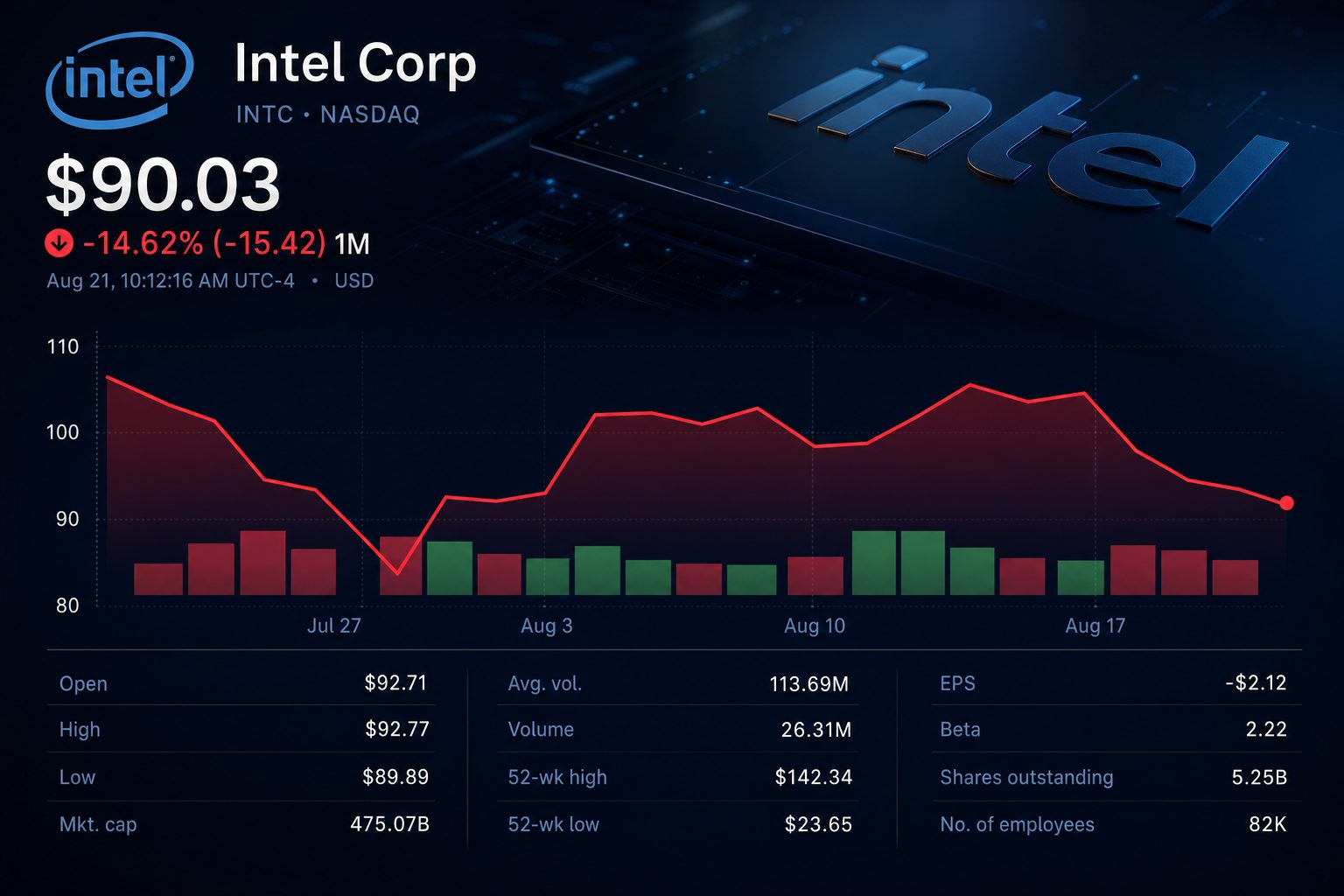
Intel Corporation NASDAQ:INTC shares remained below their $95 offering price on Friday. The stock traded at $91.92 at 09:44 EDT, down 0.2%. That left buyers in the upsized sale with a 3.2% paper loss.
The gap matters because Intel sold 210.5 million shares only nine days ago. The $20 billion raise strengthens the balance sheet. It also makes each existing share a smaller claim on future profit.
Intel expects about $19.7 billion of net proceeds before any option exercise. That equals 4.1% of Friday’s $485.5 billion market value. It is also 2.8 times second-quarter operating cash flow.
| Offering measure | Verified figure | Investor reading |
|---|---|---|
| Offer price | $95.00 | 3.2% above Friday’s quote |
| Base shares sold | 210.5 million | About 4.0% of current shares |
| Underwriter option | 31.6 million | Another 0.6% if fully used |
| Expected net proceeds | $19.7 billion | 4.1% of market value |
The company upsized the transaction from $15 billion. It said proceeds may fund capital spending and working capital. Underwriters can buy another 31.6 million shares within 30 days.
The timing is awkward. Intel’s stock has risen almost fourfold from its 52-week low. Yet it remains 35% below the high, leaving the offering between two very different valuations.
| Market reference | Price | Difference from $91.92 |
|---|---|---|
| Friday open | $92.71 | -0.9% |
| Offering price | $95.00 | -3.2% |
| 52-week high | $142.35 | -35.4% |
| 52-week low | $23.65 | +288.7% |
Chip shares also faced a softer tape. The Philadelphia semiconductor index was down about 5% for the week. Higher yields and caution before next week’s Nvidia results pressured the sector.
The capital raise follows a sharp operating rebound. Second-quarter revenue climbed 25% to $16.1 billion. Non-GAAP gross margin reached 41.8%, while operating cash flow was $7.0 billion.
Chief Executive Lip-Bu Tan called it Intel’s “strongest revenue growth in more than fifteen years.” Data-center and AI revenue rose 59%. Foundry revenue increased 31%, though the manufacturing build still requires heavy investment. Intel Q2 earnings release filed with the SEC
| Operating measure | Q2 2026 | Q2 2025 | Change |
|---|---|---|---|
| Revenue | $16.1 billion | $12.9 billion | +25% |
| Non-GAAP gross margin | 41.8% | 29.7% | +12.1 points |
| Non-GAAP operating margin | 17.2% | -3.9% | +21.1 points |
| Non-GAAP EPS | $0.42 | -$0.10 | Return to profit |
Analysts see the financing differently. UBS lowered its target to $112 and kept a Hold rating. Bank of America reiterated Buy at $145. J.P. Morgan’s $85 target sits below Friday’s price.
| Firm | Recommendation | Target | Implied move |
|---|---|---|---|
| Bank of America | Buy | $145 | +57.7% |
| UBS | Hold | $112 | +21.8% |
| Mizuho | Hold | $109 | +18.6% |
| J.P. Morgan | Sell | $85 | -7.5% |
| Rosenblatt | Sell | $80 | -13.0% |
The broader tally is cautious. Among 30 analysts tracked by Google Finance, five rate Intel Buy. Twenty-three say Hold and two say Sell. The $116.84 average target implies 27.1% upside, but the range stretches from $80 to $200.
Bank of America estimated that the larger share count could trim future earnings per share by 4% to 5%. The bank retained a positive long-term view. UBS said the raise removed a financing overhang, while cutting its target.
Investors now need revenue growth and margin gains to outrun that dilution. A sustained move back above $95 would be the first clean signal. Until then, the offering price remains a visible ceiling.
Risks: Stronger AI demand or new foundry wins could lift estimates quickly. Delays at Intel 18A, weaker PC demand, higher yields or a fully exercised option could deepen the discount.
Related articles: NASDAQ:INTC