
SANTA CLARA, California, August 22, 2026, 09:34 PDT
- Intel ended Friday trading at $90.07, marking a 5.2% drop from its latest $95 offering price.
- The stock declined 12.1% over the week, lagging other leading chipmakers.
- The $20 billion fundraising supports expansion efforts, increasing the share count by approximately 4%.
Intel Corporation NASDAQ:INTC closed at $90.07 on Friday, trading beneath the level set in its $20 billion equity sale. The stock dropped 12.1% week-on-week and declined 2.2% during the last trading session.
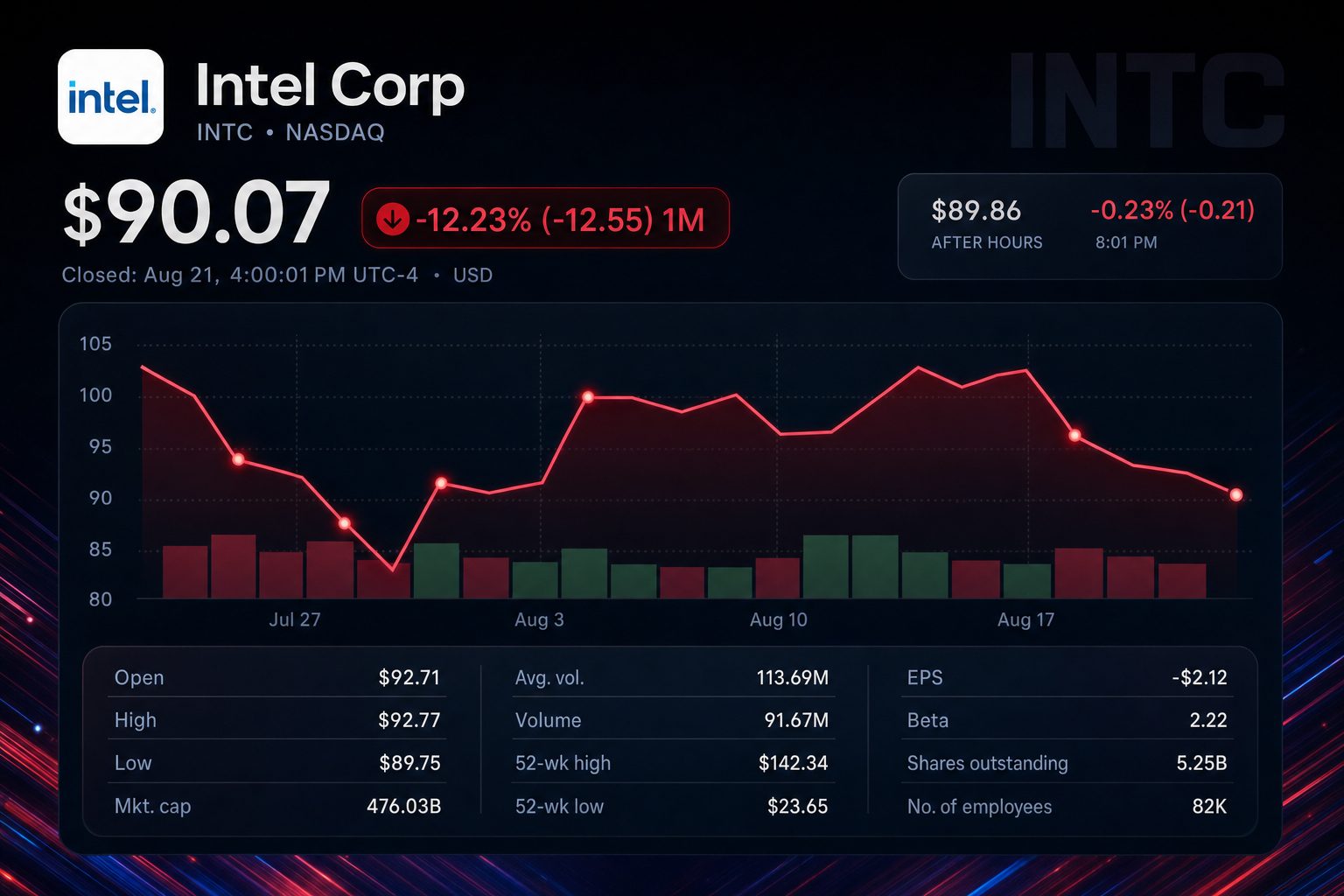
The markdown is significant. Intel raised funds for its foundry expansion by selling 210.5 million shares at $95 each. By Friday, the share price had fallen $4.93 beneath that mark. The market is currently pricing the new capital issuance below its original value.
| Offering measure | Amount | Investor effect |
|---|---|---|
| Base shares sold | 210.5 million | Roughly 4.0% of outstanding shares |
| Public price | $95.00 | Issued with 2.6% discount at pricing |
| Gross base proceeds | $20.0 billion | Supports capital expenditure and working capital |
| Estimated net proceeds | $19.7 billion | Excludes impact if option is exercised |
| Underwriter option | 31.6 million shares | Potential to bring in an additional $3.0 billion |
The drop was not solely due to dilution. Yields on long-term U.S. Treasuries increased, while semiconductor stocks retreated. Intel’s losses outpaced those of the iShares Semiconductor ETF NASDAQ:SOXX, Advanced Micro Devices, Inc. NASDAQ:AMD and NVIDIA Corporation NASDAQ:NVDA.
| Security | Aug. 14 close | Aug. 21 close | Weekly move |
|---|---|---|---|
| Intel | $102.50 | $90.07 | -12.1% |
| AMD | $514.39 | $473.25 | -8.0% |
| SOXX | $550.42 | $520.05 | -5.5% |
| Nvidia | $225.16 | $214.72 | -4.6% |
The steepest drop came on Tuesday. Intel slid 6.6% as the chip sector index dropped 5%. UBS reduced its price target to $112 from $121 but maintained its neutral stance. Climbing oil prices and bond yields added to the pressure on technology stocks with heavy capital requirements.
| Date | Close | Daily move | Volume |
|---|---|---|---|
| Aug. 17 | $103.49 | up 1.0% | 88.6 million |
| Aug. 18 | $96.69 | down 6.6% | 122.0 million |
| Aug. 19 | $92.80 | fell 4.0% | 110.3 million |
| Aug. 20 | $92.13 | dropped 0.7% | 85.7 million |
| Aug. 21 | $90.07 | declined 2.2% | 91.2 million |
The funding boosts Intel’s capacity to invest during the foundry cycle. However, it does not demonstrate customer interest or satisfactory returns. Intel Foundry generated $5.8 billion in revenue in the second quarter but reported an operating loss of $2.1 billion.
| Q2 2026 measure | Result | Year-on-year change |
|---|---|---|
| Total revenue | $16.1 billion | Up 25% |
| Data Center and AI revenue | $6.3 billion | Increased 59% |
| Foundry revenue | $5.8 billion | Up 31% |
| Foundry operating result | -$2.1 billion | Smaller loss |
| Non-GAAP EPS | $0.42 | Compared to $0.10 loss |
Chief Executive Lip-Bu Tan stated that “AI is driving unprecedented demand for compute.” Intel posted its fastest revenue growth in over 15 years. Improved yields and shorter cycle times additionally contributed to quarterly performance. Intel Q2 release
Wall Street continues to find recovery potential. The mean price target stands at $114.88, which is 27.5% higher than Friday’s closing price. Hold ratings dominate, underscoring persistent doubts regarding foundry losses and operational execution.
| Analyst / consensus | Rating | Target | Versus $90.07 |
|---|---|---|---|
| Bank of America | Buy | $145 | +61.0% |
| Baird | Neutral | $125 | +38.8% |
| UBS | Hold | $112 | +24.4% |
| Mizuho | Hold | $109 | +21.0% |
| JPMorgan | Sell | $85 | -5.6% |
| 48-analyst average | Hold | $114.88 | +27.5% |
Investors will monitor if $95 turns into a resistance level next week. If shares climb above the offering price, it would indicate sufficient demand to absorb the new supply. A decline below $90 would highlight concerns about dilution and the sector’s risk tolerance.
The extended test is running. Intel has to translate its 18A and 14A investments into income from external foundry business. Maintaining margins is also necessary as additional capacity comes online.
Risks: Foundry projects demand multi-year capital investment and may encounter postponements in yield. Issuing new shares dilutes future profit. Rising interest rates, lower chip demand, or slower customer commitments could prolong the valuation adjustment.
Related articles: NASDAQ:INTC