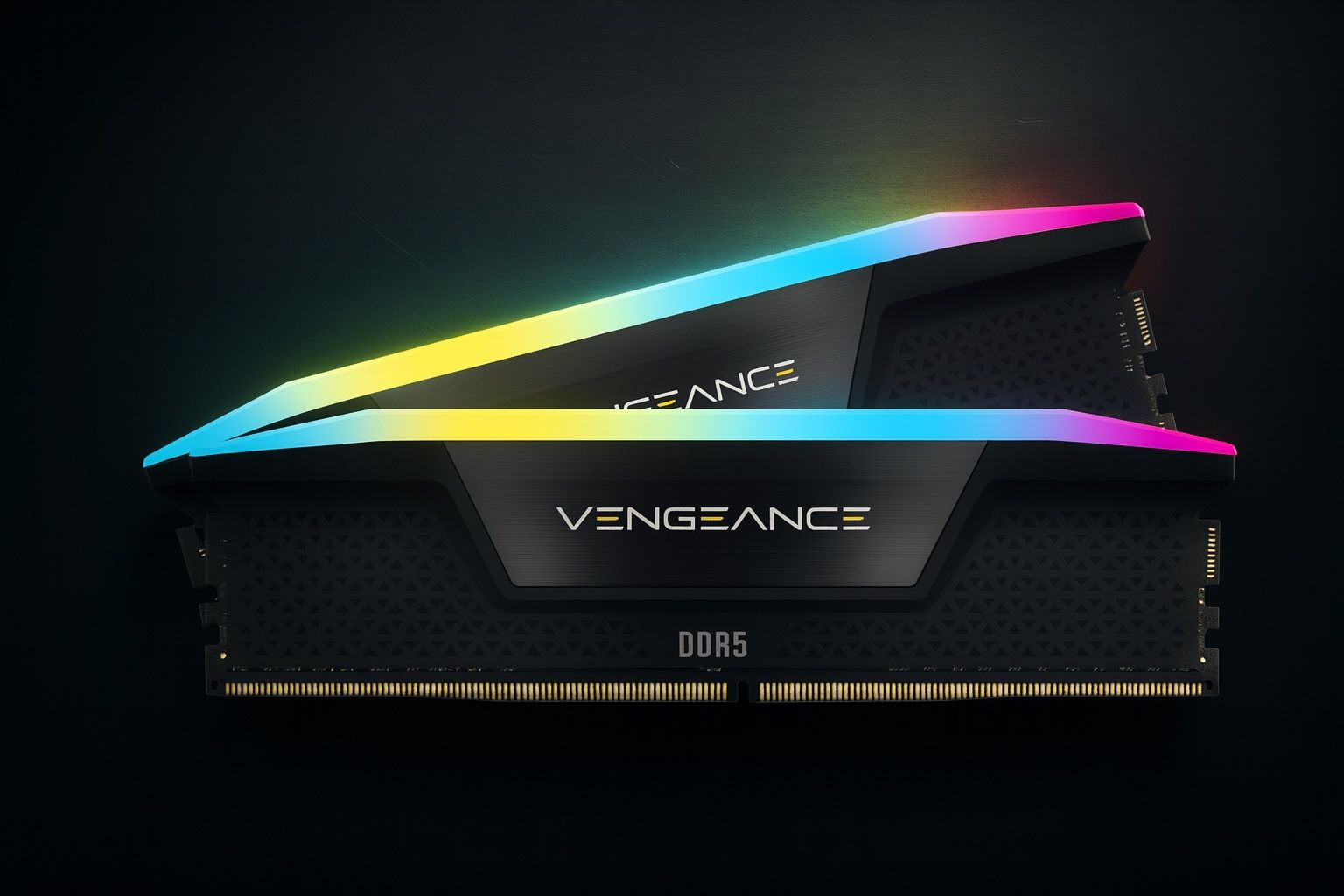

- AMD just patented a “High-Bandwidth DIMM (HB-DIMM)” for DDR5 that doubles the data rate from ~6.4 Gbps to 12.8 Gbps per pin pcgamer.com. It does this by adding buffer chips and “pseudo” memory channels on the module – effectively acting like two channels in one stick pcgamer.com tech4gamers.com.
- No new DRAM chips required: The patent claims this bandwidth boost is achieved without changing the underlying DDR5 chips pcgamer.com tech4gamers.com. Instead, a register/clock driver (RCD) on the DIMM routes commands to two independent pseudo-channels, each using existing memory dies pcgamer.com tech4gamers.com. In simple terms, the module takes two normal-speed streams and merges them into one super-fast stream to the CPU wccftech.com pcgamer.com.
- Why do we need it? Today’s high-end GPUs, servers and AI workloads are starved for memory bandwidth. As AMD’s patent notes, “memory bandwidth required for applications such as high-performance graphics processors and servers… are outpacing the roadmap of bandwidth improvements for DDR DRAM chips” pcgamer.com. In other words, DDR5 speeds (currently topping around DDR5-6400 or 6.4 Gbps) may not keep up with future CPU/GPU demands.
- Intel’s MRDIMM already did something similar: Intel introduced DDR5 modules (called MRDIMMs) that also tap both memory ranks in parallel. By placing a small multiplexer chip on server DIMMs, Intel doubled bandwidth to 8.8 Gbps (up from 6.4 Gbps) on Xeon 6 CPUs newsroom.intel.com. This became a JEDEC standard, and in tests Xeon systems with MRDIMMs finished heavy jobs ~33% faster than with regular DIMMs newsroom.intel.com. AMD’s HB-DIMM idea is more extreme (12.8 Gbps), but follows a similar “double up the ranks or channels” concept.
- Adoption hurdles remain: AMD’s proposal is an attractive idea, but it’s currently just a patent application. To become real, motherboards, chipsets and CPUs would need to support the new module. As PC Gamer notes, “proprietary memory standards don’t have much of a track record” in PCs pcgamer.com. The patent itself implies a JEDEC standard would help – but that means Intel, Samsung, Micron and others would need buy-in. In short, it’s a cool idea, but expect it years away if ever – especially for consumer PCs.
In-Depth Report: Double DDR5 Bandwidth on the Horizon?
1. The patent and how it works. Late September 2025, AMD was spotted filing a patent for what it calls a “High-Bandwidth DIMM” for DDR5 memory pcgamer.com tech4gamers.com. According to the filing, each HB-DIMM has extra buffer chips plus a smart controller (an RCD) on the DIMM. The RCD decodes addresses and commands, and uses a chip-identifier bit to steer signals into two separate pseudo-channels of DRAM on the same module tech4gamers.com pcgamer.com. Because of this, the module can transmit data at twice the normal per-pin rate. In practice, AMD’s example shows using standard DDR5 chips (6.4 Gbps) to run the module at 12.8 Gbps, effectively doubling throughput pcgamer.com tech4gamers.com. The key quote: “The data buffer chips… transmit data from the memory chips over a host bus at a data rate twice that of the memory chips,” meaning two streams merge into one high-speed stream pcgamer.com wccftech.com.
2. Why AMD thinks it’s needed. Modern CPUs and GPUs have exploded in core count and parallelism. Each core or shader demands its slice of RAM bandwidth. AMD’s patent explicitly warns that applications like “high-performance graphics processors and servers, which have multiple cores and a corresponding increase in bandwidth-per-core requirement,” are outstripping the improvements that JEDEC’s DDR5 roadmap can deliver pcgamer.com. In other words, future AI training or 3D graphics workloads could be bottlenecked by RAM speed unless something changes. AMD notes that existing DDR5 chips alone (even as they climb to DDR5-8400 or beyond) may not keep pace. The HB-DIMM is presented as one solution: giving a big bandwidth boost using today’s DRAM technology.
3. Comparisons to Intel’s solution and other memory tech.
Intel engineers faced a similar memory-wall problem in data centers. In late 2024, Intel announced MRDIMMs (Multiplexed Rank DIMMs) for its Xeon 6 servers newsroom.intel.com. By adding a small on-module “mux” chip, MRDIMMs let both ranks on a DDR5 DIMM transfer data in parallel. The result was an almost 40% jump in peak throughput, from 6400 MT/s to 8800 MT/s newsroom.intel.com. Intel hailed this as “the fastest system memory ever created – by a leap that would normally take several generations of memory technologies to achieve” newsroom.intel.com. Crucially, Intel donated the MRDIMM spec to JEDEC as an open standard. It required no changes to motherboards – the new DIMMs just plugged into existing DDR5 slots newsroom.intel.com. In real benchmarks, Xeon systems with MRDIMMs finished tasks about 33% faster than with ordinary RDIMMs newsroom.intel.com.
AMD’s HB-DIMM is more ambitious (doubling to 12.8 Gbps vs Intel’s 8.8 Gbps), but also more radical: it relies on special RCD logic and buffer chips. Conceptually it’s similar to Intel’s approach of harnessing unused parallelism on the DIMM. Another technology comparison is HBM (High Bandwidth Memory), which AMD helped develop with SK Hynix for GPUs and accelerators. HBM uses stacked die and a very wide bus to hit terabytes per second bandwidth, but it’s very expensive and power-hungry. AMD’s patent claims it’s “seeking to use the benefits of the high-bandwidth memory (HBM) format in a DIMM form-factor” pcgamer.com, essentially trying to bring HBM-like speeds to plain DDR5 modules.
4. Technical details (non-expert summary). In practice, the HB-DIMM would look like a familiar DIMM stick, but with more chips on it. When the CPU wants data, it sends a command/address to the DIMM’s RCD. The RCD adds a tiny “chip ID” bit and uses it to route the signal to one of two channel banks. Each bank contains some of the DRAM chips and its own buffer. By reading or writing to both banks in lockstep and using faster signaling, the total data fed to the CPU is doubled. Importantly, the patent emphasizes compatibility: it supports standard DDR5 command timing (“1n” and “2n” modes) and tries to maintain decent signal integrity and timing margins tech4gamers.com. So ideally, a system could run existing DDR5 code – it’s just that each DIMM carries twice as much data per cycle. In one vision mentioned by Wccftech, an AMD APU (CPU+GPU) could even use two memory interfaces: one standard DDR5 bus for bulk memory, and one HB-DIMM bus for very high-speed operations (like streaming AI data) wccftech.com.
5. Hurdles: adoption and practicality. The big question is when and if we’ll see HB-DIMMs on the market. Currently it’s just a patent filing, not an announced product. PC hardware history suggests a custom memory standard usually fails unless it becomes industry-wide. The PC Gamer article bluntly notes: “Proprietary memory standards don’t have much of a track record when it comes to gaining traction in the PC” pcgamer.com. The patent itself acknowledges that most DRAM is tied to JEDEC DDR standards, and implies that for HB-DIMM to succeed JEDEC would need to adopt it pcgamer.com. That means AMD would have to convince competitors like Intel (the largest CPU maker) to implement support. Intel might not pay AMD for licensing, and building a new RCD requires motherboard and CPU design changes. Until major vendors sign on, HB-DIMM remains theoretical. As Tech4Gamers summarizes: AMD’s idea “scales performance with existing tech to make it widely adaptable,” but adaptation is the challenge tech4gamers.com.
6. Industry context and expert commentary. Several analysts and insiders have commented on memory bottlenecks. Intel’s memory lead George Vergis observed that “most DIMMs have two ranks… [but] data can be stored across multiple ranks independently but not simultaneously”, which is why MRDIMM’s multiplexing was groundbreaking newsroom.intel.com. Intel’s product manager Bhanu Jaiswal noted that “a significant percentage of high-performance computing workloads are memory-bandwidth bound,” so anything that boosts bandwidth helps AI and HPC newsroom.intel.com. The take-away: data centers really need more bandwidth today. AMD’s patent is clearly aimed at that gap. Wccftech’s analysis highlights that doubling DDR5 speed (to 12.8 Gbps) would be a “gigantic boost to memory performance” for AI and gaming wccftech.com, citing that AMD’s solution “effectively doubles memory bandwidth without the need to rely on advancing DRAM silicon.” The article also points out AMD’s pedigree: “AMD is one of the leading firms in the memory space… Team Red designed HBM by collaborating with SK Hynix… the HB-DIMM approach certainly looks promising…” wccftech.com. In short, even if the patent is futuristic, industry experts agree that creative DIMM designs are a promising route to more bandwidth.
7. Similar products and standards. Beyond Intel’s MRDIMM, memory makers are pushing speeds upward. DDR5 kits are now available up to DDR5-7200 or even DDR5-8400, and motherboard BIOS are being tuned to hit higher GHz. Samsung and Micron are developing DDR6 (expected around 2026-27) that could start around 12800 MT/s (double DDR5) newsroom.intel.com. But those rely on chip process advances. HB-DIMM is a module-level tweak. In the APU/mobilization space, AMD’s own 3D V-Cache on CPUs and the Ryzen AI chips with stacked memory show the company’s interest in memory innovations. However, all these are one step; a two-step (HB-DIMM + future DDR6) would pile on together.
8. The investor angle. Patent news often excites traders, but investors remain cautious. Reports noted that AMD’s stock actually dipped slightly after the patent story broke robinhood.com (investors likely felt that a patent is future tech, not current earnings). The consensus on Wall Street is that AMD has many growth drivers (AI CPUs, data center GPUs, consoles), and a memory patent alone won’t move the needle much. But it does highlight AMD’s R&D focus, which may reassure some long-term tech investors.
9. Conclusion: Innovation vs. Reality. AMD’s HB-DIMM patent is an exciting peek at next-gen memory ideas. It promises the kind of performance jump (doubling bandwidth) that usually takes multiple DDR generations. In theory it could make PCs and servers much faster for heavy tasks. In practice, it will take time. Intel already demonstrated a similar concept in real hardware for servers newsroom.intel.com, showing the industry interest. But for mainstream PCs, HB-DIMM would need broad support. As PC Gamer cautions, “the net result… is a doubling of the headline DDR5 rate… Of course… [it’s all] achieved using existing DDR5 chips” pcgamer.com – clever, but there’s “no indication it’ll appear in PCs any time soon.” Still, it’s a reminder that hardware firms are looking for every trick to break the memory bottleneck, from on-chip caches to stacked memory to smarter DIMMs tech4gamers.com newsroom.intel.com. In other words, AMD’s idea is far from dead; it’s one contender in the ongoing memory wars. Whether it becomes JEDEC-standardized DDR6 extension or remains a lab concept, it shows how seriously engineers take the “memory wall” problem.
Sources: Latest news and patent analyses from PC Gamer pcgamer.com pcgamer.com, Tech4Gamers tech4gamers.com tech4gamers.com, Wccftech wccftech.com wccftech.com, and Intel’s official news release on MRDIMM technology newsroom.intel.com newsroom.intel.com, among others. These include expert insights on memory trends and AMD/Intel innovations.
Related articles: NASDAQ:AMD