- Rapid decline since 2016: Antarctic sea ice expanded modestly for decades, but satellite and ship‑log reconstructions show that after 2015–16 the trend abruptly reversed. By 2023 the winter sea‑ice peak was more than 1.5 million km² below the 1981–2010 average, and the 2025 maximum was the third lowest on recordcarbonbrief.org.
- Unprecedented variability: Extending the record back to the early 20th century revealed that the probability of the 2023 minimum occurring from natural variability alone is less than 0.1 %, suggesting human‑driven warming has pushed the system into “extreme behaviour”newscientist.com.
- Potential tipping point: Researchers warn that the sea‑ice crash may represent a tipping point where ocean stratification breaks down, letting deep, warm waters melt sea ice from belownewscientist.com. Alexander Haumann says the entire Antarctic sea‑ice system is responding as a whole and that changes are long‑livednewscientist.com.
- Feedback loops emerging: Newly published work links the sea‑ice decline to a surprising spike in surface salinity. Saltier water becomes denser, mixes more with warm deep water and accelerates melting, creating a feedback that can sustain sea‑ice lossphys.org.
- Consequences for climate and ecosystems: Less sea ice exposes dark ocean to sunlight, amplifying warming, triggers more icebergs, erodes the buttressing of land‑based ice and threatens species like emperor penguins and krillclimateandnature.org.nzclimateandnature.org.nz. Collapse of floating ice shelves could destabilise the West Antarctic Ice Sheet, which alone contains enough ice to raise sea levels by over three metresunsw.edu.au.
- Global impacts: The Southern Ocean absorbs the majority of Earth’s excess heat; changes in sea ice and ocean circulation could release this heat to the atmosphere and disrupt weather patterns worldwidebas.ac.ukbas.ac.uk. Record‑low sea ice in 2023 doubled heat loss from the ocean and increased storms across the Southern Ocean by up to seven days per monthbas.ac.uk.
- Urgent mitigation: Scientists at the Royal Society’s 2025 meeting warn that without rapid emission cuts and resilience planning, tipping points in Antarctica could accelerate global warming and cause metres of sea‑level rise over coming centuriesoceanographicmagazine.combas.ac.uk.
Antarctic Sea Ice: From Growth to Collapse
Early stability and unexpected expansion
For decades Antarctic sea ice behaved differently from its Arctic counterpart. While Arctic sea ice shrank steadily with warming, Antarctic sea ice grew slightly. The Southern Ocean is insulated from global warming by the Antarctic Circumpolar Current and strong westerly winds, and freshwater input from melting ice shelves promoted surface stratification. That stratification created a “lid” of cold, fresh water that limited mixing with deeper warm water and helped sea ice formphys.org.
Abrupt reversal in 2016
This apparent stability ended around 2015–16. In a Nature study, Marilyn Raphael and colleagues reconstructed sea‑ice extent using satellite data, old ship logs and early 20th‑century observations. They found that the chance of the record‑low ice extent seen in 2023 emerging from natural variability alone is less than 0.1 %, indicating an externally forced shiftnewscientist.com. Alexander Haumann reports that the entire Antarctic sea‑ice system is responding as one and that the decline is “very long‑term”newscientist.com. Since 2016 the continent has swung from record highs to repeated record lows, with the winter maximum in September 2025 reaching only 17.81 million km², 0.9 million km² below the 1981–2010 averagecarbonbrief.org.
Breaking the freshwater lid
Research published in 2025 by Alessandro Silvano and colleagues observed a sharp rise in surface salinity of the Southern Ocean beginning in 2015. For decades the surface had been freshening due to melting ice and precipitation, but the new salinity spike reversed this trend. Denser, saltier surface water weakened stratification, allowing warmer deep water to rise. This mix of warmth melted sea ice from below and broke down the insulating freshwater layer. As ice melted, the ocean absorbed more sunlight, warming further and reinforcing the salinity increase—a feedback loop that can perpetuate sea‑ice lossphys.org. Gavin Schmidt’s RealClimate analysis cautions that the observed salinity shift is small and that causality remains uncertain; however, he acknowledges that the abrupt turnaround in sea ice and salinity demands improved models and more observationsrealclimate.org.
Heat loss and storms: impacts of low sea ice
Sea ice acts as a blanket, limiting heat exchange between the ocean and the atmosphere. A 2024 Nature paper co‑authored by Simon Josey found that record‑low sea ice during the Antarctic winter of 2023 doubled the amount of heat lost from the Southern Ocean to the atmospherebas.ac.uk. This cooling densifies surface waters and could release deeper warm water that accelerates future sea‑ice meltbas.ac.uk. The same study noted a significant rise in storms across high‑latitude Southern Ocean waters—some areas experienced up to seven extra storm days per monthbas.ac.uk. Repeated low‑ice years could increase storms, alter ocean circulation and affect weather patterns far from Antarcticabas.ac.uk.
Changing winds, salinity and upwelling
Haumann’s research suggests that shifts in wind speeds and salinity have weakened the barrier between cold surface waters and the warmer depths since 2015, leading to greater upwelling of warm water and driving sea‑ice lossnewscientist.com. The stronger westerly winds push sea ice northwards and enhance mixing. Some studies argue that the winds’ behaviour is influenced by ozone depletion and increasing greenhouse gases. While natural variability may have initiated the changes, Haumann warns that they “unleash the effects of human‑caused warming stored in deep water”newscientist.com.
The state shift debate: is this a tipping point?
Scientists are debating whether the sea‑ice collapse constitutes a tipping point—a threshold beyond which changes become self‑sustaining and irreversible. Nerilie Abram and colleagues argue that the rapid loss of Antarctic sea ice is more abrupt and potentially irreversible than the Arctic declinereuters.com. Once sea ice disappears, she says, a self‑perpetuating process begins: without sea ice reflecting sunlight, the ocean warms; weaker stratification allows more warm water upwelling; and the Antarctic Overturning Circulation slows, reducing the formation of deep water that ventilates the global oceanreuters.com. Even if the climate stabilises, we may be committed to ongoing sea‑ice loss over centuriesreuters.com.
Not all experts agree that a tipping point has been crossed. Gavin Schmidt cautions that the salinity change is minor and emphasises the complexity of Southern Ocean processesrealclimate.org. Nevertheless, the abruptness of the shift and the multiple reinforcing feedbacks have raised alarm that Antarctica may be moving towards a new state, making recovery increasingly difficult.
Consequences of Vanishing Sea Ice
Amplified warming and iceberg formation
Sea ice reflects about 90 % of incoming sunlight, whereas the dark ocean absorbs about 90 %. Edward Doddridge and co‑authors (2025) show that in summers with low sea ice—such as the record low of 2016—the Southern Ocean absorbs much more heat. Historically the ocean “reset” over winter as heat was transferred to the atmosphere, but that mechanism no longer works; extreme low sea‑ice years trigger ocean warming that persists for at least three yearsclimateandnature.org.nz. As a result, each successive low‑ice year builds on the previous one, creating compounding warming.
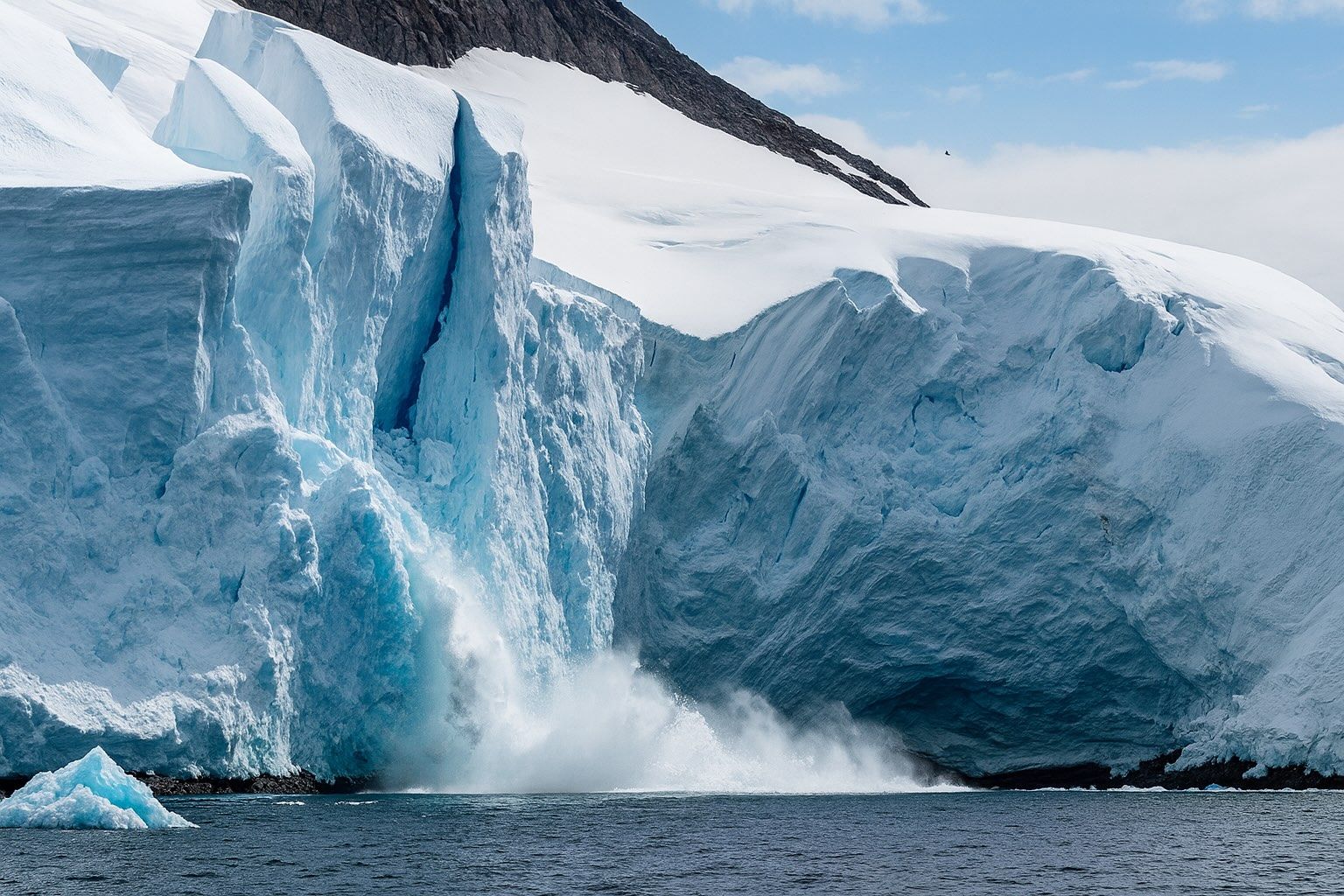
Sea‑ice loss also exposes Antarctic coasts to waves. During a typical summer, roughly a third of the coastline is ice‑free; in 2022 and 2023, more than half was exposed. Doddridge’s team reports that low‑ice summers produce twice as many icebergs as average summers—around 200 compared with 100 normallyclimateandnature.org.nz. Waves batter ice shelves, causing iceberg calving and weakening the buttressing that slows land ice flowantarctica.gov.au. That exposure increases the likelihood of large icebergs like A23a breaking free and drifting, potentially affecting shipping and ecosystems.
Destabilising the West Antarctic Ice Sheet
Antarctic sea ice acts as a buttress that stabilises floating ice shelves. Without this buffer, ice shelves become vulnerable to swell-driven fracturing. Nerilie Abram warns that the West Antarctic Ice Sheet is at severe risk; its collapse would raise global sea levels by more than three metresunsw.edu.au. The broader Antarctic ice sheet holds enough water to raise sea levels by about 58 metresnewscientist.com. Even partial destabilisation would inundate coastal cities worldwide over centuries or millennia.
Threats to marine ecosystems
Sea ice underpins Antarctic ecosystems. Many seals and penguins depend on stable sea‑ice platforms for breeding and moulting. In 2022 entire emperor penguin colonies suffered catastrophic breeding failure when sea ice melted before chicks were old enough to swimclimateandnature.org.nz. Crabeater seals need firm ice platforms to nurse pups; shrinking sea ice makes them vulnerable to predatorsclimateandnature.org.nz. Krill, a keystone species, feed under sea ice and may decline as ice disappearsunsw.edu.au.
Sea‑ice loss also reduces phytoplankton productivity. The Australian Antarctic Program notes that changes in sea ice are triggering a regime shift in phytoplankton, altering marine food websantarctica.gov.au. Professor Matthew England warns that the loss of sea ice heightens extinction risks for emperor penguins and threatens species like krill and sealsunsw.edu.au.
Disrupting global ocean circulation and climate
The Antarctic Overturning Circulation forms when dense, cold, salty water sinks off Antarctica’s continental shelf and flows northwards, driving deep ocean currents. This circulation ventilates the deep ocean, carries oxygen and nutrients and sequesters carbon. Rapid sea‑ice loss and melting ice shelves can freshen surface waters, weakening this overturning. Abram warns that a slowdown could reduce oxygen and nutrient exchange, harming marine ecosystems and altering climate regulationphys.org. A collapse of this circulation would leave nutrients at the seabed, starving surface ecosystemsunsw.edu.au.
The Southern Ocean absorbs around 90 % of the excess heat and 25 % of the carbon dioxide from human emissionsbas.ac.uk. Reduced sea ice and altered circulation may diminish this sink, allowing more heat and CO₂ to remain in the atmosphere and accelerating global warming. Michael Meredith of the British Antarctic Survey warns that Antarctica is changing faster than imagined and that urgent action is needed to cut greenhouse gas emissions and strengthen resilienceoceanographicmagazine.com.
Increased storms and weather extremes
The study by Josey and colleagues indicates that record‑low sea ice in 2023 doubled ocean heat loss and increased storms across the Southern Oceanbas.ac.uk. Enhanced storminess can push warm air and moisture into the Antarctic interior, causing heatwaves and rainfall on the ice sheet. Oceanographic Magazine notes that the Southern Ocean’s role in absorbing heat and carbon is fuelling more powerful storms, heatwaves and rainfall worldwideoceanographicmagazine.com. These extremes could feed into global weather patterns, contributing to events like the record high global temperatures and heatwaves seen in 2023–24.
Human and logistical challenges
The loss of sea ice affects human activities. Antarctic research stations rely on sea ice for resupply and transport. Doddridge’s team notes that shrinking summer sea ice narrows the window during which bases can be resupplied over the ice. Bases may need to be supplied from different locations or with smaller boats, increasing cost and riskclimateandnature.org.nz.
Data challenges and observation gaps
Observing the Southern Ocean and Antarctic sea ice requires satellites and in‑situ sensors. The conversation article notes that the US Department of Defense’s Defense Meteorological Satellite Program provides critical sea‑ice data. A temporary plan to discontinue this data threatened observations and underscored the fragility of climate monitoringclimateandnature.org.nz. Scientists emphasise the need for continuous, long‑term datasets to understand abrupt changes and warn that without data sharing, accurate climate assessment will be impossibleclimateandnature.org.nz.
What Lies Ahead?
Uncertain recovery
The emerging consensus is that the Antarctic sea‑ice system has shifted to a new regime characterised by lower extents and greater variability. Haumann suggests that natural variability may have triggered the recent decline but that human‑caused warming stored in deep water is driving its persistencenewscientist.com. Doddridge’s modelling indicates that even if low‑ice summers do not occur every year, the ocean retains heat for multiple years, making recovery harderclimateandnature.org.nz.
Climate models historically underestimated Antarctic change; many lacked interactive ice sheets and had biases in the Southern Oceanrealclimate.org. New high‑resolution models that couple ice, ocean and atmosphere processes are needed to project sea‑ice behaviour and global impacts. Observations, including Argo floats and deep‑ocean moorings, must be expanded to monitor salinity, temperature and circulation changes. Initiatives like Antarctica InSync and the International Polar Year aim to coordinate such effortslivescience.com.
Mitigation and adaptation
Researchers stress that preventing catastrophic outcomes requires swift, deep reductions in greenhouse gas emissions. Abram and colleagues urge governments to achieve net‑zero emissions by mid‑century to reduce the risk of abrupt changesantarctica.gov.au. Michael Meredith echoes this call, warning that tipping points in Antarctica could accelerate global heating and that we must cut emissions and build resiliencebas.ac.uk.
Adaptation planning is also essential. Coastal communities need to prepare for sea‑level rise, storms and infrastructure changes. Nations operating in Antarctica must adapt logistics to reduced sea ice and ensure environmental protections for ecosystems facing stress.
Conclusion
Antarctica, once viewed as a remote and stable environment, is undergoing rapid and interconnected transformations. The sudden decline in sea ice since 2016 may signify a tipping point triggered by changes in wind, salinity and ocean stratification. Feedback loops between sea‑ice melt, ocean warming and circulation changes threaten to amplify global warming, destabilise ice sheets and reshape ecosystems. While debate continues over whether a true tipping point has been crossed, the evidence shows that the Antarctic sea‑ice system has entered an unprecedented state.
The world must take heed. The Southern Ocean’s ability to absorb heat and carbon shields us from faster warming; weakening that shield will reverberate globally. Preventing further destabilisation will require deep emission cuts, sustained observations and resilience planning. As Michael Meredith put it, Antarctica is sending “a stark warning to the world”oceanographicmagazine.com—one we ignore at our peril.