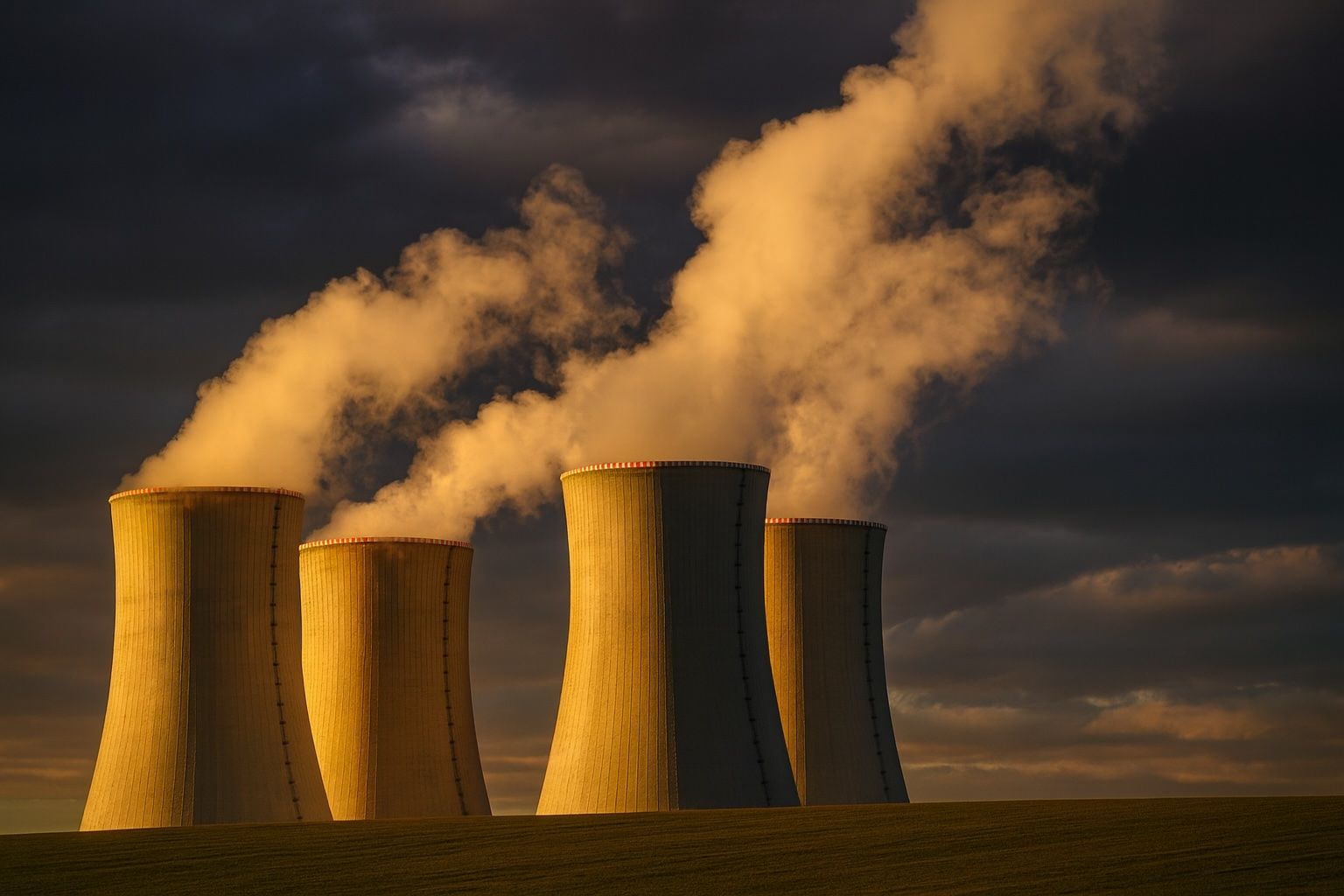

- A historic energy mix shift – Nuclear power provided around 18 % of the world’s electricity in the 1990s but fell to roughly 9 % after accidents at Three Mile Island, Chernobyl and Fukushima led to public opposition, heavier regulation and stalled innovation investing.com.
- AI’s insatiable appetite for power – Goldman Sachs estimates the energy consumption of data‑center workloads will surge by 165 % in the next five years utilitydive.com; some analysts calculate technology companies will need 85–90 gigawatts of new nuclear capacity to power AI data centers, yet only about 10 % of that capacity will exist by 2030 energytech.com.
- Tech giants are going nuclear – Microsoft signed a 20‑year power purchase agreement to restart an 835‑MW unit of Three Mile Island and contracted with fusion start‑up Helion for a future power plant energytech.com. Amazon invested US$500 million in X‑energy and is working with Energy Northwest to deploy four small modular reactors (SMRs) natlawreview.com. Meta, Google and other firms are bidding for several gigawatts of nuclear energy, and Fermi America plans a Texas “hypergrid” combining 4.4 GW of nuclear with renewables and gas natlawreview.com.
- Government support is sweeping – The United States pledges to triple or even quadruple its nuclear capacity by 2050 and has passed the ADVANCE Act to modernize licensing natlawreview.com; executive orders direct federal agencies to fast‑track projects and lease land at Savannah River and Oak Ridge for AI‑powered data‑center complexes executivegov.com. The prohibition on Russian uranium imports and a US$2.7 billion program to build a domestic fuel cycle aim to reduce dependence on foreign suppliers energytech.com.
- Small reactors lead the vanguard – SMRs and micro‑reactors promise lower costs and faster licensing; X‑energy’s Xe‑100 reactors and GE Vernova’s BWRX‑300 have global deployments planned ans.org ans.org. Radiant and Equinix agreed on 20 micro‑reactors and a 250‑MW SMR contract in the Netherlands ans.org. TerraPower’s Natrium demonstration, Oklo’s micro‑reactor for Eielson Air Force Base and TVA’s SMR project illustrate the range of designs natlawreview.com.
- Caution signs flash – Wall Street analysts warn of a speculative bubble as valuations for nuclear start‑ups soar and Bank of America downgrades firms such as Oklo and NuScale oilprice.com. Supply‑chain bottlenecks, a chronic workforce shortage and cyber‑security threats could delay deployments cnbc.com utilitydive.com. Experts stress that nuclear should complement—not replace—renewables, and rushing the renaissance could lead to cost overruns and public backlash utilitydive.com.
Introduction: From Post‑Fukushima Stagnation to AI‑Fueled Revival
A quarter century ago, nuclear energy was in decline. Fear of meltdowns, regulatory hurdles and the ascendancy of cheap natural gas reduced nuclear’s share of world electricity from about 18 % in the 1990s to roughly 9 % today investing.com. The disasters at Three Mile Island, Chernobyl and Fukushima galvanized public opposition and slowed investment, while nations turned to renewables and gas. Today, however, a new force—artificial intelligence—may be upending the calculus. Machine‑learning models like GPT‑5 run on data centers that consume vast amounts of electricity, and the prospect of constant, clean energy is pushing governments and Silicon Valley to rethink nuclear technology. This article explores the drivers, technologies, policies and controversies of the so‑called nuclear renaissance and assesses whether the hype will translate into real power.
AI‑Driven Demand: Hyperscalers Turn to the Atom
Data‑center loads explode
Goldman Sachs forecasts that energy demand from data‑center workloads will jump by 165 % in the next five years utilitydive.com. A separate analysis cited by EnergyTech suggests big technology companies will need 85–90 GW of new nuclear capacity to power AI data centers, yet only ~10 % of this capacity will be available by 2030 energytech.com. The AI boom is projected to make data centers consume 12 % of U.S. electricity by 2028 powermag.com.
Tech firms secure nuclear power
Microsoft’s 20‑year contract with Constellation Energy to restart an 835‑MW reactor at Three Mile Island, plus its separate deal with fusion start‑up Helion to procure electricity starting in 2028, signal Big Tech’s embrace of nuclear energytech.com. Amazon invested US$500 million in X‑energy and committed to deploy up to four Xe‑100 SMRs with Energy Northwest natlawreview.com; the retailer also signed long‑term agreements for up to 5 GW of nuclear capacity, while Alphabet (Google’s parent) intends to acquire around 2 GW cnbc.com. Meta launched a request for proposals for 4 GW of nuclear power natlawreview.com. The MoneyWeek article adds that Apple and Palantir have also struck deals with nuclear utilities; Palantir is even developing AI software to accelerate reactor construction moneyweek.com.
Hypergrids and government sites
Fermi America epitomizes the new scale. In Texas it plans an 11‑GW “hypergrid” combining four traditional AP1000 reactors, several small modular reactors, natural‑gas turbines, solar panels and batteries. The first gigawatt of power, mostly from gas and solar, aims to be online in 2026, with nuclear units following by 2031 reuters.com. Reuters reports that AI demand is expected to lift U.S. data‑center power needs from 25 GW in 2024 to more than 80 GW by 2030, requiring over US$500 billion in new generation reuters.com. Texas legislation (HB 14) allocates US$350 million to advanced nuclear projects and creates a state office to accelerate licensing reuters.com.
Across the country, the U.S. Department of Energy (DOE) is repurposing federal land for AI data‑center complexes. The National Nuclear Security Administration issued requests for proposals to lease tracts at the Savannah River Site in South Carolina and the Oak Ridge Reservation in Tennessee for AI data centers and on‑site power generation interestingengineering.com executivegov.com. Bidders are encouraged to integrate advanced nuclear reactors and storage solutions; successful applicants must finance construction, arrange utility interconnections and manage eventual decommissioning interestingengineering.com. Officials describe the effort as a “Manhattan Project 2.0” designed to leverage historic nuclear sites for digital and clean‑energy infrastructure executivegov.com.
Policy and Regulatory Push
Streamlining approvals and subsidizing growth
The U.S. Congress passed the ADVANCE Act in July 2024, modernizing Nuclear Regulatory Commission (NRC) licensing, reducing fees and authorizing the relicensing of older reactors natlawreview.com. The law encourages deployment of advanced reactors at existing brownfield sites and allows developers to share regulatory risks. Several executive orders issued in 2025 go even further: they direct the DOE and Department of Defense to conduct design reviews binding on the NRC, accelerating approvals but raising concerns about erosion of the regulator’s independence natlawreview.com. These orders also instruct federal agencies to deploy reactors on government land, particularly to power AI data centers and other critical facilities energytech.com.
Tax incentives also matter. The One Big Beautiful Bill Act extended clean‑energy tax credits to advanced nuclear, created bonuses for using domestic components and offered loan guarantees for new reactors energytech.com. States are joining in: Indiana approved a 20 % manufacturing tax credit for nuclear equipment, Utah set an agenda to support SMR manufacturing and training, Tennessee allocated US$150 million for SMR supply‑chain and workforce programs, Texas established the Texas Advanced Nuclear Energy Office with funding for manufacturing, and New York directed the development of 1 GW of advanced nuclear by 2040 energytech.com.
Building a domestic fuel cycle
Nuclear fuel supply is a chokepoint. After Russia’s invasion of Ukraine, the U.S. pledged to ban Russian uranium imports by 2028 cnbc.com and passed legislation to prohibit purchases of nuclear fuel from Rosatom energytech.com. The DOE launched a US$2.7 billion request for proposals to establish domestic production of low‑enriched uranium (LEU) and high‑assay LEU (HALEU) energytech.com. CNBC reports that Urenco’s New Mexico enrichment facility is currently the only commercial enrichment site in the U.S. but can meet only one‑third of domestic demand cnbc.com. Urenco is expanding production by 15 % by 2027, yet the U.S. faces a 184‑million‑pound uranium supply gap by 2034 and a bottleneck in conversion capacity cnbc.com.
International collaboration and pledges
In October 2025, fourteen global technology firms signed the Large Energy Users Pledge to support tripling worldwide nuclear capacity by 2050 and to secure continuous zero‑carbon power for data centers energytech.com. Countries are entering agreements across borders: Uzbekistan signed a contract with Russia’s Rosatom to build a plant with both large VVER‑1000 reactors and RITM‑200N SMRs, while also cooperating with the U.S. to diversify technology sources nationalinterest.org. Kazakhstan is planning a second nuclear plant to address energy shortages; Italy approved legislation establishing a National Program for Sustainable Nuclear Power, aiming to deploy SMRs and advanced reactors nationalinterest.org. The European Union is reclassifying nuclear as a green investment; nations like the Netherlands, Belgium and the UK are reversing phase‑out policies, and emerging economies such as Indonesia and Malaysia are exploring their first reactors moneyweek.com.
Technology: From Gigaton Plants to Micro‑Reactors
Fission, fusion and the innovation boom
Today’s nuclear renaissance spans two paths: fission and fusion. Traditional gigawatt‑scale fission plants remain the backbone but face long lead times and cost overruns—Georgia’s Vogtle unit took 17 years and cost US$30 billion more than planned. The new wave therefore prioritizes small modular reactors (SMRs) and micro‑modular reactors (MMRs). SMRs typically produce 50–300 MW and can be factory‑assembled, reducing construction timelines from a decade to five or seven years. Micro‑reactors, producing less than 50 MW, could be licensed in as little as 18 months and deployed off‑grid powermag.com. Their small footprint means they could sit near industrial parks, hydrogen plants or data centers moneyweek.com.
Designs are proliferating. X‑energy’s Xe‑100 high‑temperature gas‑cooled reactor, backed by Amazon, is slated for the Dow Chemicals site in Texas and potentially for a multi‑unit campus in Washington ans.org ans.org. GE Vernova’s BWRX‑300 has been selected for projects in Canada, Poland, Hungary and Slovakia ans.org. Radiant Nuclear signed a preorder with Equinix for 20 micro‑reactors and a separate 250‑MW SMR power‑purchase agreement in the Netherlands ans.org. Rolls‑Royce is developing a 470‑MW SMR for the UK and negotiated partnerships in Scandinavia. TerraPower’s Natrium reactor integrates sodium cooling with thermal storage, Oklo’s Aurora micro‑reactor uses recycled fuel, and fusion companies such as Helion and Commonwealth Fusion Systems aim to deliver commercial fusion before 2030. The U.S. even plans to send a 100‑kW reactor to the Moon natlawreview.com.
Advantages over intermittent renewables
SMRs and MMRs promise high capacity factors—around 92 % for nuclear versus 34 % for wind and 25 % for solar—and can run 24/7 powermag.com. They require far less land and can be sited near load centers, reducing transmission bottlenecks. Once built, nuclear plants deliver some of the cheapest ongoing electricity because fuel costs are low and output is constant moneyweek.com. Proponents argue that nuclear’s reliability makes it ideal for AI data centers, which cannot risk power fluctuations. Greg Eckel of Echowater Investment notes that nuclear could “do most of the heavy lifting,” with renewables filling the gaps moneyweek.com.
AI for building reactors
Artificial intelligence itself is helping to revive nuclear construction. Westinghouse signed an agreement with Google Cloud to use AI and machine learning to improve project scheduling and resource allocation for new plants investing.com. Palantir is collaborating with nuclear firms to develop software that can optimize design, permit documentation and supply‑chain management moneyweek.com. Such digital tools could reduce delays and cost overruns, addressing one of the industry’s most persistent problems.
Investment Frenzy and Market Realities
Investors pour billions—but risk of a bubble looms
Investments in advanced nuclear reached record highs in 2024 and 2025. According to OilPrice.com, billions of dollars flowed into start‑ups like Oklo, NuScale and Helion, driven by the allure of powering AI and decarbonizing grids oilprice.com. Fermi America raised billions through a special‑purpose acquisition company (SPAC) despite not yet producing power texasstandard.org. The American Nuclear Society reported that X‑energy, Amazon, Korea Hydro & Nuclear Power and Doosan Enerbility plan to mobilize up to US$50 billion for deployments of Xe‑100 reactors ans.org. Tech‑equipment and data‑center providers signed preorders for micro‑reactors ans.org.
Yet analysts warn of an “irrational exuberance” reminiscent of past bubbles. Bank of America downgraded NuScale and Oklo on concerns that valuations far exceed near‑term cash flows oilprice.com. Many projects rely on untested technologies with uncertain timelines and costs. Even Fermi America’s plan to deploy four AP1000 reactors by 2031 faces skepticism because the U.S. has completed only two new reactors in the past 30 years, both massively over budget texasstandard.org.
Uranium supply and market winners
MoneyWeek predicts global uranium demand could double to 300–350 million pounds annually by the late 2030s moneyweek.com. The U.S. Energy Information Administration sees a 184‑million‑pound supply gap by 2034 cnbc.com, while Urenco notes that conversion from uranium ore to hexafluoride remains a major bottleneck cnbc.com. Investors are gravitating toward miners like Cameco and Kazatomprom, midstream enrichment companies such as Urenco and ConverDyn, SMR developers like Oklo and Rolls‑Royce, and utilities such as Korea Electric Power and Centrica moneyweek.com. Sprott’s Uranium Miners ETF has attracted heavy inflows as prices of physical uranium approach 15‑year highs.
Challenges and Criticisms
Workforce, supply chain and cybersecurity
The U.S. nuclear workforce—engineers, welders, regulators—must triple to deliver new plants investing.com. Many components, from reactor vessels to control systems, are made overseas; repatriating these supply chains could raise costs and lengthen timelines. The conversion of uranium to hexafluoride, necessary before enrichment, is limited to three facilities worldwide, causing a choke point cnbc.com. Cyber‑attacks on utilities increased by 70 % in recent years, raising concerns about data‑center safety utilitydive.com.
Regulatory independence and public trust
Executive orders empowering the DOE and DOD to override the NRC have sparked debate about regulatory capture natlawreview.com. Critics caution that rushing approvals could compromise safety and erode public trust. Large reactors like those at Vogtle illustrate the risk of cost overruns and schedule slips. The closure of NuScale’s flagship SMR project in Idaho due to rising costs underscores uncertainty about whether SMRs can deliver the promised low prices natlawreview.com.
Diverse energy mix and environmental impacts
Powering the AI economy will require a diverse mix. Even proponents of nuclear stress that wind, solar and storage must expand alongside nuclear to maintain flexibility and resilience utilitydive.com. Others worry that focusing resources on nuclear could crowd out cheaper renewable options or delay investment in transmission. Managing spent fuel remains a challenge; no permanent U.S. repository exists, and proposals to export waste to countries like Kazakhstan raise geopolitical and ethical concerns. Meanwhile, environmental groups remind policymakers that uranium mining and processing come with ecological costs and that nuclear accidents, though rare, carry catastrophic risks.
Global Nuclear Renaissance: Beyond the United States
China dominates new construction, building about 22 reactors and expected to leapfrog the U.S. in installed nuclear capacity by 2030 investing.com. Russia’s Rosatom is constructing 19 reactors worldwide investing.com and recently signed a deal with Uzbekistan for a plant mixing large and small reactors nationalinterest.org. Kazakhstan plans to build multiple plants to alleviate blackouts, possibly with Chinese or Russian partners nationalinterest.org. The United Kingdom and Poland are ordering SMRs; the Czech Republic, Slovakia and Hungary are negotiating for GE Vernova’s BWRX‑300 designs ans.org. Belgium reversed plans to shut down its reactors, Italy is legislating a return to nuclear with expectations of a US$55 billion domestic market by 2050 nationalinterest.org, and Germany debates reclassifying nuclear as renewable moneyweek.com. Emerging economies in Southeast Asia and Africa view SMRs as a way to electrify remote regions without giant grids. Such international momentum hints that nuclear’s future will be diversified and multi‑polar.
Conclusion: Balancing Hype with Hard Realities
Artificial intelligence has thrown nuclear energy back into the spotlight. Data‑center operators, technology firms and governments see atomic power as a solution to the twin challenges of decarbonization and digital expansion. With supportive policies, investors are pouring tens of billions into new reactors, small and large. The revival is visible in the U.S. pledge to triple nuclear capacity, in global pledges to triple output by 2050, and in the flurry of start‑ups building SMRs, micro‑reactors and even fusion machines. Yet the sector must navigate supply‑chain hurdles, workforce shortages, financing risks, regulatory controversies and public skepticism. In the end, nuclear is unlikely to become a panacea but will increasingly complement renewables in a diversified, resilient grid. The coming decades may indeed see a nuclear renaissance—provided that policy, technology and market realities align with the soaring aspirations of AI‑hungry innovators.
In summary, the research underscores how global interest in nuclear energy is being rekindled by the exponential power demands of AI data centers. Technology giants like Microsoft, Amazon and Alphabet are signing long-term nuclear power contracts and investing billions in small modular reactors, while governments are streamlining regulations and offering generous incentives to reboot the industry energytech.com. The United States pledges to triple its nuclear capacity by 2050, and even historically anti-nuclear nations such as Italy and Belgium are revisiting the technology nationalinterest.org. Yet supply-chain bottlenecks, workforce shortages and ballooning costs remain major hurdles, leading some analysts to warn of a potential investment bubble oilprice.com.
Moreover, the renaissance extends beyond large reactors; innovative small reactors and micro-modular designs promise faster deployments and placement near industrial hubs powermag.com. These units, backed by AI-driven project management tools and new fuel cycles, could offer reliable, low-carbon power that complements renewable energy sources moneyweek.com. However, the report cautions that nuclear must be part of a balanced energy mix, as accelerating deployment without addressing safety, regulatory independence and spent-fuel management could erode public trust utilitydive.com. Overall, the report advocates for measured optimism: nuclear power can play a pivotal role in powering the AI era, but success hinges on realistic timelines, careful policy implementation and transparent stakeholder engagement.
Related articles: NASDAQ:META