
SANTA CLARA, California, May 14, 2026, 05:03 PDT
- Applied Materials is set to release fiscal second-quarter results after the bell on Thursday.
- Options markets are flashing signals for a potential 7% swing, and traders are on alert for a big move.
- AI chip spending still drives the bull case, but China export controls are the sticking point.
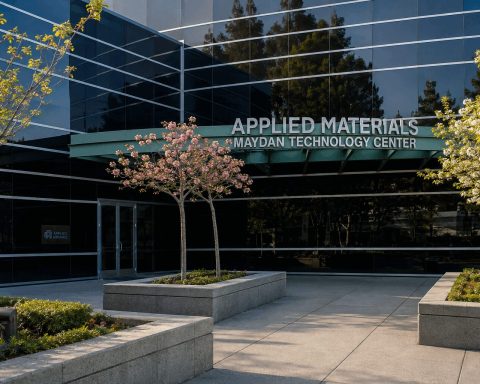
Applied Materials is set to deliver its fiscal second-quarter results after Thursday’s closing bell, a moment that stands to challenge the chip-equipment stock’s outperformance this year. The company, headquartered in Santa Clara, will hold its earnings call at 4:30 p.m. ET—1:30 p.m. PT.
Timing is key here, with the stock already making a notable move. Last trade: $436.61, up $5.32 from the previous close during early U.S. hours. Lam Research, KLA, and ASML were also showing gains ahead of the market open.
Applied Materials is expected to report roughly $7.7 billion in revenue and adjusted earnings of around $2.67 per share, Investopedia noted, citing analyst forecasts. Options traders are bracing for volatility, with current pricing pointing to a swing as large as 7% by week’s end—suggesting a premium on hedges both ways.
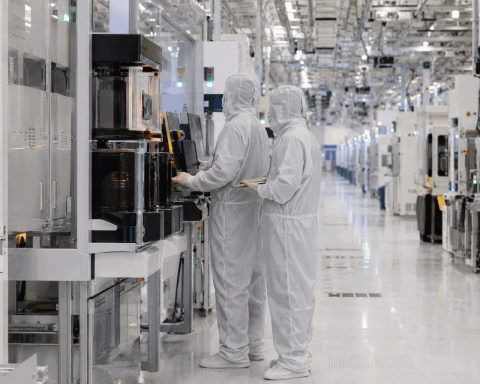
The earnings report is drawing attention as investors look for clues on how much chipmakers are shelling out to boost capacity for artificial intelligence. Applied, which supplies the gear needed to manufacture chips—not the chips themselves—offers a window into just how hard its clients are pushing ahead with new factories and production line upgrades.
Traders in the prediction markets are piling in on a beat here. Over at Polymarket, the contract tracking whether Applied Materials posts non-GAAP EPS above $2.67 is pricing in a 94% chance of a “Yes.” The contract resolves based on the company’s own published earnings numbers. Polymarket
Back in February, Applied set expectations high. The company projected fiscal Q2 revenue around $7.65 billion, give or take $500 million, and non-GAAP diluted EPS at $2.64, plus or minus 20 cents, following Q1 revenue of $7.01 billion.
Back then, Chief Executive Gary Dickerson credited the quarter’s gains to a surge in industry spending on AI computing. He highlighted rising demand for “higher performance and more energy-efficient chips,” saying it pushed growth in leading-edge logic, high-bandwidth memory, and advanced packaging. Applied Materials
High-bandwidth memory, or HBM, is built by stacking DRAM layers, letting data zip through AI processors at much higher speeds. After Applied’s February guidance, Rothschild & Co. Redburn analyst Timm Schulze-Melander called memory “a greater growth driver near-term.” Morningstar’s William Kerwin, for his part, projected a “massive wafer fabrication equipment growth cycle” stretching over three years. Reuters
But there’s a hitch. China is still a major market, and policy uncertainty there hasn’t gone away. In the first quarter, Applied’s revenue from China came in at $2.095 billion—about 30% of its total haul, just a hair below last year’s 31%, according to company data.
The risk came into sharper focus this week after China fired back at the U.S. over the MATCH Act—a bill aimed at blocking Chinese chipmakers from getting their hands on cutting-edge semiconductor equipment, while also pushing Japan and the Netherlands to clamp down further. According to Reuters, ASML and Tokyo Electron are squarely in the spotlight, with Lam and KLA—like Applied—also caught up in the same equipment cycle.
Applied is pushing to prove it can keep growth alive even as pressure mounts. The company on Monday unveiled a new innovation partnership with TSMC, centered at its EPIC Center in Silicon Valley. The focus: materials, equipment, and process tech for advanced AI chips. “Meeting AI demand at global scale requires industry-wide collaboration,” said TSMC’s Y.J. Mii. Applied Materials
For investors, it’s not so much about if there’s demand for AI—nobody’s doubting that—but how much of it’s baked into the stock already. If results come in strong and the guidance stays solid, bulls can argue there’s still upside in chip factory spending. Weak signals on China, margins, export licenses or the pace of customer capacity expansions, though, could drag on a stock that’s shown little tolerance for anything short of a blowout.
Related articles: NASDAQ:AMAT