
SANTA CLARA, Calif., May 15, 2026, 01:07 PDT
- Applied Materials is looking for fiscal third-quarter revenue to land around $8.95 billion—solidly topping what Wall Street had penciled in.
- Chip-equipment maker hit a quarterly revenue record at $7.91 billion. Adjusted earnings clocked in at $2.86 per share.
- The company is now projecting growth of over 30% for its semiconductor equipment business in calendar 2026.
Applied Materials shares climbed after the chip equipment maker projected fiscal third-quarter revenue and profit ahead of analyst targets—an indication that AI-driven demand from data centers continues to impact suppliers of advanced semiconductor tools. The Santa Clara firm late Thursday put its revenue estimate at roughly $8.95 billion, give or take $500 million, with adjusted earnings around $3.36 per share, plus or minus 20 cents.
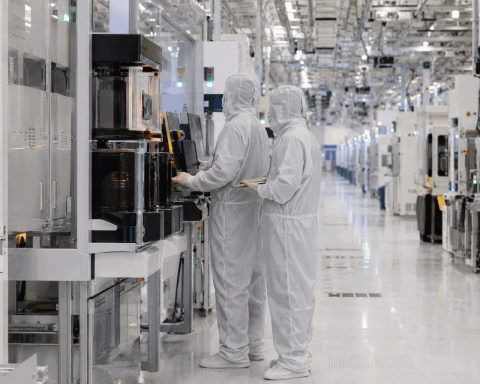
Timing is key here. Investors want evidence that the artificial intelligence surge isn’t only benefiting Nvidia and the cloud giants, but also reaching down to the lower-profile suppliers—the ones making the specialized machines used in chip manufacturing. Applied’s equipment is crucial for producing chips on silicon wafers. Wafer fabrication gear—think of it as heavy-duty machinery—handles the precise depositing, etching, and shaping of chip materials at the microscopic level.
Analysts polled by LSEG had been looking for third-quarter revenue of $8.09 billion and adjusted earnings of $2.88 per share, Reuters reported. For the second quarter, Applied posted revenue of $7.91 billion, outpacing the LSEG forecast of $7.65 billion. Adjusted profit landed at $2.86 a share, also ahead of the $2.66 estimate.
The company posted an 11% jump in second-quarter revenue from a year ago. GAAP net income landed at $2.81 billion, up 31%. Adjusted earnings per share—excluding certain items management deems outside core operations—rose 20% year-over-year, according to Applied.
After the results crossed the wire, shares tacked on 3% in late trading, according to Reuters. The stock last changed hands at $440.56, putting Applied’s market cap around $352 billion.
Applied’s CEO Gary Dickerson called it “record quarterly performance,” and said the company now sees its semiconductor equipment segment expanding by more than 30% in calendar 2026. CFO Brice Hill pointed to accelerating AI demand, saying growth is “now in full force.” Hill noted that Applied has ramped up build plans, inventory and logistics to keep pace. Applied Materials
Here’s the headline takeaway: AI tech hungers for cutting-edge logic chips, larger DRAM memory pools, and higher-spec packaging—that’s the tech shorthand for linking chips and memory to boost performance and trim energy costs. Applied’s semiconductor systems unit turned in $5.97 billion in quarterly revenue; DRAM sales alone made up 29% of that number.
William Kerwin, a senior equity analyst at Morningstar, told Reuters the results point to a “strengthening” AI-fueled upcycle for wafer-fab equipment investment. Suppliers such as Applied could benefit, with chipmakers like TSMC and Samsung pushing ahead on capacity expansions. Reuters
The equipment cycle’s momentum has shifted toward ASML’s rivals, too. Back in April, ASML—Dutch supplier of the lithography gear crucial for chipmaking—raised its revenue forecast for 2026. The driver? Customers ramping up capacity, chasing surging AI demand.
SEMI expects global 300mm fab equipment spending to climb 18% in 2026, reaching $133 billion, and tack on another 14% in 2027, hitting $151 billion. “AI is resetting the scale of semiconductor manufacturing investment,” SEMI Chief Executive Ajit Manocha said in April. SEMI
Applied is pushing to cement its role in customers’ future plans. This week, it spotlighted its EPIC Center collaboration with TSMC, a move targeting accelerated work on materials, equipment, and process tech for next-gen AI chips. According to Applied, the Silicon Valley site could see capital spending hit roughly $5 billion as work with customers picks up.
The risks aren’t trivial. Applied reported that China made up 24% of Semiconductor Systems plus Applied Global Services revenue last quarter. In its outlook, the company flagged swings in demand, trade policy shifts, export restrictions, tariffs, geopolitical tensions, and supplier limits as possible threats. Free cash flow dropped sharply, landing at $210 million—down from $1.06 billion a year ago—as the company boosted capital spending.
At this point, the company is assuring investors that customer visibility looks better. In his prepared remarks, Dickerson pointed out that key customers are now supplying rolling eight-quarter forecasts—longer than typical for a cyclical business. That extended planning view gives Applied more room to maneuver, but the expectations go up: the AI spending surge needs to keep hitting its marks.
Related articles: NASDAQ:AMAT