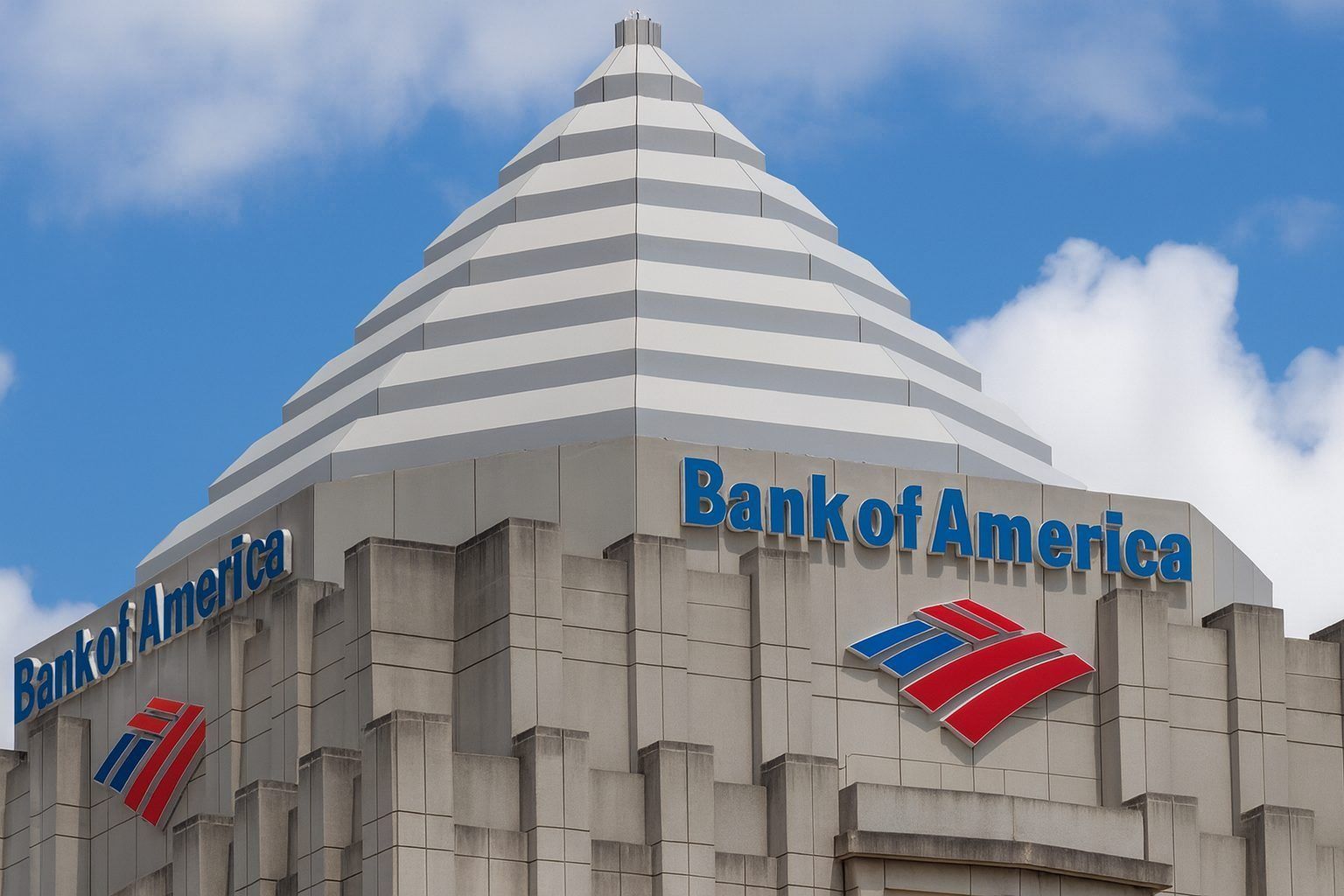
As the Federal Reserve heads into its final policy decision of 2025, Bank of America Corporation (NYSE: BAC) is trading near its 52‑week high, backed by strong earnings, higher net interest income guidance, and ongoing optimism from Wall Street—even as Warren Buffett continues to sell down his once-massive stake.
Below is a detailed look at where BAC stock stands today, the latest news, forecasts, and risks that matter for investors as of December 10, 2025.
Bank of America stock today: price, range and valuation
Bank of America shares opened around $53.5 on Wednesday and are changing hands in the mid‑$53s, putting the stock just below its recent 52‑week high near $54.8 and well above its one‑year low around $33.1. At these levels, BAC carries a market capitalization of roughly $390 billion and a trailing price‑to‑earnings (P/E) ratio in the mid‑teens, depending on the data source.MarketBeat+1
Valuation metrics from independent platforms show:
- Trailing P/E: ~13.3–14.6×
- Price‑to‑book: about 1.3×, implying the stock trades at roughly a 30% premium to its stated book value.iO Charts+1
- Price‑to‑sales: just over 2×, in line with other large U.S. money‑center banks.iO Charts
Liquidity and leverage remain typical for a global systemically important bank: debt‑to‑equity around 1.1, with quick and current ratios just under 0.8, reflecting the nature of bank balance sheets rather than a traditional industrial company profile.MarketBeat
Technical indicators such as the 50‑day and 200‑day moving averages (around $52.2 and $49.3 respectively) show BAC trading above both, confirming the uptrend that’s been in place through the second half of 2025.MarketBeat
Latest fundamentals: Q3 2025 earnings beat and upgraded guidance
Bank of America’s most recent reported quarter—Q3 2025—set the fundamental backdrop for today’s price action:
- Revenue (net of interest expense):$28.1 billion
- Net income:$8.5 billion
- Diluted EPS:$1.06
- Return on tangible common equity (ROTCE):15.4% Bank of America Corporation
A Reuters breakdown highlighted that net interest income (NII)—the spread between what the bank earns on loans and pays on deposits—rose 9% year‑over‑year to $15.2 billion, a record for the franchise. Management now expects Q4 2025 NII between $15.6 and $15.7 billion, about 8% higher than a year earlier, and reiterated that 2025 should mark a record year for NII overall.Reuters+2Reuters+2
Investment banking was another standout. Fees surged about 43% year‑over‑year to roughly $2 billion, far above the earlier 10–15% growth guidance, as corporate clients returned to deal‑making and capital markets activity.Reuters+1
Analysts tracking the quarter noted that the earnings beat (EPS of $1.06 vs. consensus around $0.95–$0.93) and stronger guidance for Q4 NII pushed the stock higher in mid‑October and helped fuel its late‑year rally.MarketBeat+1
Dividend, buybacks and yield: what BAC pays shareholders
For income‑focused investors, Bank of America is increasingly positioning itself as a dividend growth and buyback story:
- On July 23, 2025, the board raised the quarterly common dividend from $0.26 to $0.28 per share and authorized a $40 billion share repurchase program beginning August 1, 2025.Nasdaq+1
- On October 23, 2025, the bank confirmed a fourth‑quarter 2025 common dividend of $0.28 per share, payable on December 26, 2025 to shareholders of record as of December 5, 2025.Bank of America
At the current share price in the mid‑$53s, the annualized dividend of $1.12 per share works out to a dividend yield of roughly 2.1%.iO Charts+1
Dividend data from iO Charts indicates:
- 7 consecutive years of dividend growth
- 5‑year dividend growth rate: ~8–9% annually
- Forward payout ratio: roughly mid‑20s percent on analyst EPS estimates, leaving ample room for buybacks and future increases if earnings track forecasts.iO Charts+1
Bank of America has also kept up regular dividends on its many series of preferred stock; an October 17, 2025 announcement detailed dividend rates and payment dates across several preferred series payable in November and December 2025.Stock Titan
Buffett is selling—but BAC remains a core Berkshire holding
One of the most eye‑catching storylines around BAC in 2024–2025 has been Warren Buffett’s steady selling.
A detailed August 23, 2025 analysis notes that:
- Between July 2024 and mid‑2025, Berkshire Hathaway sold about 427 million BAC shares, cutting its stake by roughly 41%.
- Even after those sales, Berkshire still holds around 605 million shares, representing about 8.2% of Bank of America and making BAC Berkshire’s third‑largest holding by market value.Nasdaq
Buffett’s reasons aren’t spelled out in detail, but the article highlights two key points:
- Valuation: BAC’s price‑to‑book ratio around 1.29 earlier this year meant the stock was trading at roughly a 29% premium to book value, richer than in prior years.Nasdaq+1
- Tax and optionality: Berkshire has been raising cash to record levels and reallocating to other opportunities, including companies like Pool Corp., while also positioning ahead of potential changes in U.S. corporate tax rates.Nasdaq
Importantly, Buffett trimming his stake hasn’t translated into a bearish analyst consensus. If anything, it has sparked debate about whether BAC’s rerating has run too far, or whether it’s simply now priced like a high‑quality, capital‑rich bank in a friendlier regulatory and rate environment.
Fresh institutional flows on December 10, 2025
Today’s headlines also feature new 13F‑related activity in BAC:
- Stamos Capital Partners L.P. increased its BAC position by 46.8%, buying 50,662 additional shares to bring its holding to 158,815 shares worth about $7.5 million. BAC now represents ~1.3% of its portfolio and is its 16th‑largest holding.MarketBeat
- Integrated Investment Consultants LLC cut its stake by 26.2%, selling 10,283 shares and ending the quarter with about 29,034 shares valued at $1.37 million.MarketBeat
- Axa S.A. reduced its position by 17.8%, selling 167,459 shares and retaining 774,634 shares worth about $36.7 million.MarketBeat
Despite individual funds trimming or adding, MarketBeat data shows that about 70.7% of Bank of America’s shares are held by institutions and hedge funds, underscoring the stock’s status as a core institutional holding.MarketBeat+1
Analyst ratings and price targets: Wall Street leans positive
Wall Street remains broadly constructive on BAC:
- A December 2, 2025 MarketBeat survey of 28 brokerages reports a consensus rating of “Moderate Buy,” with 23 Buys and 5 Holds, and an average 12‑month price target of $57.77.MarketBeat
- That implies mid‑single‑digit to low‑double‑digit upside from current levels, depending on exactly where the stock is trading when you look.
Several major firms have raised their targets in recent months:
- Seaport Global Securities: from $59 to $66 (Buy)
- Citigroup: from $58 to $62 (Buy)
- JPMorgan: from $55 to $58 (Overweight)
- Other houses including Daiwa and Erste Group have upgraded BAC to Buy or Outperform.MarketBeat
StockAnalysis, which aggregates forecasts from around 27–28 analysts, also shows an average “Buy” rating and provides a more granular look at fundamentals:StockAnalysis
- Revenue 2025: $111.1B (up ~15.6% from $96.1B in 2024)
- Revenue 2026: $118.0B (up ~6.2% from 2025)
- EPS 2025:$3.86, up ~20% vs 2024
- EPS 2026:$4.40, up ~14% vs 2025
On those estimates, BAC trades at a forward P/E in the mid‑teens, with analyst models implying continued earnings growth through at least 2026, albeit at a slower pace after 2025’s post‑rate‑hike boost.
Separately, a December feature from Zacks highlighted BAC alongside Carvana, Lennar and Newmont as one of its Investment Ideas for current market conditions, reflecting its mix of cyclicality and income.Yahoo Finance
And a December 2025 long‑term forecast from 24/7 Wall St. characterizes Bank of America as the #2 U.S. bank but notes that the stock faces several headwinds over the next 5–10 years if it’s to revisit its prior decade high, including economic cycles, margin pressure and evolving regulation.24/7 Wall St.
Macro backdrop: Fed cuts, AI spending and deregulation
Fed’s December 10 decision looms
Today’s Fed meeting is a key near‑term catalyst not just for BAC, but for the entire banking sector.
- Markets are widely expecting a 25‑basis‑point rate cut—the third consecutive cut—as the Fed tries to balance sticky inflation (still above 2%) with a softening labor market and a slowing economy.Business Insider
- Goldman Sachs and other strategists warn of a potential “hawkish cut,” where the Fed reduces rates but signals a higher bar for further easing in 2026.Business Insider
From Bank of America’s own research desk, a December 2, 2025 Global Research outlook calls for:Bank of America
- Above‑consensus U.S. GDP growth in 2026 (about 2.4% 4Q/4Q)
- Two additional Fed cuts in 2026 (after the expected December 2025 cut)
- A 10‑year U.S. Treasury yield ending 2026 around 4.0–4.25%, slightly lower than mid‑2025 levels
For Bank of America’s NII, this mix—moderately lower short‑term rates but still relatively high long‑term yields and healthy loan demand—is close to a sweet spot. It allows funding costs to gradually ease while loan yields stay attractive.
AI as both cost lever and growth engine
On the structural side, a December Reuters piece on AI in banking notes that Bank of America plans to spend billions of dollars on artificial intelligence and related technologies aimed at improving productivity, automating routine processes, and enhancing revenue generation.Reuters
For BAC, AI investment matters in at least three ways:
- Operating leverage: More automation can keep expense growth flat (or even down) while revenue and volumes climb.
- Risk management: Better models for credit, fraud detection and AML could limit loan losses and compliance costs.
- Customer experience: Smarter digital channels can drive cross‑selling and retention in consumer and wealth management.
Management has repeatedly emphasized “responsible growth” and efficiency, and the bank’s Q3 commentary suggested they expect operating leverage again in Q4, meaning revenue to rise faster than expenses.AlphaSense+1
Regulation tilts more bank‑friendly—for now
Regulation is another major moving piece:
- At the end of November, U.S. regulators issued a final rule modifying certain capital regulations, estimating overall capital levels would remain broadly unchanged but that some bank holding companies would see small reductions in Tier 1 capital requirements.Federal Reserve
- In early December, regulators withdrew long‑standing leveraged‑lending guidance that had effectively capped banks’ exposure to highly leveraged loans, arguing it had pushed business into the less‑regulated private credit sector. This rollback is widely seen as a positive for large U.S. banks, potentially restoring market share in leveraged finance.Reuters
- Jefferies estimates that ongoing U.S. deregulation could unlock around $2.6 trillion in lending capacity for big banks over time, bolstering their ability to grow loans, fund M&A and invest in technology.Bloomberg Law+1
At the same time, proposals to give the U.S. Treasury’s FinCEN unit more central authority over AML enforcement underscore that compliance demands aren’t disappearing—they’re changing form. The Treasury could, in some cases, overrule other regulators’ findings, potentially avoiding punitive actions for purely “technical” violations but putting more emphasis on substantive AML performance.Reuters
Taken together, the late‑2025 direction of travel appears incrementally favorable for large, well‑capitalized institutions like Bank of America, though clearly subject to political and regulatory swings.
What the forecasts say about BAC’s earnings power
Pulling the pieces together, consensus numbers and management guidance suggest:
- Net interest income: Q4 2025 NII is guided to the upper end of $15.5–$15.7 billion, roughly 8% higher year‑over‑year, with management expecting NII growth of about 5–7% in 2026 vs 2025.AlphaSense+3Reuters+3Yahoo Finance+3
- Revenue growth: Street forecasts call for ~15–16% revenue growth in 2025, moderating to ~6% in 2026 as the one‑time lift from higher rates starts to fade.StockAnalysis
- EPS trajectory: Consensus EPS moves from $3.21 in 2024 to $3.86 in 2025 (up ~20%) and $4.40 in 2026 (up ~14%), according to StockAnalysis’ aggregation of analyst models.StockAnalysis
If those numbers materialize, BAC would be:
- Growing earnings faster than U.S. GDP, even in a more normalized rate environment
- Generating enough capital to fund dividends, multi‑billion‑dollar buybacks, and growth investments simultaneously
Of course, forecasts are just that—forecasts. But they help explain why BAC has been rerated higher and why analysts on balance remain bullish despite Buffett’s sales.
Bull case vs. bear case for Bank of America stock
Bull case: why optimists like BAC here
Supporters of BAC at today’s prices tend to point to:
- Scale and diversification
Bank of America spans consumer banking, credit cards, wealth management, global banking and trading. This diversification helped deliver a 15.4% ROTCE in Q3 2025 even amid choppy markets.Bank of America Corporation+1 - NII and earnings growth runway
With NII already at record levels and still projected to grow in 2026, bulls argue that earnings can grow even if the Fed cuts rates, thanks to repricing of assets, loan growth, and improved funding mix.Reuters+2StockAnalysis+2 - Capital returns
An 8% dividend hike in 2025, a $40B repurchase program, and a ~2.1% yield signal confidence in the bank’s capital position and earnings durability.Nasdaq+2Bank of America+2 - AI & technology leverage
Planned multi‑billion‑dollar AI and tech investments are expected to drive productivity, risk management and revenue efficiency over time—especially as deregulation frees up capacity for tech spending.Reuters+2Bloomberg Law+2 - Regulatory environment tilting supportive
Relaxed leveraged‑lending guidance and an apparent shift toward more industry‑friendly capital rules may boost returns on equity and support higher valuations relative to pre‑2023 regulation paths.Reuters+2Reuters+2
Bear case: what could go wrong
Skeptics, including those who see Buffett’s trimming as a warning, counter with several concerns:
- Valuation risk
With BAC trading around 1.3× book value and at a premium to many global peers, there’s less margin of safety if earnings disappoint, credit losses rise, or the regulatory pendulum swings back toward tighter rules.iO Charts+1 - Credit cycle and consumer health
While current charge‑offs and delinquencies remain manageable, any meaningful deterioration in consumer credit or commercial real estate could pressure earnings, especially given the large consumer and card portfolios.iO Charts+1 - Rate‑cut squeeze
If the Fed cuts faster or deeper than BofA’s economists expect, NII could compress more than forecast, particularly if deposit costs stay sticky while asset yields roll down.Bank of America+1 - Regulatory whiplash and AML scrutiny
Even as some capital and lending rules ease, proposals to centralize AML enforcement, plus lingering uncertainty around a revised “Basel III Endgame,” create the risk of future capital or compliance surprises.Reuters+2CEPR+2 - Buffett’s signaling power
Berkshire’s 41% reduction in its BAC stake, tied partly to valuation, may cap upside if other long‑term holders view current pricing as full.Nasdaq
Near‑term catalysts investors are watching
Several upcoming events could move the stock:
- Fed decision and press conference – December 10, 2025
A more dovish or more hawkish tone than expected could quickly shift the outlook for NII, credit, and bank valuations.Business Insider+1 - Brian Moynihan at Goldman Sachs U.S. Financial Services Conference – December 10, 2025 (3 p.m. ET)
The CEO is scheduled to speak later today, giving him a platform to update investors on NII trends, loan growth, credit quality, and capital returns after the strong Q3 print and November investor day.Bank of America Corporation+1 - Q4 2025 earnings – expected January 14, 2026
This will be the first look at full‑year 2025 performance versus guidance and will set the tone for 2026 NII and expense expectations.Bank of America Corporation+1 - Implementation details on deregulation and Basel revisions
Clarification around new capital rules and lending capacity estimates will directly impact how much capital BAC can return to shareholders versus retain.Federal Reserve+1
Bottom line: what today’s setup means for BAC stock
As of December 10, 2025, Bank of America stock sits at an interesting crossroads:
- Fundamentals look strong: record NII, double‑digit EPS growth, and solid ROTCE.
- Shareholder returns are robust, with a higher dividend, a massive buyback program, and room to grow capital returns if earnings track forecasts.
- Macro and regulatory winds are blowing in a more supportive direction for large U.S. lenders, even if the path is bumpy.
- Valuation is no longer distressed; BAC now trades as a quality franchise with a multi‑decade track record, not as a turnaround story.
Buffett’s selling underscores that even high‑quality banks can become “too popular” at certain price points, but the ongoing enthusiasm from analysts, institutional investors, and BofA’s own research team suggests markets still see upside in earnings and returns on capital over the next couple of years.
Whether BAC is attractive at today’s price ultimately depends on your views about:
- The pace of Fed cuts and the shape of the yield curve
- The resilience of the U.S. consumer and corporate credit
- How much value you assign to deregulation, AI‑driven efficiency, and buybacks
For investors who are comfortable with bank‑sector risk and believe the U.S. economy avoids a deep downturn, Bank of America remains one of the central ways to express a bullish view on U.S. financials heading into 2026.