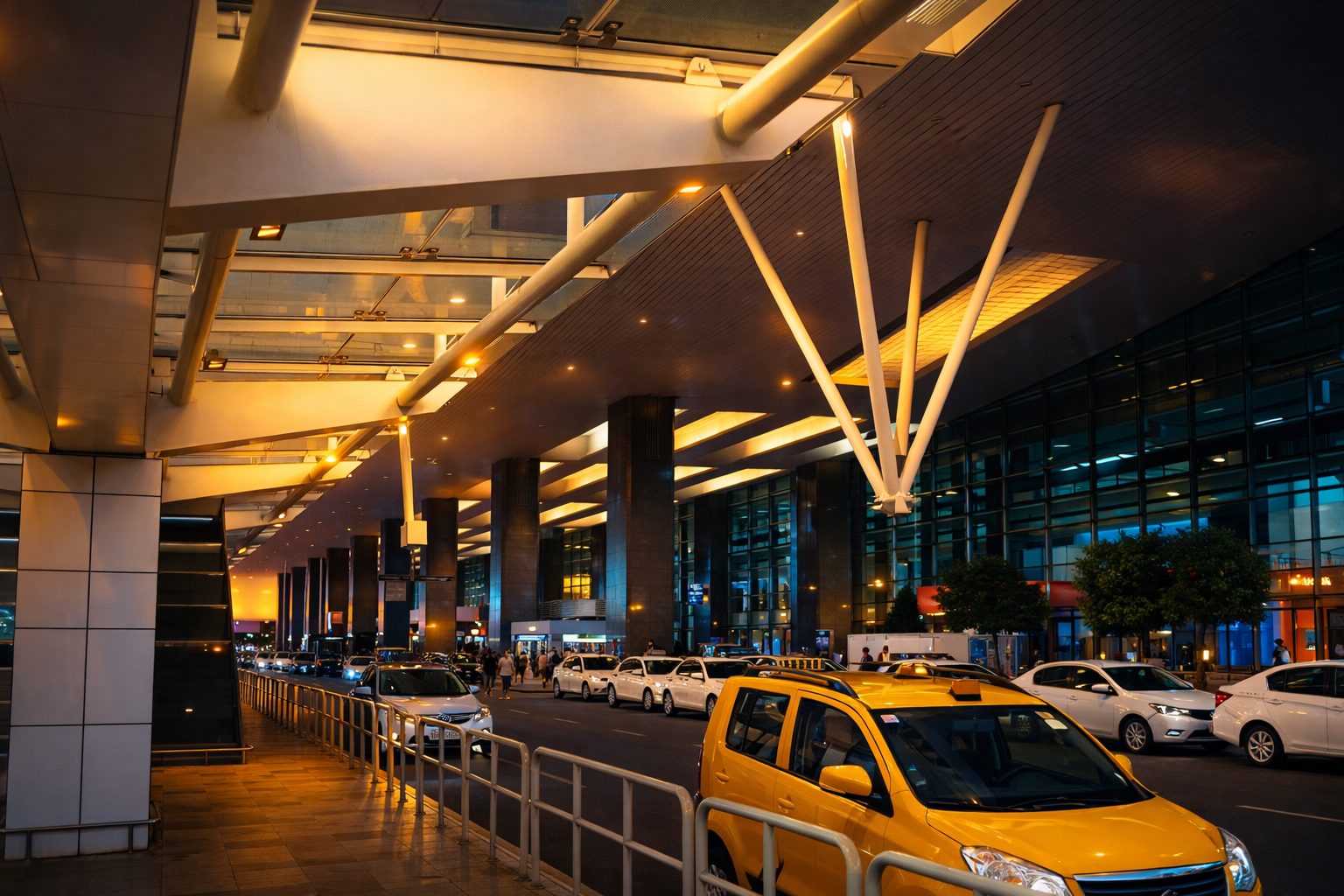

Bengaluru (Dec. 26, 2025) — Bengaluru’s Kempegowda International Airport (BLR) has extended the free parking window at Terminal 1 (T1) arrivals from 10 minutes to 15 minutes, following passenger complaints and taxi-driver pushback over recently tightened pick-up rules. The updated grace period takes effect December 26 and applies to both private vehicles and taxi services using the T1 arrival pick-up areas (P3/P4).
The revision is the first major tweak since the airport operator, Bangalore International Airport Limited (BIAL), rolled out a stricter curbside management plan earlier this month — a plan that introduced time limits, new pick-up zones, and penalties aimed at reducing congestion and “unauthorised” stopping near the terminal. The New Indian Express
Below is what changed, what hasn’t, and what arriving passengers should know before stepping out of Terminal 1.
What changed on December 26: 15 minutes free at T1 arrivals (P3/P4)
The key update is straightforward:
- Free parking at Terminal 1 arrival pick-up areas is now 15 minutes (up from 10).
- The revised timing is effective December 26, 2025, and applies to private vehicles and taxi services using these pick-up areas.
BIAL has also pointed to “last-mile” support to help passengers reach the pick-up zones. In a statement carried by PTI, the airport said travellers can use shuttles running about every seven minutes, along with six cars and 10 buggies operating between the terminal and the P3/P4 pick-up areas. Telegraph India
Why BIAL changed the policy: backlash over long walks, confusion, and accessibility concerns
The free-parking extension follows days of growing criticism that the revised pick-up setup at T1 created unnecessary friction for arriving passengers — particularly senior citizens, families with children, and travellers with mobility issues.
A Deccan Herald report described how passengers were being routed to a new pick-up zone located about 700 metres from arrivals, and how the change triggered an online petition calling for a rollback.
The petition was launched by Hareesh Amjuri, a Bengaluru resident who said he arrived from a trip and couldn’t find his cab driver because he was still searching at the “usual” arrivals pickup lane — only later realising the driver had been moved to Parking Zone P4. Deccan Herald
Amjuri also raised a pointed accessibility concern, citing how difficult the walk could be for vulnerable travellers, including his father, who he said is a Parkinson’s patient.
Passenger frustration wasn’t limited to distance alone. One traveller, Seema Kothari, told Deccan Herald that premium services (such as higher-end ride options) appeared closer to the terminal while other aggregators and buses were farther away — an arrangement she suggested could affect what customers end up paying.
Meanwhile, Moneycontrol reported that users of several ride-hailing and mobility services still faced a walk of more than 1 km to the P4 pick-up area at Terminal 1.
There were also signs of organised resistance. The broader rule changes have prompted protests by parts of the taxi ecosystem in and around the airport corridor, including demonstrations that escalated into police action in at least one reported incident.
The bigger context: BIAL’s curbside crackdown and the “lane segregation” system
To understand why a five-minute change matters, it helps to understand what came before it.
Earlier this month, BIAL announced a lane segregation system and a tighter enforcement approach at pick-up zones. In its public messaging, the airport operator cited rising traffic volumes and a need to prevent vehicles from waiting or stopping in ways that block movement.
According to BIAL’s statement reported by The New Indian Express, the airport planned to allow eight minutes of free use in designated arrival pick-up zones, after which escalating charges would apply — including ₹150 for 8–13 minutes, ₹300 for 13–18 minutes, and towing beyond that threshold.
BIAL also directed commercial vehicles (including taxis) to wait in designated parking zones rather than at the curb, with complimentary parking originally set at 10 minutes at those zones.
BIAL MD & CEO Hari Marar framed the move as a safety-and-order initiative — “not as enforcement,” but as a way to protect travellers and keep traffic moving. The New Indian Express
Deccan Herald reported that the new rules were introduced December 11 at Terminal 2 and December 13 at Terminal 1, and that BIAL said it would monitor performance and stabilise the system over the following weeks.
What taxi drivers need to know: the revised free window and parking fees
For taxi pickups at Terminal 1, the practical impact is this:
- Designated taxi pickup remains in parking zones (P3/P4).
- Free time in those zones is now 15 minutes.
After the free window, Deccan Herald reported that cab drivers would have to pay ₹100 for a half-hour slot, and ₹50 for every additional hour.
This matters because the “pickup clock” often competes with real-world arrival variability: walking time, baggage belts, delayed flights, senior travellers needing assistance, and the simple friction of finding one another in a noisy arrivals environment.
What passengers should do at Terminal 1 arrivals: the latest pickup guidance from BLR Airport
BIAL has been publishing more explicit passenger instructions as the debate intensified.
In an official advisory shared via the airport operator’s LinkedIn presence, BLR Airport outlined three broad categories for Terminal 1 pickups:
- Friends & Family Pick-Up: proceed to the Private Vehicle Lane at Terminal 1
- BLR Airport Authorised Cabs: follow designated airport-authorised pickup zones
- Other Cab Services: proceed to Parking Zones P3 and P4 for pickup (including listed partners such as Ola and Uber, among others) LinkedIn
The same advisory said buggies and shuttles are available for travellers, including Passengers with Reduced Mobility (PRM), to ease movement to P3/P4.
In plain terms: if you land at Terminal 1 and you’re not being picked up in the private vehicle lane or by an airport-authorised cab, expect that your pickup may be routed to P3/P4 — and plan your call/text to your driver accordingly.
Expert view: why airports impose pickup time limits—and where the passenger experience can break
Airport curbside congestion is not unique to Bengaluru. It’s a global operational headache because pickup lanes are high-demand, high-conflict spaces: people stop longer than intended, drivers circle repeatedly, and passengers naturally gravitate toward the closest doors.
Transportation research highlights that vehicle dwell time (how long vehicles occupy curb space) is one of the core drivers of congestion, and travellers typically prefer to stop at locations closest to the doors serving their flight or airline.
Industry guidance from the Airport Cooperative Research Program (ACRP) and related transportation research also discusses operational levers airports use to improve flow — including modifying dwell time policies and redesigning how curb space is allocated and enforced.
That’s the logic BIAL is leaning on: reduce curbside dwell time, move commercial pickups into controlled zones, and discourage informal roadside pickup behaviour.
But Bengaluru’s blowback underscores the other side of curbside management: if the path from arrivals to pickup is too long, too confusing, or poorly supported, passenger friction rises fast — especially for the elderly, families, and travellers with limited mobility.
The move from 10 minutes to 15 minutes suggests BIAL is trying to recalibrate that balance without abandoning the broader framework.
What happens next: more tweaks likely as BIAL monitors feedback
BIAL has publicly indicated that the new system would be monitored as it stabilises, with adjustments based on feedback.
One element still in flux is the airport’s plan around corporate taxis and dedicated pickup lanes at Terminal 1 departures. Moneycontrol reported BIAL said a proposal to allow corporate taxis to pick up from a dedicated lane for a fee would be introduced later.
For now, the immediate change travellers will notice is simply the extra five minutes of free time — and the message behind it: passenger experience feedback is forcing a rethink of how strict “discipline” can be without becoming a hardship.
Bottom line for Bengaluru flyers: what to remember before you land at T1
If you’re arriving at Terminal 1 at Kempegowda International Airport this week:
- The free parking/pickup window is now 15 minutes in the Terminal 1 arrival pick-up areas (P3/P4).
- If you’re using certain ride-hailing services, you may still face a long walk to reach pickup zones — so coordinate with your driver once you’ve collected baggage.
- Use airport-provided shuttles/buggies if you need assistance, and look for updated pickup instructions by category (private vehicle lane vs authorised cabs vs other cabs).
As Bengaluru Airport continues to refine the policy in public view, the real test will be whether operational order can be achieved without making the last 700 metres of the journey feel like the hardest part of flying.




![US Stock Market Today 08/28/2026 [UPDATE: 01:00 EDT] [Marvell Pins Near Overnight Low as Analyst Targets Diverge]](https://ts2.tech/wp-content/uploads/2026/08/US-market-dashboard-2026-08-28-0058-480x384.jpg "US Stock Market Today 08/28/2026 [UPDATE: 01:00 EDT] [Marvell Pins Near Overnight Low as Analyst Targets Diverge]")