Bengaluru, December 7, 2025 — Namma Metro is in the middle of its most transformative phase yet. The long-awaited Yellow Line to Electronic City is finally running, ridership has crossed the one‑million‑a‑day mark, the Pink Line is inching towards a 2026 opening, and the state government has set up a special monitoring group to keep the airport‑bound Blue Line on track.
At the same time, Bangalore Metro Rail Corporation Limited (BMRCL) managing director J Ravishankar has publicly committed to expanding the city’s metro network from about 96 km today to 175 km by 2027 and 225 km by 2030, with train frequencies tightening to roughly 4–6 minutes across the system. Moneycontrol+1
This article pulls together all the key updates as of December 7, 2025 — from new trains and timetable tweaks to delayed deadlines and ambitious Phase 3 plans — and ends with a quick, commuter‑friendly guide to using Namma Metro right now.
Where Namma Metro Stands Today
As of late 2025, Namma Metro operates around 96 km of track with three main corridors — Purple, Green and Yellow — serving about 83 stations across the city. Wikipedia+3Wikipedia+3Wikipedia+3
- Purple Line (East–West): Runs roughly 43.5 km from Challaghatta in the southwest to Whitefield (Kadugodi) in the east, with 37 stations. It passes through major job and commercial hubs including MG Road, Vidhana Soudha, Majestic, Vijayanagar and Whitefield. Wikipedia+1
- Green Line (North–South): Connects Madavara in the northwest to Silk Institute in the south, largely via Tumkur Road, Majestic, Basavanagudi, Jayanagar and Kanakapura Road, with 32 stations. Wikipedia+1
- Yellow Line (Electronic City Line): The newest corridor, fully elevated and about 19.15 km long, linking Rashtreeya Vidyalaya Road (RV Road) to Delta Electronics Bommasandra with 16 stations and a depot at Hebbagodi. Wikipedia+1
On the demand side, the metro has grown from a niche service into Bengaluru’s busiest mass transit system:
- The network carried an average of about 6.3–7.6 lakh passengers per day through 2023–24. Wikipedia+1
- On 11 August 2025, shortly after the Yellow Line opened to the public, Namma Metro logged a record 10.48 lakh rides in a single day, crossing the one‑million mark for the first time. Wikipedia+2Deccan Herald+2
- Even after the initial excitement, ridership stayed high: on 7 October 2025, the network recorded about 10.09 lakh boardings across all lines. Deccan Herald
Financially, BMRCL has also turned a corner. The operator reported operational profits of roughly ₹129–130 crore in FY 2023–24, with more than 23 crore passenger journeys that year — its highest figures so far. The New Indian Express+1
Yellow Line: Electronic City Finally on the Metro Map
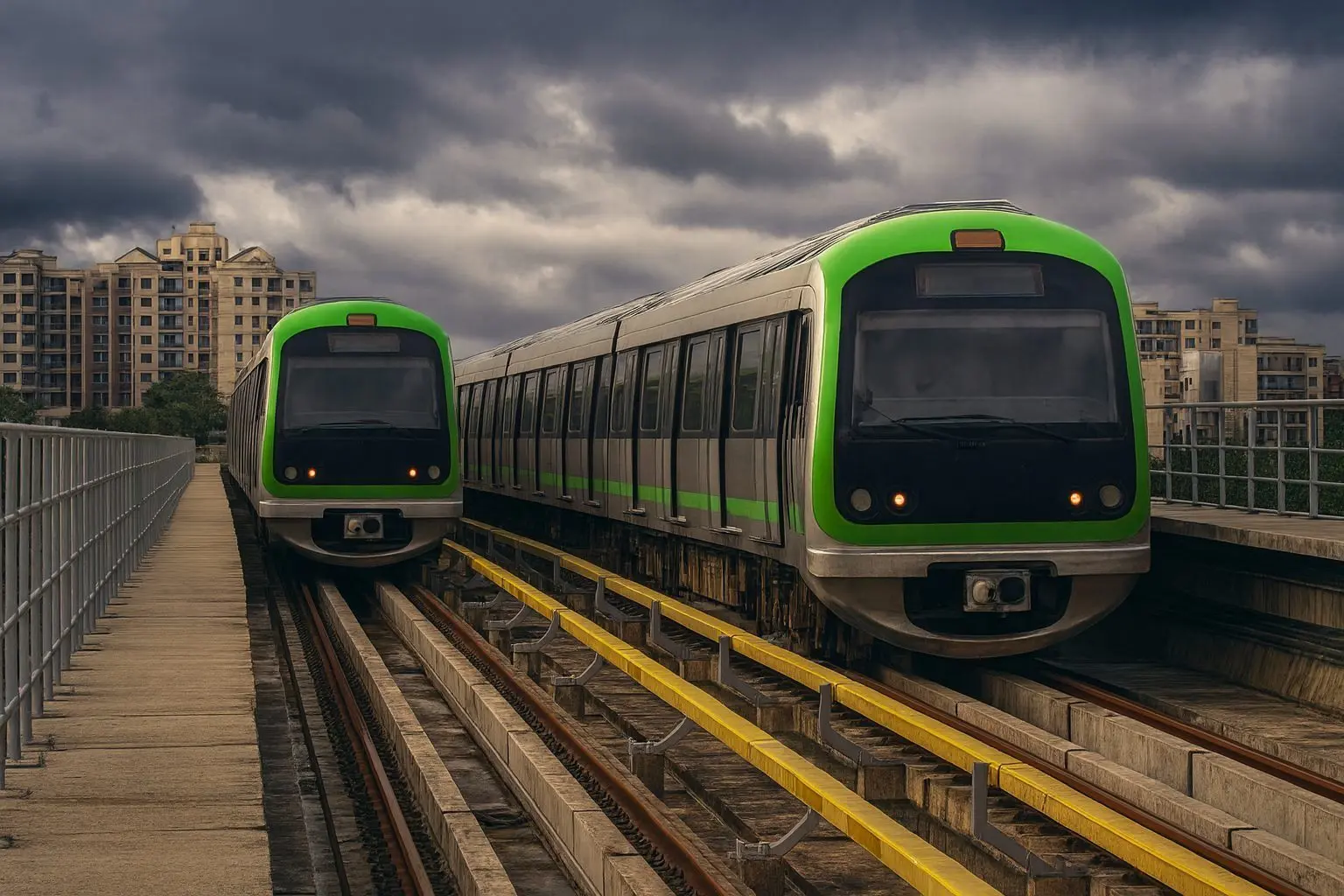
After years of construction, protests and coach delays, the Yellow Line was inaugurated on 10 August 2025 and opened to commuters the next day. Trains now run between RV Road and Bommasandra, connecting dense residential areas and one of India’s largest IT hubs, Electronic City, entirely on elevated tracks. Wikipedia+2The Times of India+2
Key features of the Yellow Line:
- Length: ~19.15 km
- Stations (16): RV Road, Ragigudda, Jayadeva Hospital, BTM Layout, Central Silk Board, Bommanahalli, Hongasandra, Kudlu Gate, Singasandra, Hosa Road, Beratena Agrahara, Electronic City, Konappana Agrahara, Huskur Road, Biocon Hebbagodi, Delta Electronics Bommasandra Wikipedia+1
- Interchanges:
- With Green Line at RV Road
- Planned with Pink Line at Jayadeva Hospital
- Planned with Blue Line (ORR–Airport) at Central Silk Board Wikipedia+2Wikipedia+2
Ridership surge — but early teething problems
On its first full weekday of operation, the Yellow Line alone carried more than 83,000 commuters, helping push total Namma Metro ridership to around 10.5 lakh — a new daily record at the time. The Times of India+1
However, the line opened with too few trainsets:
- At inauguration, there were only three trains, with end‑to‑end frequency around every 25 minutes. The Times of India+1
- A fifth train arrived at Hebbagodi depot and began testing in October–November, allowing BMRCL to improve peak frequency to about 15 minutes. The Times of India
The real breakthrough came this month. A sixth Yellow Line trainset reached Bengaluru in early December, with three of its coaches entering the Hebbagodi depot over the weekend and the remaining coaches expected shortly. Deccan Herald+1
Once fully commissioned, the first six‑train fleet should:
- Reduce peak‑hour headways to about 12 minutes, and
- Bring off‑peak intervals down to about 15 minutes, compared with 19–25 minutes at launch. Wikipedia+1
Additional trainsets scheduled through early 2026 are expected to push Yellow Line frequency towards 5–6 minutes, aligning it with the busier sections of the Purple Line. Wikipedia+1
Responding to commuter feedback: seats and earlier trains
Commuter feedback, especially on the Yellow Line, has been loud and effective:
- After complaints about standing for long periods on crowded platforms, BMRCL has installed rows of metal seating at most Yellow Line stations, including BTM Layout, Jayadeva Hospital, Ragigudda and Konappana Agrahara, with space for roughly three dozen passengers per platform. The Times of India
- Following a protest at RV Road station on 17 November over late first trains, BMRCL has advanced Yellow Line services on Mondays. The first departures are now scheduled at 5:05 am and 5:35 am, instead of the earlier 6 am start, to help weekend returnees and early‑morning workers complete their journeys without long transfers. The Daily Jagran+1
These incremental improvements, paired with the arrival of additional trains, are slowly turning the Yellow Line from a “nice to have” into a credible daily commute option for the Electronic City corridor.
Pink Line: Underground North–South Spine Now Firmly a 2026 Story
If the Yellow Line is about connecting jobs, the Pink Line is about stitching together the city’s dense central spine.
The 21.25 km Pink Line will run from Kalena Agrahara (Bannerghatta Road) in the south to Nagawara on Outer Ring Road in the north, with 18 stations, including 12 underground and 6 elevated. Wikipedia+2Wikipedia+2
It will act as a high‑capacity trunk line, providing:
- An interchange with the Purple Line at MG Road
- An interchange with the Yellow Line at Jayadeva Hospital
- A future interchange with the Blue Line at Nagawara, along with links to proposed lines at Dairy Circle and JP Nagar 4th Phase. Wikipedia+2HexaHome+2
Prototype train rollout delayed to December 11
Rolling stock is now the main bottleneck.
- On 4 December 2025, Deccan Herald reported that BEML was set to roll out the first six‑coach prototype trainset for the Pink Line, to be unveiled in Bengaluru in the presence of senior BEML and BMRCL officials. Deccan Herald
- A day later, the event was pushed to 11 December, with officials citing equipment readiness and coordination issues behind the short postponement. Deccan Herald
This first prototype will be crucial for the start of trial runs and safety testing on the elevated stretch.
Opening in two phases, starting mid‑2026
The Pink Line has seen repeated deadline resets. Earlier expectations of a 2025 opening have been quietly shelved; newer timelines are more conservative:
- The elevated southern section (about 7–7.5 km from Kalena Agrahara to Tavarekere) is now expected to open around May 2026. Wikipedia+1
- The longer underground stretch (roughly 13.8 km from Dairy Circle to Nagawara) is planned to follow by late 2026, after tunnelling, systems integration and safety approvals are complete. Wikipedia+2The Times of India+2
Reports note that at least three trains are required to begin meaningful service, and that each new trainset needs a few months of testing before passenger operations. Combined with earlier tunnelling delays, this has pushed full Pink Line operations to the second half of 2026. Hindustan Times+2Grokipedia+2
Once operational, however, the Pink Line is expected to significantly cut travel times between Bannerghatta Road, central Bengaluru and tech clusters around Nagawara and Manyata Tech Park — while also decongesting MG Road and surrounding arterial roads. Grokipedia+1
Blue Line: ORR and Airport Metro Get a High‑Level Push
The Blue Line (Phase 2A + 2B) is arguably the most anticipated metro project after the Yellow Line:
- Route: A 58.19 km corridor from Central Silk Board to Kempegowda International Airport, built in two segments — 2A (Silk Board–KR Pura) and 2B (KR Pura–Airport). Wikipedia+1
Progress so far:
- As of late 2025, civil work on Phase 2A is around 85% complete, while Phase 2B is roughly 60% done, with viaducts and stations steadily rising along the Outer Ring Road and the airport road. Expected completion: late 2026 for 2A and around 2027 for 2B. KOTS+1
Recognising how important this line is for the city’s economy, the Karnataka government has taken an unusually hands‑on step:
- On December 7, 2025, the state announced a “nano‑monitoring” or high‑level monitoring group to track Blue Line construction and related road works along the tech‑heavy ORR. The Times of India+2The Times of India+2
- The Central Silk Board–KR Pura stretch (~19 km) is being targeted for opening in December 2026, while extensions towards Hebbal and the airport are eyed for 2027. The Times of India+2The Times of India+2
The stakes here are huge. The ORR corridor houses over 500 companies and about 1.3 million tech workers, and is said to contribute more than 18% of India’s IT exports — yet it suffers from chronic gridlock and long commute times. The Times of India+1
If delivered broadly on time, the Blue Line will offer:
- Direct, high‑frequency airport access from the city’s south and east
- A mass‑transit backbone for ORR that not only supports office commuters but also ties into suburban rail, buses and future metro phases
Phase 3 and Hebbal–Sarjapur: The Next Wave of Expansion
Beyond Phase 2, Bengaluru’s Phase 3 metro plan is finally moving from paper to the ground.
- The Union Cabinet approved Phase 3 in August 2024, with a total cost of about ₹15,611 crore, and construction is expected to stretch into the early‑to‑mid 2030s. The Metro Rail Guy+1
- Phase 3 initially adds two new corridors spanning roughly 44–45 km, while a further 37 km Hebbal–Sarjapur line is proposed under “Phase 3A”. The Metro Rail Guy+1
Recent developments:
- In November 2025, work ceremonially began on key Phase 3 segments, including a double‑decker structure where metro tracks will share a vertical stack with a flyover — intended to save space and costs on congested stretches. Early targets for commercial operations have slid from 2029 towards around 2031. Bangalore Mirror+1
- BMRCL is also reworking estimates for the Hebbal–Sarjapur corridor, with Moneycontrol reporting a proposed cost reduction of nearly ₹2,900 crore as the corporation seeks central approval between late 2025 and early 2026. Moneycontrol
While Phase 3 will not contribute to the 175 km by 2027 target, it is central to the 225 km by 2030 vision and to providing east‑west and north‑south redundancy beyond the existing Purple and Green lines. Moneycontrol+2The Daily Jagran+2
How BMRCL Plans to Reach 175 km by 2027 and 225 km by 2030
BMRCL’s MD has laid out a broad roadmap for the next five years: Moneycontrol+2The Daily Jagran+2
- Consolidate today’s 96 km network
- Full stabilisation of Purple, Green and Yellow Lines, with better frequencies and more rolling stock. Wikipedia+2NoBroker+2
- Add the Pink Line (~21 km) by late 2026
- Elevated Kalena Agrahara–Tavarekere stretch around mid‑2026
- Underground Dairy Circle–Nagawara stretch by late 2026 Wikipedia+2The Times of India+2
- Complete the Blue Line (~58 km) by 2027
- Silk Board–KR Pura section (Phase 2A) by late 2026
- KR Pura–Airport section (Phase 2B) by 2027 Wikipedia+2KOTS+2
- Phase 2 leftovers and connector links
- Finishing touches on depots, stabling lines, station upgrades and missing links that together add up to smaller length increments but big operational flexibility. The Times of India+2Wikipedia+2
When you add these to the current 96 km, BMRCL’s target of roughly 175 km by 2027 and 225 km by around 2030 appears aggressive but not impossible — provided that the Blue and Pink Lines hit their revised deadlines and Phase 3 accelerates from 2026 onward. Moneycontrol+2The Daily Jagran+2
Crucially, Ravishankar has also emphasised that by 2030, headways across the network should fall to about 4–6 minutes, especially at busy stations and interchanges, dramatically increasing capacity and reliability compared with today. Moneycontrol+2The Daily Jagran+2
What This Means for Commuters
The metro’s rapid expansion is already reshaping daily travel:
- Shorter end‑to‑end journeys:
- The full Purple Line has made Whitefield–Challaghatta commutes far quicker and more predictable. Wikipedia+1
- The Yellow Line allows Electronic City commuters to bypass long, congested stretches of Hosur Road and the elevated expressway, even if current frequencies still require patience. Wikipedia+2The Times of India+2
- Growing role in emergencies and essential services:
Ravishankar highlighted how the metro has been used to move donor hearts between hospitals in under 20 minutes, underlining the network’s value beyond regular commuting. Moneycontrol+1 - Competition and complementarity with buses:
While the metro is expanding, BMTC is also innovating. A new AC bus service along NICE Road between Madavara and Electronic City promises a 45‑km limited‑stop ride in about 90 minutes, marketed as a smoother alternative to making multiple metro interchanges across almost 40 stations. The Times of India In practice, these services will likely complement each other: metro for dense urban stretches and interchanges, and buses for point‑to‑point and peripheral links. - Relief on key roads:
As metro construction winds down on some corridors, long‑suffering motorists are finally seeing improvements. For instance, stretches of Bannerghatta Road around Dairy Circle and Lakkasandra are gradually reopening after years of Pink Line tunnelling work, even if road quality still needs attention. The Times of India+1
Key Challenges to Watch
Despite the optimistic timelines and visible progress, several risks remain:
- Construction and contractor delays
- Phase 2 has already overshot its original 2020 completion target by several years, largely due to land acquisition, design changes, contractor issues and the pandemic. The Times of India+1
- Rolling‑stock bottlenecks
- The Yellow Line’s slow ramp‑up and the Pink Line’s revised schedules both stem from coach shortages and delayed deliveries. BEML and Titagarh Rail are now expected to supply additional sets more steadily through 2026, but any slippage will immediately show up as lower frequencies. Wikipedia+3The Times of India+3Deccan Hera…
- Land and integration issues
- For Blue Line and Phase 3, viaducts, stations, flyovers and the upcoming Peripheral Ring Road (PRR) all compete for space. Authorities have introduced a new land‑compensation policy with multiple options for landowners and say acquisition will not be allowed to derail timelines — a claim that will be tested on the ground. The Times of India+1
- Funding and cost overruns
- Phase 2’s cost has risen from about ₹26,000 crore to over ₹40,000 crore. Although fresh approvals have been granted for escalations and Phase 3, sustained funding and cost control will be critical for hitting the 2030 network goals. The Times of India+2MagicBricks+2
How to Use Namma Metro Right Now: A Quick Guide
Until the new lines arrive, here’s how commuters can best use the existing network:
- Core corridors to know
- Purple Line: Whitefield (Kadugodi) ↔ Challaghatta — ideal for IT parks in Whitefield, CBD (MG Road), government areas (Vidhana Soudha) and intercity connections at Majestic. Wikipedia+1
- Green Line: Madavara (BIEC) ↔ Silk Institute — covers Peenya industrial areas, Yeshwanthpur, Malleshwaram, Majestic, Basavanagudi, Jayanagar and southern residential belts. Wikipedia+1
- Yellow Line: RV Road ↔ Bommasandra — the fastest current option for Electronic City, Bommasandra industrial belt and areas around Central Silk Board. Wikipedia+1
- Interchange stations
- Nadaprabhu Kempegowda (Majestic): Purple + Green, plus major bus and rail connections. Wikipedia+2Wikipedia+2
- RV Road: Green + Yellow. Wikipedia+1
- Future key hubs: Jayadeva Hospital (Yellow + Pink), Central Silk Board (Yellow + Blue), MG Road (Purple + Pink), Nagawara (Pink + Blue). Wikipedia+2Wikipedia+2
- Timings and frequency (approximate)
- Most lines begin operations around 5:00–5:30 am and run until about 11:00 pm, though first and last train timings vary by station and day. NoBroker+2The Times of India+2
- Purple and Green Lines typically run every 4–6 minutes at peak times; the Yellow Line currently runs closer to 12–19 minutes, improving as new trains are inducted. NoBroker+2The Times of India+2
- Tickets and payments
- Commuters can pay using smart cards, QR tickets, National Common Mobility Cards (NCMC) and traditional tokens, with recharge and QR purchase available via the official Namma Metro app and ticket counters. The Times of India+1
- Where to check live updates
- BMRCL’s official website and social media channels carry notices on service disruptions, timetable changes (such as the advanced Monday Yellow Line timings) and trial‑run announcements. bmrc.co.in+2The Daily Jagran+2
As of December 7, 2025, Bengaluru’s metro story is one of visible progress mixed with familiar delays. The Yellow Line is finally easing Electronic City commutes, the Pink Line’s first trainset is waiting in the wings, and the Blue Line has the full attention of the state’s top leadership. If BMRCL can deliver on its 175 km by 2027 pledge, Namma Metro will move from being a partial solution to Bengaluru’s traffic woes to the backbone of everyday mobility in India’s tech capital.