
Berkshire Hathaway’s Class B shares hover around $504 as a record cash hoard, a new Alphabet stake, continued buying of Domino’s Pizza, Visa’s trillion‑dollar potential and Warren Buffett’s looming retirement dominate today’s headlines.
Berkshire Hathaway stock today: price, range and market cap
Berkshire Hathaway’s Class B shares (ticker: BRK.B) closed on Friday, November 21, 2025 at $504.04, up about 0.6% on the day, according to multiple price-history datasets.
That puts the stock roughly:
- 7% below its 52‑week high of $542.07 (set on May 2, 2025)
- 15% above its 52‑week low of $440.10 (hit on January 10, 2025) INDmoney+1
At around $504 per share, Berkshire’s market capitalization is just over $1.0–$1.1 trillion, leaving it as one of the world’s largest companies and the only major U.S. conglomerate in the trillion‑dollar club alongside mostly technology names.
With U.S. markets closed this Saturday, November 22, the latest available figures show BRK.B sitting near the middle of its 2025 trading range and modestly above its January levels.
Performance vs. the broader market
Despite the enormous valuation, Berkshire Hathaway has lagged the S&P 500 in 2025:
- Various third‑quarter earnings analyses put B‑shares’ year‑to‑date gain at roughly 5–6%,
- Versus an S&P 500 advance of around 16% over a similar period.
A quant snapshot from Trefis today notes that Berkshire’s one‑day return over the most recent trading session was roughly flat, compared with a roughly 1% rise in the S&P 500, framing the stock as slightly underperforming a strong tape in the very short term.
That muted share‑price reaction stands in contrast to the very loud fundamentals story: record earnings, a towering cash pile, new high‑profile equity stakes — and Warren Buffett’s final weeks as CEO.
Q3 2025 earnings: 34% profit surge and a record cash mountain
Berkshire’s third‑quarter 2025 results, released on November 1, continue to shape how investors see the stock today.
Across several detailed breakdowns, the headline numbers are remarkably consistent:
- Operating earnings jumped about 34% year‑on‑year to roughly $13.5 billion.
- Quarterly revenue edged up about 2% to nearly $95 billion, driven largely by the insurance operation.
- Insurance underwriting income more than doubled to around $2.3 billion, helped by stronger reinsurance results and attractive yields on the float invested in short‑dated U.S. Treasuries.
Most striking is the cash position:
- Berkshire’s cash and equivalents rose to approximately $381.6–$381.7 billion, an all‑time high.
A number of analysts describe that as “dry powder” parked primarily in short‑term Treasury bills — a low‑risk way to earn a real return while waiting for better deals. Investopedia+2Saxo+2
Net seller of stocks, fifth straight quarter with no buybacks
Several pieces this month emphasize that Berkshire remains cautious on equity valuations:
- The company sold more stocks than it bought for the 12th consecutive quarter, making it a net seller of roughly $6 billion in Q3.
- One breakdown cites about $12.4 billion in stock sales vs. $6.4 billion in purchases, leaving Berkshire’s equity portfolio near $283 billion while cash swelled.
- Berkshire did not repurchase any of its own shares for the fifth straight quarter — the longest buyback drought since Buffett got wider authority to repurchase stock in 2018.
For shareholders, that mix — record cash, steady selling and no buybacks — is widely read as a valuation warning. If the company doesn’t see its own stock, or the broader market, as compellingly cheap, management is clearly content to wait in T‑bills.
Today’s headlines: Alphabet, Domino’s and Visa in the Berkshire spotlight
While the core numbers are old news by now, November 22, 2025 has brought a fresh wave of articles focused on specific Berkshire holdings and portfolio moves.
Alphabet: Berkshire’s “quantum computing” bet that still fits the value playbook
One of the most talked‑about developments remains Berkshire’s new stake in Alphabet (GOOG, GOOGL), the parent of Google and YouTube.
A November 22 analysis syndicating across outlets (including Finviz/Nasdaq) recasts Alphabet as the “genius quantum computing stock” Berkshire Hathaway just bought, highlighting how unusual it is to see Buffett’s conglomerate lean into a business with cutting‑edge quantum‑computing ambitions. Finviz+1
Key details from recent regulatory filings and coverage:
- Berkshire disclosed owning about 17.85 million Alphabet shares as of September 30,
- A position valued near $4.9 billion at the time of the filing,
- Enough to send Alphabet’s stock up roughly 5.5% in pre‑market trading when the stake was revealed.
Despite the quantum‑computing angle, commentators stress that the purchase still looks very “Berkshire”:
- Alphabet’s core ad business, powered by Google Search and YouTube, throws off massive, predictable cash flows — exactly the kind of economics Buffett and his lieutenants typically favor.
- At the time Berkshire was buying, Alphabet traded at roughly 19× forward earnings, a multiple value investors can comfortably analyze even if they treat quantum computing as a free option.
Whether Buffett personally made the call or delegated it to Todd Combs or Ted Weschler remains unclear, but coverage is unanimous that this is one of his final marquee moves as CEO.
Domino’s Pizza: the one stock Berkshire keeps quietly buying
Another November 22 feature zeroes in on Domino’s Pizza (DPZ) as “the one stock Warren Buffett keeps buying despite market volatility.” Finviz+1
According to Q3 13F analyses and today’s commentary:
- Berkshire first took a stake in Domino’s in Q3 2024,
- And has added to the position every quarter since, even as it has been a net seller of stocks overall.
The rationale, as framed by these articles:
- Domino’s is a global consumer brand with a strong “moat” in delivery, technology and franchise scale. Finviz
- The pizza category is resilient — an affordable, mass‑market comfort food that tends to hold up even when consumers feel pressure from higher living costs.
- The business is highly profitable and still growing, yet valuation is portrayed as reasonable relative to its cash‑flow profile.
Taken together, Domino’s looks like a classic Buffett‑style consumer compounder that Berkshire is willing to accumulate discretely while trimming more fully valued positions elsewhere.
Visa: can a Buffett stock join Berkshire in the $1 trillion club?
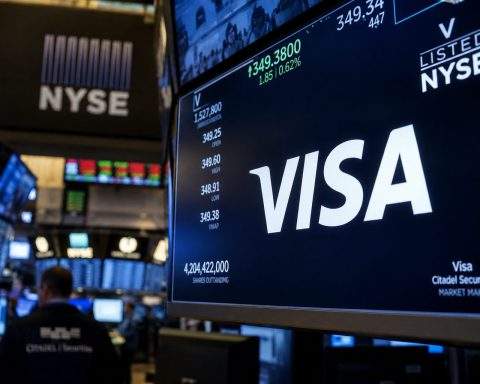
A widely syndicated piece published this morning argues that Visa (V) — another Berkshire holding — could join Berkshire itself in the $1 trillion market‑cap club by 2030.
Highlights from that analysis:
- Berkshire owns approximately $2.7 billion of Visa stock, alongside its giant stakes in names like Apple, Coca‑Cola, and American Express.
- Visa already commands a valuation around $630+ billion, implying it would need less than 10% compound annual growth in market value to reach $1 trillion by 2030.
- The thesis leans on Visa’s network‑effects‑driven business model, where revenue scales with transaction volumes and processed transactions rather than credit risk.
The article frames Visa as a “Buffett‑compatible” growth stock: predictable, asset‑light, highly profitable, and suitable as a core long‑term holding — much like Berkshire itself has been for many investors.
Portfolio positioning: net selling, new stakes and ¥210.1 billion in yen bonds
Beyond individual stocks, several pieces this month dissect what Berkshire’s capital allocation says about the current investing environment.
13F update: concentrated bets and selective new positions
A deep Q3 2025 portfolio review finds that Berkshire’s 13F equity portfolio now sits near $267 billion, dominated by a handful of giants: Apple, American Express, Bank of America, Coca‑Cola and Chevron.
Key moves highlighted:
- New stake in Alphabet, as discussed above,
- Exit from BYD, the Chinese EV maker, as Berkshire gradually unwound a long‑running position, Seeking Alpha
- Adds to Chubb, Domino’s Pizza, and Sirius XM,
- Continued trimming of Apple and Bank of America, locking in gains and further reducing tech and money‑center bank exposure.
Separate analysis from Investopedia frames those moves as part of a broader 2025 pattern: rotating away from richly valued Big Tech, while adding to high‑quality businesses in health insurance (e.g., UnitedHealth), homebuilding (Lennar, D.R. Horton) and steel (Nucor) that face cyclical or regulatory headwinds but still possess durable competitive advantages.
Yen‑denominated debt: ¥210.1 billion in new senior notes
On November 21, Berkshire filed an 8‑K and a separate notice confirming it has issued ¥210.1 billion (about $1.4 billion) in new yen‑denominated senior notes across four tranches: Investing.com
- ¥123.7 billion of 1.510% notes due 2028
- ¥53.3 billion of 1.826% notes due 2030
- ¥26.1 billion of 2.422% notes due 2035
- ¥7.0 billion of 2.810% notes due 2040
The bonds were sold under an existing shelf registration, with Mizuho Securities USA and Merrill Lynch International underwriting the deal.
This continues Berkshire’s long‑running habit of tapping Japanese markets for low‑cost yen funding, then redeploying capital globally — a strategy that complements its enormous U.S. dollar T‑bill holdings and reinforces the company’s reputation for conservative, opportunistic funding.
Leadership transition: Buffett’s final weeks as CEO and the fading “Buffett premium”
A major theme in today’s coverage is that the Warren Buffett era as CEO is formally ending.
“Going quiet” while backing Greg Abel
Reuters and regional outlets report that in a late‑year letter and Thanksgiving message, the 95‑year‑old Buffett reiterated that he will step down as Berkshire’s CEO at the end of 2025, though he will stay on as chairman and keep a large personal stake.
Key points from those reports:
- Buffett says he will be “going quiet”, with vice chair Greg Abel taking over shareholder letters and the public spotlight at annual meetings. Reuters+2Star Tribune+2
- He strongly endorses Abel, writing that he cannot think of anyone he would rather have “handle your savings and mine,” and noting that Abel now understands many Berkshire businesses better than Buffett himself does. Reuters+1
- Buffett recently accelerated $1.3 billion in charitable gifts to family foundations, while stressing that this does not reflect any loss of confidence in Berkshire’s long‑term prospects.
An Associated Press piece carried by regional media adds a more personal note: Buffett acknowledges that “Father Time” is catching up, even as he still goes into the office five days a week to look for deals. The North State Journal
Erosion of the “Buffett premium”
Multiple analyses tie Berkshire’s recent underperformance partly to the diminishing “Buffett premium” — the extra valuation investors historically paid to ride alongside the “Oracle of Omaha.” Investopedia+2CryptoRank+2
- Reuters points out that since Buffett unexpectedly confirmed his departure earlier this year, Berkshire’s share price has fallen around 8%, while the S&P 500 has surged roughly 20%.
- Investopedia notes that the stock’s more modest 2025 gains, compared with prior years, may reflect investors recalibrating expectations for a post‑Buffett era, even as the underlying businesses remain strong.
At the same time, Buffett himself continues to emphasize that:
- Berkshire’s businesses have “moderately better‑than‑average prospects”,
- But the conglomerate’s sheer size and elevated market valuations mean investors should not expect the outsized outperformance of earlier decades.
Buffett vs. speculation: crypto, gold and the “Buffett way” back in the news
Even stories not directly about BRK.B’s price feed into how the market views the stock.
A prominent column today highlights author Robert Kiyosaki’s renewed criticism of Buffett’s longstanding skepticism toward Bitcoin, recalling Buffett’s famous comments that he would not buy all the bitcoin in the world even for $25 because it “doesn’t do anything.” Moneywise
Other features revisit Buffett’s equally blunt views on gold as an unproductive asset, contrasting them with his decades‑long preference for cash‑generating businesses and broad index funds.
For Berkshire shareholders, these pieces don’t change the numbers, but they reinforce the philosophical foundation beneath the company:
- Favor simple, cash‑rich, competitively advantaged businesses,
- Avoid assets that depend solely on someone paying more later,
- Remain patient, especially when markets look expensive.
In other words, today’s chatter about crypto, gold and “fake assets” mainly underlines why Berkshire’s balance sheet is stuffed with Treasury bills and operating companies, not speculative tokens.
How Berkshire Hathaway stock looks today, in one view
Pulling all of this together, Berkshire Hathaway’s Class B shares on November 22, 2025 sit at the intersection of stellar fundamentals and tempered market expectations.
Bullish pillars
- Earnings power and diversification
- Operating earnings are growing in the mid‑30% range, led by a very profitable insurance segment and solid contributions from rail, utilities and manufacturing.
- The conglomerate remains broadly diversified across insurance, transportation, energy, industrials, retail and a concentrated but high‑quality equity portfolio.
- Fortress balance sheet with record liquidity
- Roughly $382 billion in cash and equivalents, mostly in short‑term U.S. Treasuries, gives Berkshire enormous flexibility to act when valuations reset or distressed opportunities appear.
- Conservative funding — including the recent ¥210.1 billion yen‑bond issuance — further reinforces the balance sheet.
- High‑quality equity holdings
- New positions in Alphabet, Domino’s and Visa show that even in a cautious stance, Berkshire is still willing to back companies with strong moats and compelling long‑term economics.
Key risks and open questions
- Valuation and opportunity cost
- With BRK.B trading near the middle of its 52‑week range and a market value above $1 trillion, upside depends on whether the market continues to reward steady compounding over flashier growth.
- The extended buyback pause suggests management does not view the stock as a screaming bargain at current levels.
- Underperformance vs. the S&P 500
- The stock’s mid‑single‑digit YTD gain vs. a mid‑teens S&P 500 rise — and an 8% lag since Buffett’s departure announcement — show that investors can no longer assume automatic outperformance.
- Leadership transition and the post‑Buffett narrative
- While Buffett and many observers are unequivocal in their support for Greg Abel, markets may need time to fully price in a post‑Buffett Berkshire. The erosion of the “Buffett premium” could continue to weigh on valuation, even if the underlying operations remain robust. Reuters+2The North State Journal+2
What investors should watch next
For readers tracking Berkshire Hathaway stock after today’s news flow, several signposts matter more than the weekend’s flat price action:
- Buybacks or a major acquisition: Either would signal that management finally sees compelling value — in Berkshire’s own shares or in an external “elephant‑sized” deal. Saxo+2Investopedia+2
- How Greg Abel communicates in 2026: His first shareholder letter and performance at the annual meeting will be closely watched for continuity of culture and capital‑allocation discipline.
- Deployment of the cash pile: With T‑bill yields still attractive but not spectacular, prolonged inaction could weigh on returns; selective moves into businesses like Alphabet, Visa, Domino’s, UnitedHealth or real‑asset deals like Occidental’s chemical unit offer clues to the next chapter.
For now, Berkshire Hathaway stock represents exactly what today’s headlines suggest: a trillion‑dollar, cash‑rich, cautiously positioned compounding machine, moving into a carefully planned post‑Buffett era without abandoning the philosophy that built it.
This article is for informational purposes only and does not constitute financial advice, investment recommendation or an offer to buy or sell any security.
Related articles: NYSE:V