
NEW YORK, August 6, 2026, 15:06 EDT (00:06 PKT, August 7) — U.S. cash trading begins.
- The stock was last at $91.72, falling 38.84%. Trading volume was almost four times higher than its 65-day average.
- Revenue for the second quarter increased by 64% to $109.4 million. The company maintained its full-year forecast at $450 million to $465 million.
- The outlook suggests growth in the second half will range from about 29% to 38%. Revenue in the first half increased by 74%.
BillionToOne stock slid 38.8% to $91.72 as of 3:03 p.m. The company maintained its 2026 sales forecast following a robust quarter. Based on basic shares as of August 3, the decline wiped out approximately $2.75 billion in market capitalization.
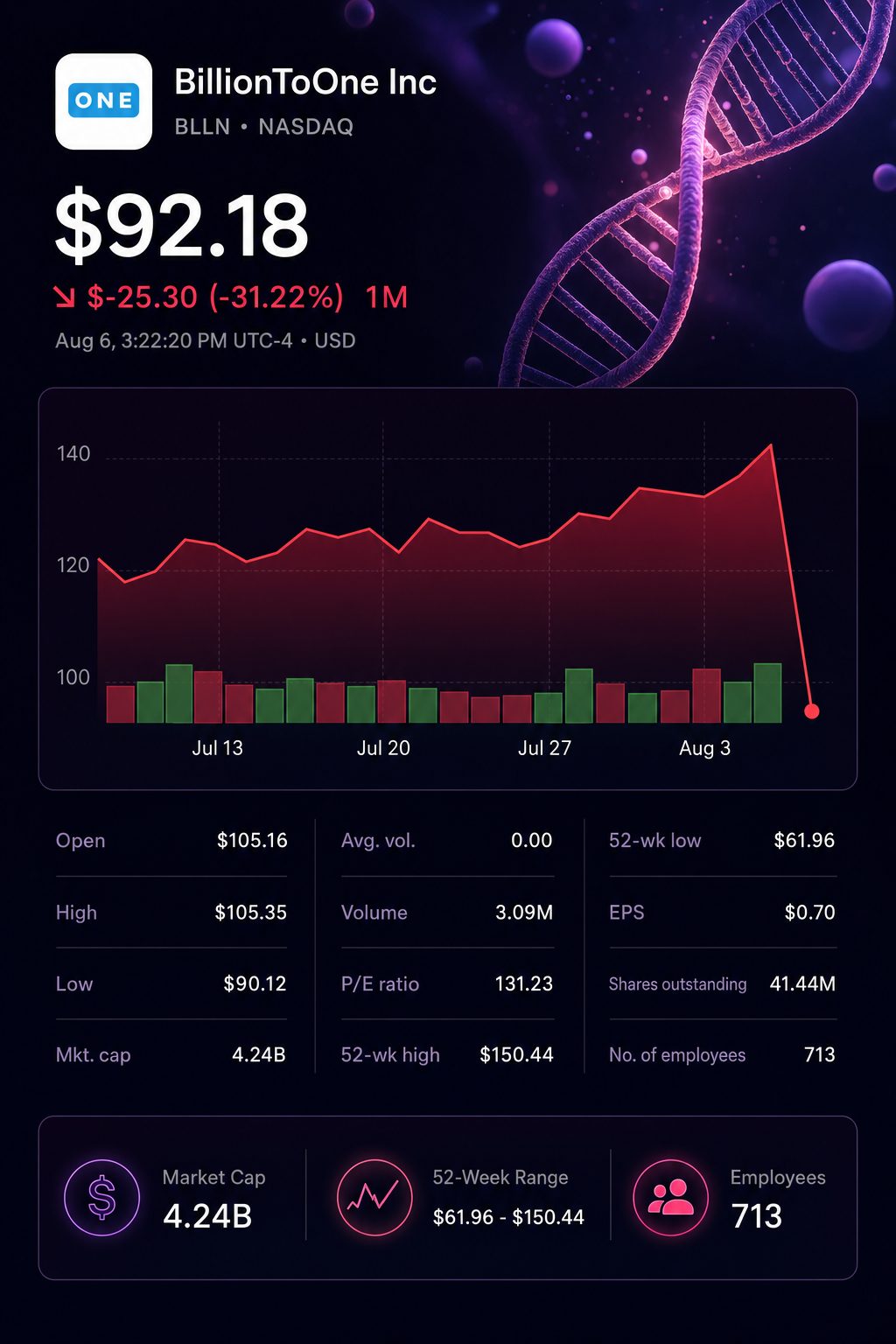
The development was primarily related to the company. The Nasdaq showed little change, while the SPDR S&P Biotech ETF (NYSEARCA:XBI) rose approximately 0.3%.
The market was not dismissing the quarterly results but was instead adjusting valuations for the second half’s exit rate. Using the guidance midpoint, mean quarterly revenue in the back half is just 9.5% higher than in the second quarter.
Implications of maintaining guidance
| Measure | Revenue or growth | Investor read-through |
|---|---|---|
| First-half 2026 revenue | $217.8 million | Gained 74% compared to previous year |
| Full-year guidance | $450 million-$465 million | Increase of 48%-52% |
| Second-half revenue required | $232.2 million-$247.2 million | Figures come from company guidance |
| Implied second-half growth | 29.4%-37.7% | Significant drop in pace versus first half |
| Average second-half quarter | $116.1 million-$123.6 million | At the midpoint, that’s 9.5% higher than Q2 |
The numbers for the second half are derived calculations and not distinct guidance provided by the company.
The significance of that trajectory is underscored by BillionToOne’s gain of over 84% following its May earnings. Shares ended Wednesday at $149.97, just below the record high of $150.44. Investor expectations were already elevated.
The quarter demonstrated solid operational performance. Test volume expanded by 35%, and the average selling price went up 21%. Gross margin stood at 70.5%, with operating profit at $5.5 million.
Oncology continued as the unit with the strongest growth, posting revenue of $13.7 million, up 176%. Revenue from prenatal clinical services climbed 55% to $94.2 million.
Operating results by quarter
| Metric | Q2 2025 | Q1 2026 | Q2 2026 |
|---|---|---|---|
| Tests performed | 145,000 | 188,000 | 196,000 |
| Average selling price excluding true-ups | $440 | $522 | $537 |
| Average selling price reported | $455 | $571 | $551 |
| Total revenue | $66.6 million | $108.4 million | $109.4 million |
| Gross profit margin | 65.3% | 73.0% | 70.5% |
| Operating income/(loss) | $(1.6) million | $17.8 million | $5.5 million |
| Adjusted EBITDA | $2.9 million | $26.0 million | $16.1 million |
Revenue was up just 1% from the previous quarter, but rising 8% when excluding reimbursement true-ups. BillionToOne retained over $10 million in claims amid national-payor code modifications.
Core pricing advanced, with ASP excluding true-ups increasing by $15 compared to the first quarter, supported by recent payor agreements. The data indicate that headline revenue did not fully reflect underlying sequential gains.
Chief Executive Oguzhan Atay said, “Our second quarter demonstrated the durability of our model.” The company intends to launch a 130-gene fetal-risk panel on August 17. Northstar Origin remains set for September 1. BillionToOne Inc.
Same-day shifts among peers clarified the direction of guidance.
Molecular-diagnostics profit comparison
| Company | Q2 revenue growth | Q2 profitability | Key update | August 6 stock move |
|---|---|---|---|---|
| BillionToOne NASDAQ:BLLN | 64% | Net income of $8.1 million | Maintained guidance between $450 million and $465 million | -38.8% |
| Caris Life Sciences NASDAQ:CAI | 45% | Net loss of $0.6 million | Guidance increased to a range of $1.03 billion to $1.04 billion | +16.4% |
| GRAIL NASDAQ:GRAL | 26% | Net loss of $110.2 million | FDA advisory committee review set for autumn | -17.2% |
Movements tracked between 14:50 and 15:03 EDT.
Caris shares surged even though its growth lagged behind BillionToOne. The company lifted its outlook. The difference highlights investors’ strong focus on future guidance.
Matt Larew, an analyst at William Blair, described BillionToOne as “a victim of its own success.” BTIG analyst Mark Massaro kept his Buy rating but lowered his price target to $130 from $142. That revised target still remained 42% higher than the current share price. Investor’s Business Daily
Latest analyst ratings
| Date | Firm and analyst | Rating | Price target | Action |
|---|---|---|---|---|
| August 6, 2026 | BTIG — Mark Massaro | Buy | $130 | Reduced from $142 |
| June 29, 2026 | Guggenheim — Subbu Nambi | Buy | $125 | Started coverage |
| May 7, 2026 | JPMorgan — Casey Woodring | Overweight | $125 | Lifted from $120 |
| March 5, 2026 | Wells Fargo — Brandon Couillard | Equal Weight | $90 | Lowered from $110 |
| December 1, 2025 | Stifel — Daniel Arias | Buy | $145 | Started coverage |
| December 1, 2025 | Jefferies — Tycho Peterson | Hold | $117 | Started coverage |
According to MarketWatch’s FactSet data, there were six Buy recommendations and two Holds. The mean price target stood at $121.43, representing a roughly 32% premium to the current share price. Analyst forecasts may shift again following Thursday’s decline.
Valuation is still high. With basic shares at $91.72, equity is valued at approximately $4.33 billion. Subtracting $548.6 million in cash and adding $91 million in debt, enterprise value stands at about 8.5 times the midpoint of projected 2026 revenue.
Risks: Over 90% of first-half revenue came from third-party reimbursement. Accounts receivable increased 80% since December, reaching $74.9 million. Accelerating oncology growth could squeeze margins, as those tests are less profitable at present.
Upcoming tests are approaching fast. Investors are set to monitor the August and September launches, as well as reimbursement collection and ASP figures without true-ups. Most importantly, they seek proof that the current guidance is cautious—not an indication of stalled growth.
Related articles: Biotechnology