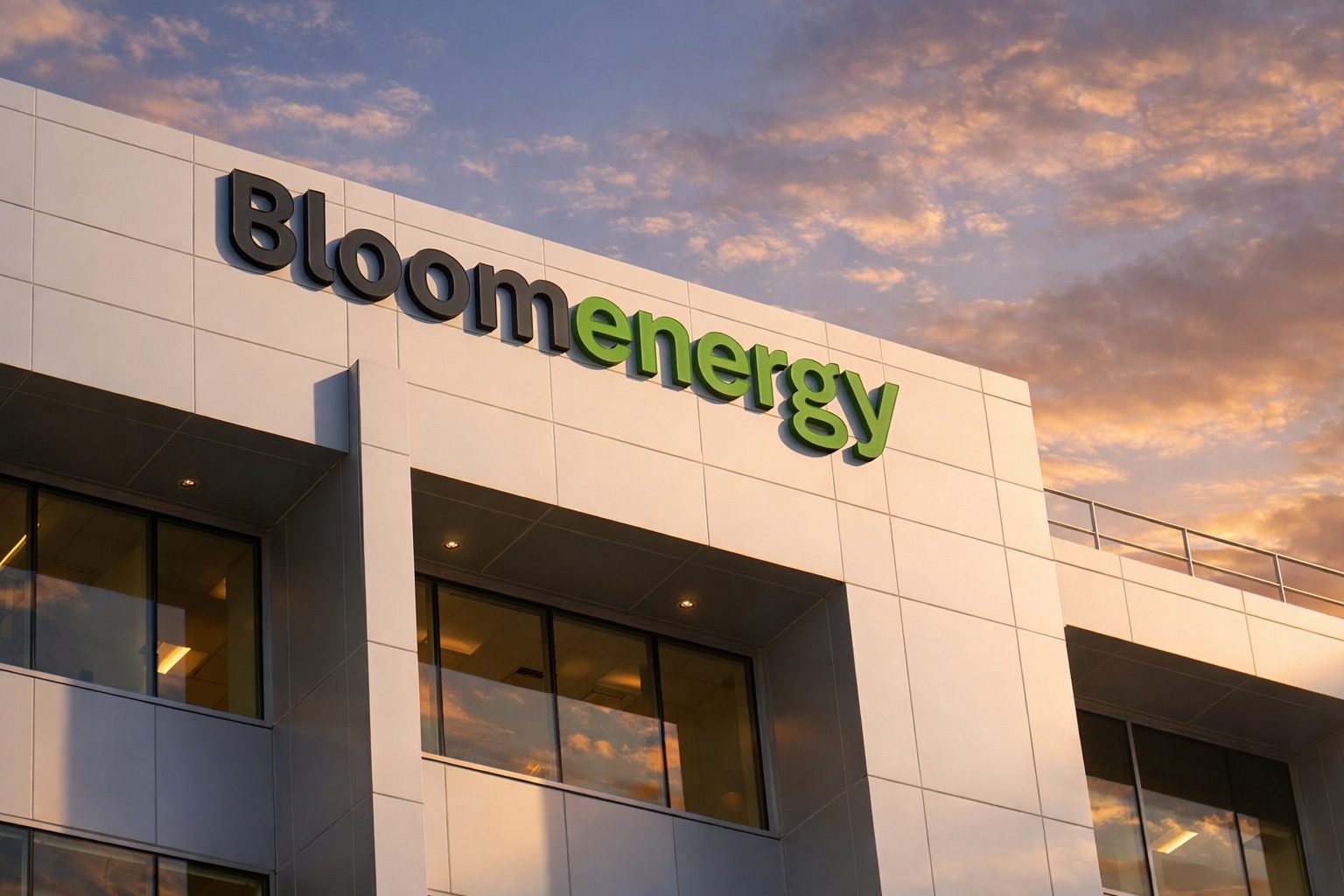
Bloom Energy Corporation (NYSE: BE) closed higher on Thursday, December 18, 2025, snapping a bruising streak of downside volatility and reclaiming some lost ground after Wednesday’s sharp selloff. The stock finished the regular session at $80.21, up 4.21%, after trading in a wide $78.73 to $85.30 intraday range—another reminder that BE remains a high-beta, sentiment-driven name tied to the “AI power” and clean-energy narratives. The Motley Fool+1
After the bell, after-hours quotes were mixed depending on the data feed and timestamp: MarketWatch showed BE around $80.25 (+0.05%) at 5:40 p.m. EST, while Yahoo Finance’s quote page indicated $81.49 (+1.60%) at 7:08 p.m. EST. Thin liquidity after-hours can amplify differences between feeds—so traders should treat late prints as directional signals, not definitive. MarketWatch+1
Below is what moved Bloom Energy stock today, the headlines and filings investors focused on, and the key catalysts to watch before Friday’s open (December 19, 2025).
What happened to Bloom Energy stock today
BE’s Thursday move looked like a relief rally after the stock closed Wednesday at $76.97 (a one-day drop of about 12%), an abrupt reset that followed weeks of choppy trading and debate over how much growth is already priced into “AI data center power” plays. MarketBeat+1
By midday Thursday, BE was up much more—around 7% intraday—before it gave back part of the gain into the close, consistent with a market still searching for conviction rather than chasing aggressively into the weekend. The Motley Fool
Why Bloom Energy rose: FuelCell’s earnings surprise lifted the whole fuel-cell tape
The biggest same-day catalyst highlighted by market commentators wasn’t a new Bloom Energy press release—it was positive read-through from a peer.
A widely circulated market take Thursday pointed to FuelCell Energy’s earnings beat and management commentary about accelerating demand for electricity and data-center projects. That narrative matters because Bloom Energy has been positioned by investors as one of the more scalable “on-site power” solutions for data centers and grid-constrained markets. The Motley Fool+1
In other words, BE traded like a “sector sympathy” winner: when a close peer posts better-than-feared results (and talks up data-center demand), capital often rotates across the theme—especially after a sharp drawdown.
Today’s filings: Insider sales made headlines, but the transactions were small relative to holdings
BE also saw attention from traders tracking Form 4 activity.
TradingView summarized that two insiders sold shares in transactions tied to tax and restricted stock unit (RSU) mechanics:
- Director Maciej Kurzymski sold 3,264 shares on Dec. 16 at a weighted average price of $86.48 (about $282,270), and
- COO Satish Chitoori sold 431 shares at a weighted average price of $88.12 (about $37,979). TradingView+1
MarketBeat emphasized that Chitoori’s sale was disclosed as a very small position reduction (about 0.19%) and that he still held 229,449 shares afterward. MarketBeat
How investors typically interpret this: routine tax-withholding sales are generally viewed as less informative than discretionary open-market selling. Still, in a stock as momentum-sensitive as BE, insider headlines can influence short-term sentiment.
The bigger context: AI data-center power is still the bull case—and also the risk
Why the AI power narrative matters
Bloom Energy is frequently grouped with “AI infrastructure power” beneficiaries because its solid-oxide fuel cell systems can provide distributed, dispatchable power, potentially helping data centers and industrial customers navigate grid constraints and resiliency demands. Reuters’ company profile notes Bloom’s footprint includes roughly 1.4 gigawatts deployed across more than 1,000 locations and nine countries, spanning its Energy Server platform and electrolyzer offering. Reuters
Why the market has been questioning valuation
Even with Thursday’s bounce, a key theme in recent commentary is whether expectations ran ahead of near-term fundamentals. A Trefis note published Thursday framed Wednesday’s plunge as a sign that the “AI data-center narrative” is being stress-tested as investors reassess what growth is sustainable versus what was momentum and multiple expansion. Trefis
And competition risk is becoming harder to ignore. Barron’s recently reported that GE Vernova is developing fuel cells for data centers, with commercialization discussed in a 1–2 year timeframe and broader industrial production in 2–3 years—a development analysts described as validation of the market, but also a factor that can pressure incumbents’ valuations. Barron’s
Wall Street outlook: “Hold” consensus, but a very wide spread of price targets
Analyst views on Bloom Energy remain mixed, reflecting both the long-term upside scenario (data centers + distributed power + hydrogen optionality) and the near-term risks (valuation, competition, policy sensitivity, and execution).
MarketBeat’s snapshot for Thursday listed:
- A consensus rating of “Hold” with an average price target around $93.77,
- But targets ranging roughly from $26 to $145, and
- A rating mix spanning Strong Buy/Buy/Hold/Sell (with “Hold” the largest bucket). MarketBeat+1
That dispersion matters for Friday: when a stock sits in the middle of a narrative tug-of-war, it tends to react more sharply to incremental news (peer earnings, policy headlines, big contract rumors, or even options flows).
“Forecast” signals traders are watching tonight: volatility, trend damage, and key levels
While analyst targets are the long-range compass, short-term traders are focused on two things: whether Thursday’s rebound repaired trend damage—and where support may sit if selling resumes.
Some technical/quant screens still characterize BE as high-risk after the recent slide, noting it has fallen in 7 of the last 10 sessions and remains down materially over that stretch despite Thursday’s bounce. StockInvest
From a purely price-action perspective, these levels are likely to be watched into Friday:
- Support zone: the $78–$77 area (Thursday’s $78.73 low and Wednesday’s $76.97 close are nearby reference points). The Motley Fool+1
- Resistance zone: the mid-$80s, especially Thursday’s $85.30 high. The Motley Fool
What to know before the market opens Friday, Dec. 19, 2025
1) Friday is a major options-expiration day (expect volatility)
December 19, 2025 is the triple/quadruple-witching expiration date (the third Friday of December), when multiple derivatives contracts expire and market volume can spike—sometimes creating abrupt moves that don’t necessarily reflect fundamental news. Investopedia
For BE—a high-beta stock that has already been swinging widely—this is a meaningful setup risk heading into the open.
2) Watch whether FuelCell’s post-earnings move holds
Because today’s rally narrative leaned heavily on peer read-through (FuelCell’s earnings beat and data-center demand commentary), BE traders will watch whether that peer momentum extends or fades. If the peer group reverses, BE can reverse with it. The Motley Fool+1
3) Keep an eye on any additional SEC filings or insider headlines
Insider selling stories circulated today largely tied to tax obligations and were small relative to insider holdings, but follow-on filings can keep the story in the news cycle. TradingView+1
4) Competition headlines can move the multiple
Bloom’s valuation has been sensitive to “who else can power data centers” news. Any fresh reporting on major industrial entrants (or new timelines) can move BE even without company-specific announcements—especially after Barron’s reporting on GE Vernova’s fuel-cell push. Barron’s
5) Expect different after-hours quotes—don’t overread them
With different feeds showing different after-hours levels at different times this evening, the cleanest approach is to treat the overnight tape as sentiment, and wait for premarket liquidity and broader market direction (index futures, rates, and risk appetite) before drawing conclusions. MarketWatch+1
Bottom line
Bloom Energy stock ended December 18, 2025 higher, with BE rebounding to $80.21 (+4.21%) amid renewed fuel-cell optimism and data-center demand commentary from a peer—while the market continues to debate valuation and competitive threats. The Motley Fool+2The Motley Fool+2
For Friday’s open (December 19), the most important near-term factor may be market structure rather than fundamentals: triple/quadruple-witching expiration is a known volatility catalyst, and BE’s recent swings suggest traders should be prepared for wide ranges and fast reversals. Investopedia+1