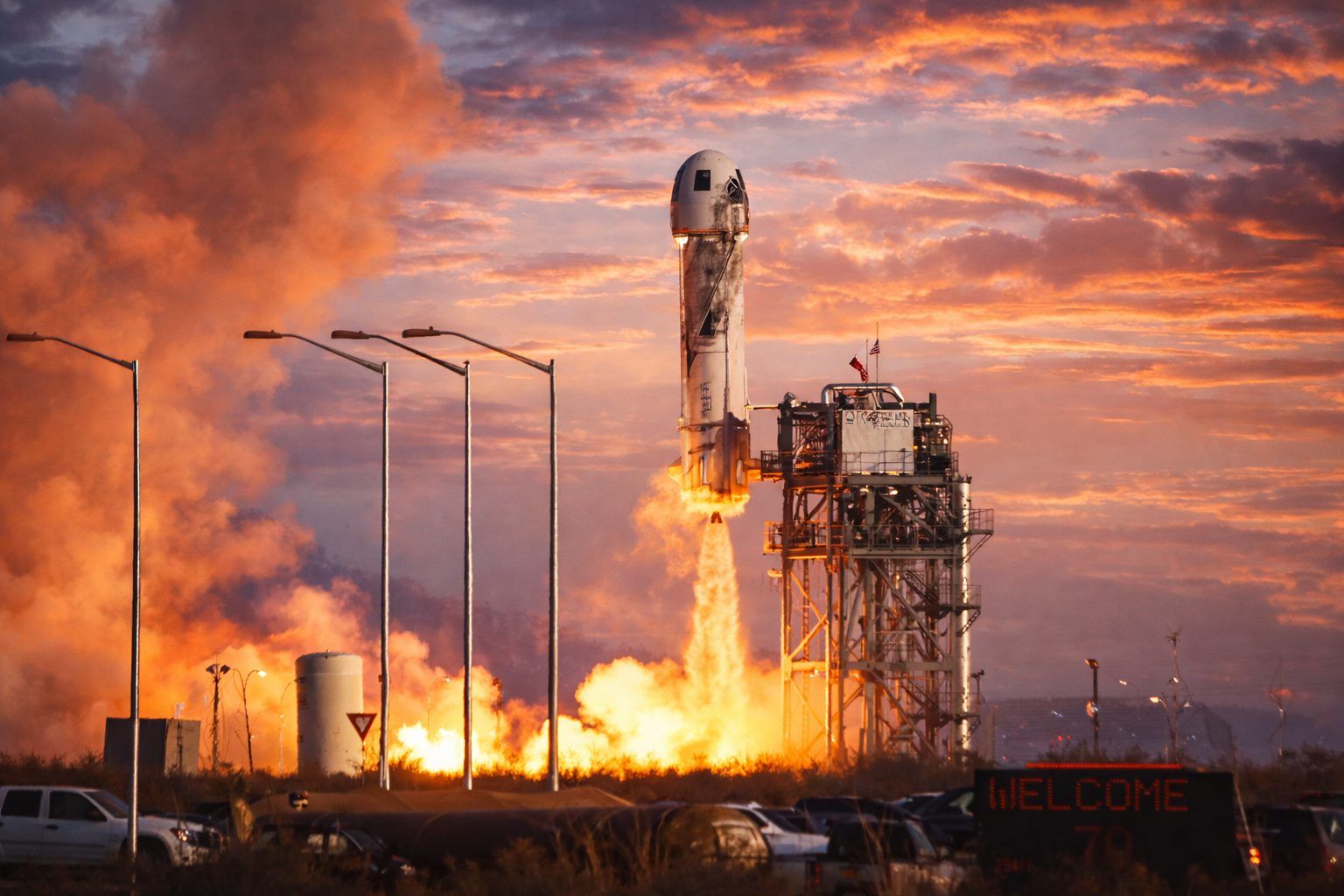

Blue Origin called off its planned New Shepard NS-37 launch attempt on Thursday, Dec. 18, 2025, saying the team “observed an issue” during built-in preflight checks and is now assessing the next opportunity to launch. The suborbital mission is closely watched because it is slated to carry Michaela “Michi” Benthaus, an aerospace and mechatronics engineer who uses a wheelchair—positioning her to become the first wheelchair user to travel beyond the Kármán line, the widely recognized boundary of space. Blue Origin+1
The delayed flight is more than a space-tourism headline. It has become a high-profile test of how commercial spaceflight can expand participation—especially for people whose mobility needs have historically been treated as a disqualifier in astronaut selection and spacecraft design.
What happened on Dec. 18: the launch window opened, then the mission was stood down
Blue Origin had been targeting a Dec. 18 liftoff from its West Texas facilities near Van Horn, with coverage planned on the company’s livestream. In updates leading into launch day, the company said it was monitoring upper-level winds and cited a launch window opening later in the morning than originally announced.
Multiple outlets tracking the countdown reported holds as teams worked through weather and technical considerations. GeekWire, for example, said managers called holds in the countdown due to wind concerns and an unspecified technical issue—common choreography for launch operations, but especially scrutinized here because the mission is tied to an accessibility milestone.
Ultimately, Blue Origin’s official word was clear: the company stood down after noticing an issue with built-in checks prior to flight, and no new launch date was immediately announced.
Why NS-37 matters: a first for wheelchair access in human spaceflight
If and when NS-37 flies, it is expected to mark the first time a person who uses a wheelchair travels to space—a milestone frequently discussed in disability advocacy and aerospace circles because microgravity can reduce the constraints of mobility on orbit, even as spacecraft access and emergency procedures remain major design challenges.
Benthaus is a German-born engineer who works with the European Space Agency and has used a wheelchair since a 2018 mountain-biking accident that resulted in a spinal cord injury affecting her ability to walk. Blue Origin and other outlets note she has pursued parabolic “zero-g” experience and astronaut-like analog training since her injury—signals of a longer-term push to normalize disability-inclusive participation beyond symbolic “firsts.” Blue Origin+2ABC News+2
The SpaceX connection: Hans Koenigsmann’s role in making the flight happen
One of the most widely shared angles on Dec. 18 was the involvement of Hans Koenigsmann, a German-American aerospace engineer and longtime SpaceX veteran who is flying on NS-37 alongside Benthaus.
A CNN Newsource report republished by KTVZ describes how Koenigsmann and Benthaus met at an event in Munich and discussed her dream of reaching space after her injury—an exchange that prompted Koenigsmann to help turn the idea into a concrete seat on a competitor’s vehicle. The story underscores an unusual feature of today’s commercial space era: intense industry rivalry on the one hand, and occasional cross-company bridges when a mission carries broader symbolic weight.
Blue Origin’s own crew profile notes Koenigsmann spent roughly two decades at SpaceX and has been deeply involved in reusable spacecraft and launch-vehicle development—credentials that make his participation notable even aside from the human-interest storyline.
What NS-37 is supposed to look like: a short flight, a huge spotlight
NS-37 is a New Shepard mission—Blue Origin’s reusable suborbital rocket-and-capsule system. These flights are designed to cross above the 100-kilometer (62-mile) Kármán line, offer a few minutes of weightlessness, and return to the West Texas desert with the booster landing autonomously and the crew capsule descending under parachutes.
Typical New Shepard missions last roughly 10 to 12 minutes from liftoff to touchdown. That short timeline is part of why NS-37 has become a key test case for inclusion: every phase—from boarding to unstrapping to emergency egress—has to work smoothly within tight operational constraints.
Accessibility, in practice: the “astronaut experience” has to work end-to-end
The NS-37 attention isn’t only about whether Benthaus can ride the vehicle; it’s about whether the full experience—training, lodging, boarding, cabin movement, and contingency procedures—can be adapted without turning inclusion into a one-off exception.
Reporting ahead of launch described practical accommodations, including techniques for capsule entry/exit and measures to manage leg positioning during the microgravity portion of the flight. The KTVZ/CNN Newsource piece said Benthaus planned to use a strap to keep her legs together in weightlessness, and noted Koenigsmann’s role as a companion who could assist if needed.
Other coverage emphasized that Blue Origin has been working to improve accessibility at its New Shepard facilities, including infrastructure changes such as an elevator on the launch tower—an upgrade that matters not just for passengers with mobility impairments, but also for broader operational accessibility.
The NS-37 crew: who’s on board when the mission finally flies
Blue Origin lists six passengers for NS-37:
- Michaela “Michi” Benthaus (ESA aerospace/mechatronics engineer)
- Joey Hyde (physicist and quantitative investor)
- Hans Koenigsmann (aerospace engineer; longtime SpaceX veteran)
- Neal Milch (business executive and entrepreneur)
- Adonis Pouroulis (entrepreneur/investor; mining engineer)
- Jason Stansell (computer scientist and self-described “space nerd” rooted in West Texas) Blue Origin+2ABC News+2
The mix is typical of New Shepard’s human flights—business leaders and private citizens—yet the mission’s framing is unusually centered on accessibility and participation rather than celebrity.
A mission patch with a message: symbolism built around science, identity, and breaking barriers
In the lead-up to launch, Blue Origin also highlighted the NS-37 mission patch and its embedded symbols—details that have become part of the broader storytelling around the flight.
Among the patch elements Blue Origin described:
- DNA representing science’s impact for Neal Milch
- A hippo representing Benthaus’ favorite animal, with her plush hippo—a comfort item after her accident—expected to join her on the flight
- A tennis ball referencing Benthaus’ competitive passion
- A baobab tree representing Pouroulis’ South African roots
- A spiral galaxy referencing Joey Hyde’s astrophysics background
- Elements tied to Jason Stansell’s personal tribute (including “K” in memoriam for his brother), plus design features representing barrier-breaking
- Shards symbolizing Blue Origin’s stated commitment to breaking down barriers to access—including cost, nationality, and ability Blue Origin
For Google Discover audiences in particular, these small details matter: they signal that NS-37 is being presented not only as a flight, but as a narrative about who gets to be included in “astronaut” stories going forward. Blue Origin+1
Where this fits in Blue Origin’s New Shepard program
By mission numbering, NS-37 would be the 37th overall New Shepard flight and the 16th human flight of the program. Blue Origin says it has now flown 86 people (80 individuals) above the Kármán line—reflecting repeat flyers among the total seat count.
New Shepard is also one of the most visible platforms in the suborbital tourism market, where the line between “tourism,” “research,” and “technology demonstration” is frequently debated. In NS-37’s case, the accessibility milestone has pushed the cultural conversation beyond ticket pricing and celebrity passengers toward design assumptions that have long shaped human spaceflight participation. GeekWire+2KTVZ+2
What comes next: Blue Origin says it’s assessing the next launch opportunity
As of Dec. 18, 2025, Blue Origin has not announced a new target date for NS-37, stating only that it is assessing the next launch opportunity after the preflight-check issue.
For readers following along: the key watch item is not just “when do they launch,” but what Blue Origin says about the nature of the issue—because “built-in checks” can span everything from vehicle health monitoring to ground-side verification gates. Until Blue Origin posts a new window and status, the mission remains in a holding pattern—still historic, but not yet flown. Blue Origin+1
The bigger picture: an inclusion milestone that doesn’t end at suborbital
Even with a scrubbed attempt, NS-37 has already become a marker of a broader shift: commercial spaceflight is increasingly a place where long-held assumptions about who can fly are being pressure-tested.
Recent years have included other steps toward disability inclusion in space—such as civilians with medical histories or prosthetics flying on private missions—and ongoing evaluation of astronauts with physical disabilities for future spaceflight roles. Coverage around NS-37 highlights that Benthaus’ flight, if completed, could help normalize the idea that wheelchair use is not automatically incompatible with human spaceflight—especially as spacecraft and training pipelines evolve.
Related articles: Space