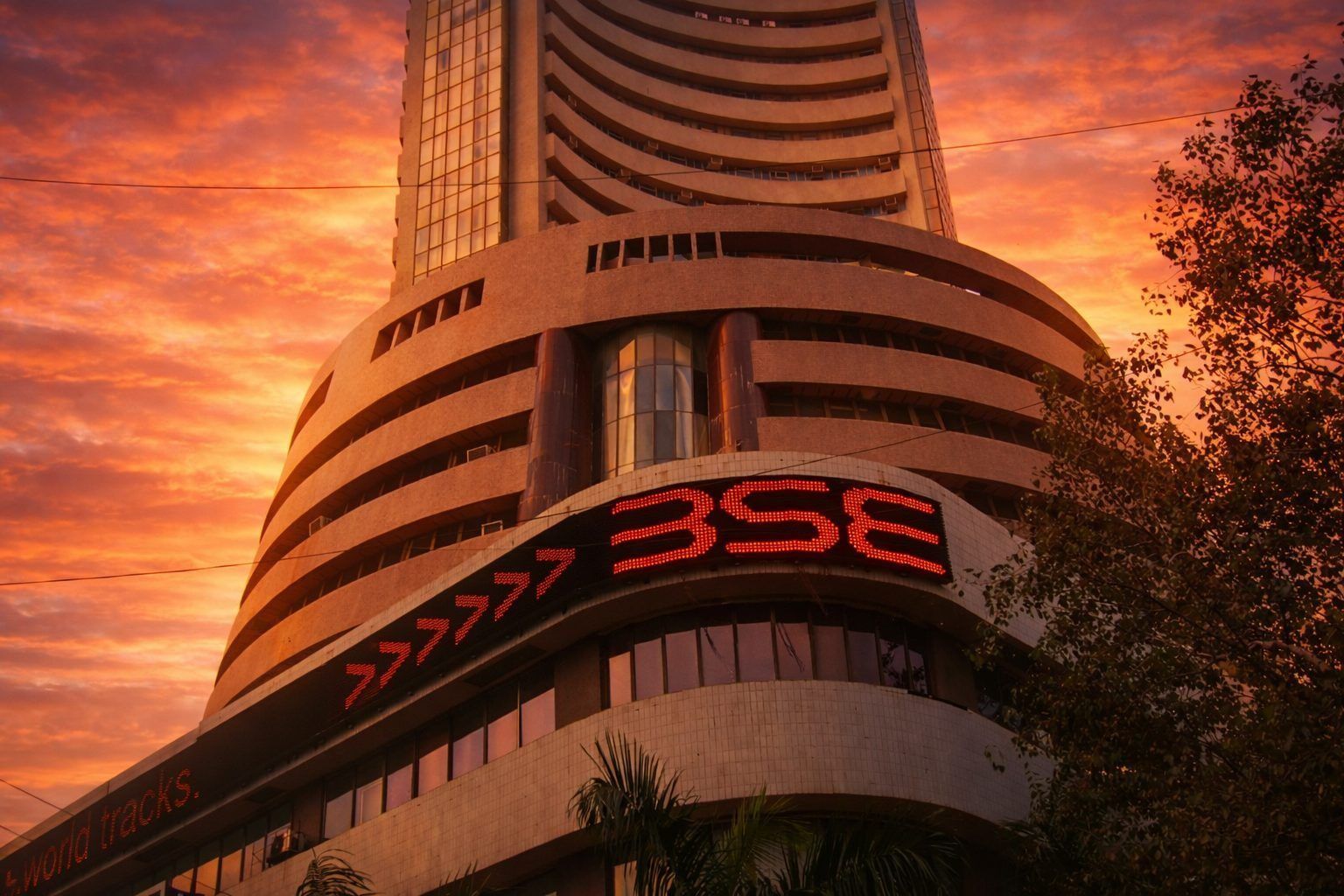
NEW YORK, Dec. 27, 2025, 8:32 a.m. ET — Market closed
The Bombay Stock Exchange (BSE) is shut for the weekend, but Dalal Street is ending 2025’s final stretch with a familiar year-end cocktail: record-adjacent index levels, thinner participation, and investors trying to separate “healthy consolidation” from “quietly rising risk.”
When trading last wrapped up on Friday, the S&P BSE Sensex fell 0.43% to 85,041.45, while the NSE Nifty 50 dropped 0.38% to 26,042.3—moves widely framed as profit-taking near highs in holiday-thinned conditions. Reuters+1
Sensex and Nifty: weekly gains survived, but momentum cooled
Even with Friday’s dip, benchmarks still managed to claw out modest weekly advances—helped by earlier gains that snapped a three-week losing run. Reuters attributed the week’s “near-the-top” pause to a lack of fresh catalysts and muted activity as the calendar winds down. Reuters
Siddhartha Khemka, head of research of wealth management at Motilal Oswal Financial Services, told Reuters that consolidation near record highs persisted because of the “lack of fresh triggers” and softer year-end engagement. He added that markets may need stronger corporate updates beginning January 1 and progress on a potential India–U.S. trade deal to push decisively higher from current levels. Reuters
One concrete sign of the year-end “volume diet”: Reuters reported average daily trading volumes of Nifty 50 stocks in December around 250 million shares versus roughly 300 million in the prior month. Reuters
Bombay Stock Exchange news: Bankex reshuffle takes effect and puts derivatives in the spotlight
The most BSE-specific headline in the past 48 hours is the overhaul of the BSE Bankex (banking index), which The Economic Times reported came into effect on December 26.
According to the report, Canara Bank, AU Small Finance Bank, Punjab National Bank, and Union Bank of India were added—expanding Bankex to 14 constituents. The Economic Times also highlighted a revamped weighting structure, including a cap on the combined weight of the top three stocks at 45%. The Economic Times
That 45% “top-three cap” is also spelled out in BSE Indices’ methodology notice, which outlines the cap structure for Bankex (including an individual constituent cap) and notes the revised approach being effective from December 26, 2025. BSE Indices
Why it matters now: BSE is openly fighting for mindshare—and market share—in index derivatives. The Economic Times quoted BSE MD and CEO Sundararaman Ramamurthy as saying the exchange is focused on making Bankex a prominent product by promoting monthly derivatives, while also pointing to BSE’s efforts to broaden monthly derivative offerings. The Economic Times
The same report cited B&K Securities and named analyst Swarnabha Mukherjee, who said BSE is “well-positioned” to maintain growth and share gains in index options, pointing to factors such as new product introductions, expiry-day strategy, and efforts to deepen liquidity beyond just expiry sessions. The Economic Times
Macro check: rupee pressure remains a key “risk thermostat” for equities
Equities aren’t trading in isolation. The rupee’s behavior continues to matter for risk sentiment, foreign flows, and sector leadership (especially export-heavy IT).
Reuters reported Friday’s rupee close at 89.85 per U.S. dollar, with a 0.6% weekly decline, noting steady corporate dollar demand and activity in the non-deliverable forwards (NDF) market. Traders told Reuters that state-run banks were selling dollars around the 89.90 level to help limit deeper weakness. Reuters
On the forward look, Reuters cited:
- a trader at a large private bank who flagged that maturing NDF positions could add pressure and potentially pull USD/INR back below 90.50 next week, and
- ANZ analysts who expect “gradual depreciation” until a favorable U.S. trade deal supports the currency, adding that any INR strength could be used by the RBI to build FX reserves. Reuters
Reuters also noted India’s FX reserves were nearly $689 billion as of December 12 (per central bank data). Reuters
Global cue from New York: Wall Street’s “Santa Claus rally” watch is still on
From the New York lens, U.S. stocks ended Friday’s post-Christmas session nearly flat, with all three major indexes nominally lower but still near record territory. Reuters quoted Carson Group chief market strategist Ryan Detrick describing the move as the market “catching our breath” after a strong run, with investors watching the seasonal “Santa Claus rally” window into early January. Reuters
For India-watchers, the implication is less about superstition and more about tone: global risk appetite hasn’t collapsed—but liquidity is thin, and headline sensitivity can spike when trading desks are half-staffed.
Forecasts and technical levels: where analysts say the next break could happen
With volumes lighter, technicians have been unusually loud this week—because in quiet markets, levels can matter more than narratives.
Ahead of Friday’s session, Mint quoted multiple market technicians laying out near-term markers:
- Shrikant Chouhan, Head of Equity Research at Kotak Securities, flagged 85,750 as a key Sensex resistance area and 85,300 as immediate support, with an upside zone cited around 86,000–86,200 if resistance breaks decisively. mint
- Amruta Shinde, Technical & Derivative Analyst at Choice Equity Broking, pointed to moderating volatility (India VIX cited at 9.19) and described derivatives positioning consistent with resistance around 26,200 and support near 26,000 for the Nifty. mint
- Ajit Mishra, Senior Vice President–Research at Religare Broking, said he maintains a positive bias and a “buy-on-dips” approach while the uptrend holds. mint
- Rajesh Bhosale, Equity Technical Analyst at Angel One, said the broader undertone remains positive and described the 26,050–26,000 area as a support zone, with 26,300–26,350 as a key resistance band for Nifty. mint
Separately, The Economic Times quoted Vinod Nair, Head of Research at Geojit Investments, attributing Friday’s decline to thin year-end volumes and profit booking, while also citing the drag from the absence of fresh catalysts—including any progress on a U.S.–India trade agreement—and the continued pressure of foreign outflows on the rupee. The Economic Times
If you’re watching BSE before the next session: what to know and what to prep
With the BSE closed today, the practical investor question becomes: what could realistically change before Monday’s open?
1) Watch the “trade deal + flows + rupee” triangle.
Reuters and multiple India-facing market reports repeatedly tie near-term sentiment to progress on a potential India–U.S. trade deal and foreign investor behavior. If the rupee pushes toward fresh weakness, it can quickly become a risk-off accelerant for domestic equities (and a relative tailwind for select exporters). Reuters+1
2) Understand what the Bankex revamp changes—and what it doesn’t.
If you track Bankex-linked products (or anything sensitive to index composition and weights), the move to 14 constituents and the updated cap structure can influence rebalancing flows and relative demand within PSU banks and newer entrants. The Economic Times+1
3) Calendar basics: holidays are done for now, but liquidity is still a factor.
Indian markets were closed for Christmas on December 25 and resumed Friday, and Mint noted the next scheduled market closure as January 26, 2026 (Republic Day). That means the market is open—yet participation may remain “thin” into year-end as many institutions square books. mint
4) Know the market session structure so Monday morning isn’t chaotic.
India’s equity market day includes a pre-open session (9:00–9:15 a.m. IST) followed by the normal trading session (9:15 a.m.–3:30 p.m. IST), with a post-market window afterward. If you place orders around the open, the pre-open mechanics matter. Zerodha Support
Heading into the final trading days of 2025, the BSE story is less about a dramatic directional call and more about microstructure and catalysts: lighter liquidity, a derivatives arms race (with Bankex as a key chess piece), and macro crosswinds from the rupee and foreign flows. Monday’s session won’t magically reveal the market’s “true” mood—but it will show whether this consolidation is a pit stop before a new high, or the market quietly preparing for a bumpier 2026.