
NEW YORK, Dec. 28, 2025, 8:48 a.m. ET — Market closed
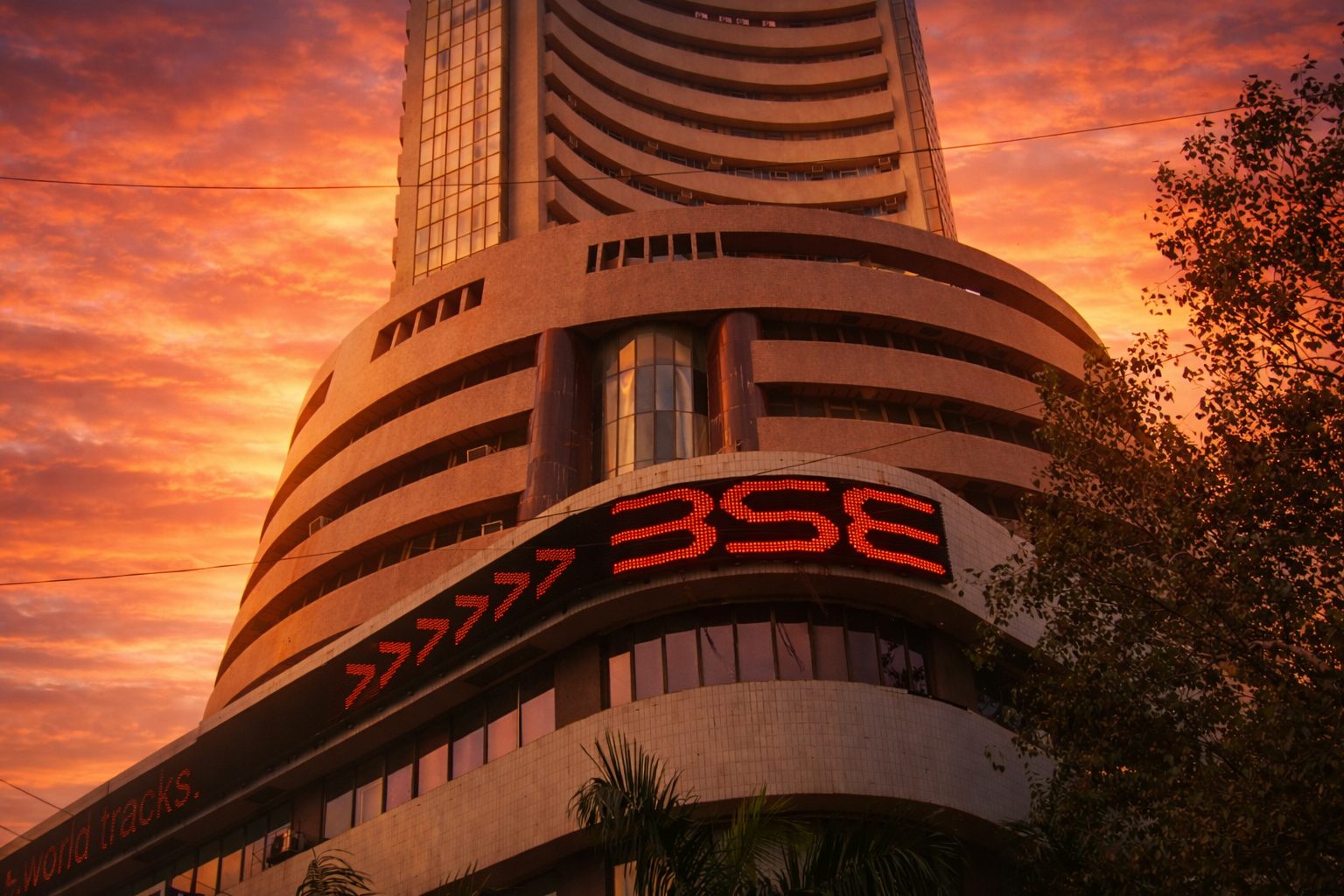
With U.S. markets shut for the weekend and Dalal Street also closed, the focus shifts to what moves next when the Bombay Stock Exchange (BSE) reopens for the final stretch of 2025 trading. Friday’s session ended with a familiar late-December cocktail: thin participation, profit-taking near record highs, and persistent foreign selling pressure—tempered by pockets of sector strength and a derivatives story at BSE that’s getting harder for global investors to ignore.
Where the BSE Sensex left off: year-end profit-taking trims weekly gains
India’s benchmark BSE Sensex fell 0.43% on Friday to close at 85,041.45, while the Nifty 50 ended at 26,042.3 (down 0.38%). The dip pared back what still amounted to modest weekly gains—important mainly because they snapped a multi-week losing run and kept benchmarks hovering close to record territory.
Market participants pointed to year-end conditions rather than a single headline catalyst: liquidity thins out, positioning becomes more fragile, and “normal” flows can look dramatic. Reuters noted that average daily volumes in December for Nifty 50 stocks have run below the prior month’s pace—one reason price action can feel oddly calm even when underlying risk is not. Reuters
Siddhartha Khemka, head of research (wealth management) at Motilal Oswal Financial Services, described the tone as continued consolidation near record highs amid muted year-end activity, adding that the next leg higher may require stronger corporate updates and/or a fresh macro trigger.
The foreign flow problem hasn’t gone away—and it’s colliding with FX reality
One of the loudest signals into Monday isn’t a single stock—it’s the tug-of-war between foreign portfolio investors and domestic flows, and the way that battle shows up in the currency.
On the FX front, the Indian rupee ended the week weaker at 89.85 per U.S. dollar, down about 0.6% over the week, as corporate dollar demand and non-deliverable forward (NDF) market dynamics eroded the prior intervention-led bounce. ANZ analysts said they expect gradual depreciation until a favorable U.S. trade deal improves the backdrop—and that even if the rupee strengthens, the Reserve Bank of India may use the opportunity to add to reserves.
That matters directly for equities: a softer rupee can pressure foreign returns and can amplify risk-off behavior when global investors are already cautious.
The equity flow story looks even starker in the year-end totals. The Economic Times reported that foreign institutional investors were on track for a record net exit in 2025—about ₹1.58 lakh crore of net outflows as of Dec. 27—citing Geojit Financial Services’ Chief Investment Strategist V.K. Vijayakumar, who called it the worst selling since FIIs began investing in India.
Week-ahead setup: derivatives expiry, key data, and global Fed cues
If the market has felt sleepy, the calendar is trying to wake it up.
Indian market watchers are highlighting derivatives-related volatility risk into the turn of the year. Ajit Mishra, SVP (research) at Religare Broking, told The Times of India that the week’s transition into the new calendar year could bring heightened volatility tied to the month-end derivatives setup, while attention also turns to industrial production data and the final HSBC manufacturing PMI reading. He also flagged U.S. signals—particularly FOMC minutes—as an important global cue.
From a U.S. perspective, Reuters’ “Week Ahead” coverage framed markets as sitting near record highs into year-end, with investors watching how the Federal Reserve’s path (and the minutes that illuminate it) influences rates, risk appetite, and leadership rotation. Those themes matter to India because they feed directly into global allocation decisions—especially when currency volatility is already on the radar. Reuters
Meanwhile, Reuters’ global markets wrap underscored that U.S. equities ended close to record peaks in muted post-holiday trading, while precious metals pushed to record highs on rate-cut expectations and safe-haven demand—another reminder that “quiet tape” doesn’t always mean “low risk.” Reuters
Technical picture: calm on the surface, tension underneath
A big psychological storyline into Monday is whether benchmarks can stabilize above key round-number supports—or whether thin liquidity turns a small move into something messier.
Economic Times contributor Milan Vaishnav highlighted a striking feature of the recent environment: India VIX sliding to record lows (9.15), a level often associated with complacency and vulnerability to sudden volatility spikes. In his analysis, the market has been rangebound with narrowing breadth—conditions that can persist… right up until they don’t.
In a separate ETMarkets interview-style piece, Anand James, Chief Market Strategist at Geojit Investments, argued that weakness from record highs does not automatically signal a major trend break. He outlined a support cluster near 26,000 on the Nifty and suggested that a successful hold could fuel a sharper rebound attempt, while also detailing nearby support levels and warning what would open up if those levels fail. He also pointed to cautious foreign positioning—FIIs holding a relatively small share of index futures longs and maintaining meaningful shorts—suggesting the “flow fight” is still unresolved. The Economic Times
LiveMint, quoting Ganesh Dongre, Senior Manager of Technical Research at Anand Rathi, echoed the same basic map: 26,000 as the key psychological level, with the prior breakout zone (roughly 25,700–25,800) seen as a support base and resistance building in the 26,300–26,500 area.
The Bombay Stock Exchange story isn’t just the Sensex anymore
While the Sensex is the headline, the exchange itself—BSE Ltd.—has become part of the investable narrative, largely because of derivatives.
The Economic Times reported that under CEO Sundararaman Ramamurthy (since January 2023), BSE executed a sweeping turnaround driven by cost discipline, technology upgrades, and a deliberate push into equity derivatives—particularly Sensex weekly options. The report quotes Ramamurthy describing a ₹100 crore cost-cutting exercise early in his tenure and details a broad tech overhaul intended to reduce latency and scale capacity.
Crucially, ET wrote that BSE’s index options footprint has expanded meaningfully: citing Jefferies, the article said BSE’s market share in premium turnover for index options reached 28.4% in November, with notional turnover share also rising sharply versus a year earlier. That’s not a small footnote—it’s a structural shift in how trading activity (and exchange economics) can evolve in India’s market microstructure.
BSE’s product strategy is also visible in its index maintenance. ETMarkets reported that BSE Bankex was reconstituted effective Dec. 26, expanding to 14 constituents and adding banks including Canara Bank, AU Small Finance Bank, Punjab National Bank, and Union Bank of India—a move positioned as part of BSE’s broader effort to strengthen participation in its Sensex and Bankex derivatives ecosystem.
What investors should know before the next BSE session opens
Because markets are closed right now, the smartest preparation is less about prediction and more about avoiding surprise. Here’s the practical checklist investors and traders tend to watch heading into the next opening bell:
- Currency first, headlines second: If the rupee shows renewed pressure (or volatility), it can quickly shape foreign flow expectations—especially after a week that ended with the rupee near 89.85 per dollar and with analysts warning of further downside risk.
- Flow watch: Year-end positioning can exaggerate moves. Record-scale net FII outflows reported for 2025 make it harder to hand-wave foreign selling as “noise,” even if domestic bids remain supportive. The Economic Times+1
- Derivatives can swing the tail: Expiry dynamics into the year’s close can turn small spot moves into larger intraday ranges—particularly in bank-heavy baskets and index options where liquidity is deepest.
- Volatility is cheap—until it isn’t: With India VIX near record lows in recent analysis, markets may be pricing a smooth ride. Historically, that’s exactly when sharp spikes can blindside crowded positioning.
- Watch the U.S. macro drumbeat: Even if India’s domestic story is steady, global risk sentiment can shift quickly around Fed communication, especially when U.S. equities are sitting near record levels into year-end.
- BSE’s derivatives momentum is a real theme: Beyond the index level, BSE’s growing traction in index options—and its product/index adjustments like the Bankex reshuffle—are increasingly part of how investors evaluate India’s exchange landscape.
Bottom line: the BSE enters the final stretch in “rangebound mode,” but with big undercurrents
Friday’s Sensex close near 85,041 doesn’t scream panic. It whispers something more interesting: a market near highs that’s trying to levitate through year-end with lighter volumes, stubborn foreign selling, and a currency that won’t sit still.
Into Monday, the spotlight is likely to stay split between (1) whether key supports hold as liquidity returns, and (2) whether structural shifts—especially BSE’s expanding derivatives franchise—continue to reshape how global and domestic investors think about India’s market plumbing, not just its stock picking.
Related articles: Stock Market